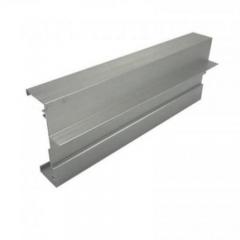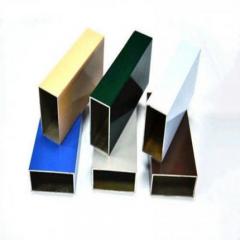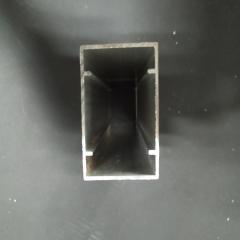
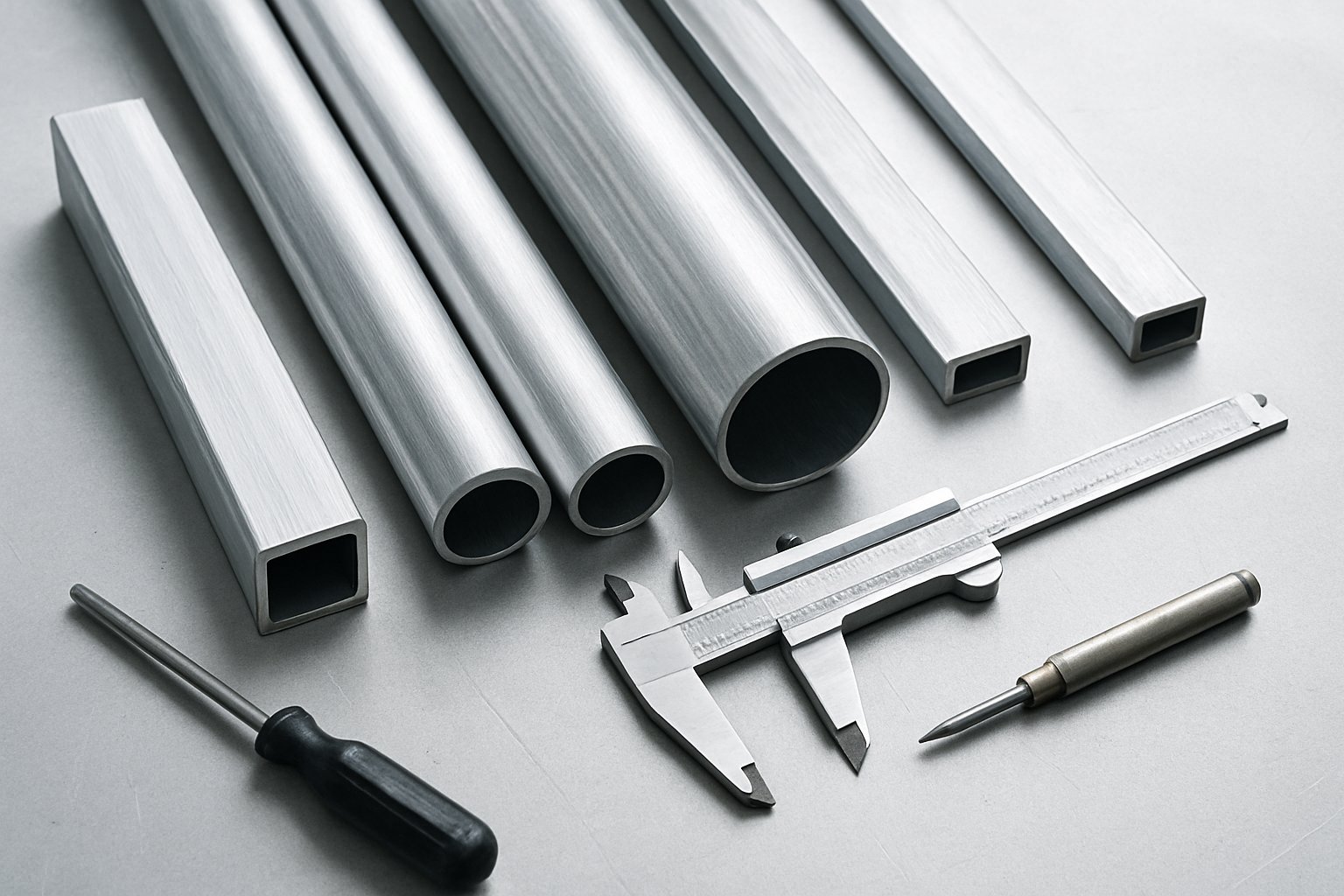
If supplier listings feel like a blur of tube, pipe, rod, and bar, the easiest fix is to start with plain language. A small wording difference can lead you to the wrong shape, the wrong dimensions, or the wrong manufacturing method.
Aluminium tube is a hollow aluminum product made in a defined shape, such as round, square, or rectangular, and selected by its size, wall thickness, and intended job.
That hollow center is only part of the story. When buyers compare aluminium tubes, shape and measured dimensions matter because they affect fit, weight, stiffness, and how the part can be cut, bent, or joined. Two hollow sections may look similar at a glance, but a change in outer shape or wall can lead to a very different result in use.
Manufacturing method also matters. Material from Profile Precision Extrusions explains that an extruded aluminium tube is made by pushing heated aluminum through a die. Drawn tube is then worked through additional dies to reduce diameter and wall thickness, which helps achieve tighter tolerances and a smoother finish.
In practical buying terms, that distinction keeps you from ordering a solid product when you actually need a hollow one, or a flow-focused product when you need a frame member.
US readers should not let the spelling throw them off. Gabrian notes that both aluminum and aluminium are accepted spellings. North America usually prefers aluminum, while the UK and many international suppliers use aluminium. So if a catalog says aluminium tube, it is still the same base metal.
The language is simple once the labels stop competing. The real decision pressure usually starts with shape, because round, square, and rectangular sections each solve a different kind of problem.
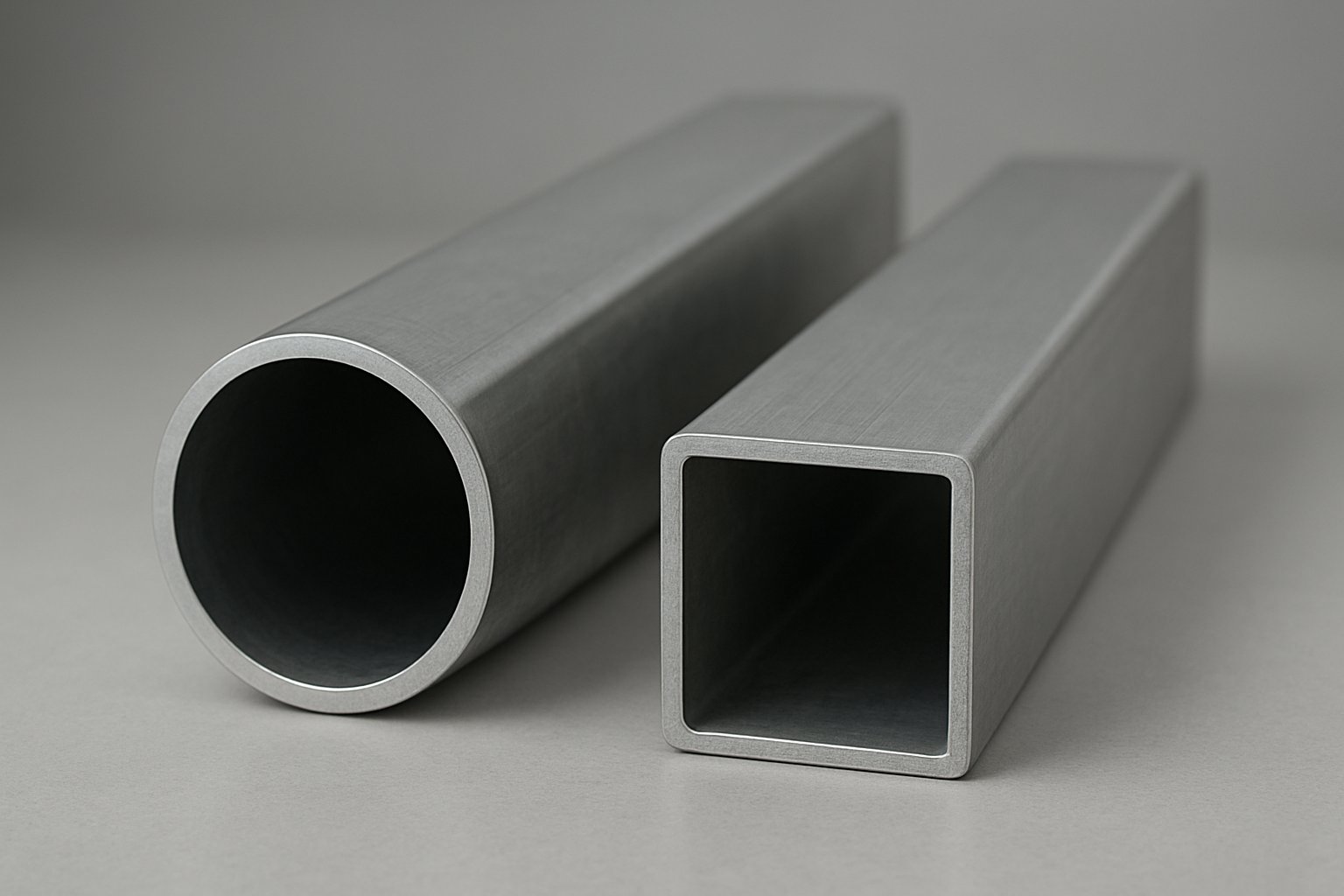
Shape usually makes the first big cut in your options. Before alloy, temper, or finish enter the picture, the profile already tells you a lot about how a section will carry load, fit into a space, accept hardware, and look in the final build. Supplier ranges commonly separate tubing into round, square, and rectangular forms, and square or rectangular products are often grouped under box section language by Aluminium Warehouse.
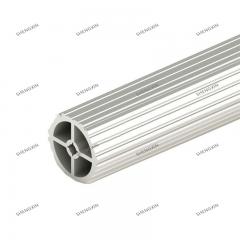
An aluminium round tube is usually the best match when the job benefits from smooth geometry. Round sections handle internal pressure evenly, which helps explain their common use in fluid paths, heat-transfer components, and similar line applications. They also feel better in the hand, create less visual drag, and suit curved forms well. That is why round profiles are widely used for rails, guards, lightweight handling parts, and streamlined assemblies. If your priority is flow, comfort, or a cleaner aerodynamic look, round tube aluminium is often the natural choice.
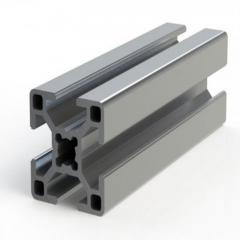
Frames like flat faces. Geometric guidance highlighted by Alliance Tubular Products shows why square and rectangular tubing are often favored in structural layouts: flat sides make alignment easier and simplify welding, bolting, and fastening. That same geometry also supports efficient load distribution in many frame-style applications. In practical buying terms, aluminium square tube fits shelving, furniture, guards, machine stands, and modular systems because it is easier to line up, easier to attach to plates, and easier to pair with inserts and connector systems. Some listings even shorten the name to aluminium sq tube, especially in hardware-driven product ranges.
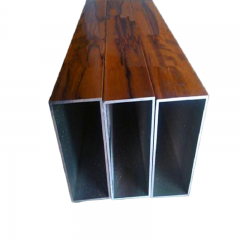
An aluminium rectangular tube becomes especially useful when the design has a clear strong direction. The longer face can help increase stiffness in one orientation, and it often packages more neatly against walls, panels, and tight envelopes than a round section. Notes from Chalco also reflect this space-saving advantage, which is one reason rectangular profiles are common in supports, facades, racks, transport structures, and other aluminium box tube uses. It is also a smart choice when you want a modern, architectural appearance with broad flat surfaces for drilling, mounting, or finishing.
| Shape | Typical advantages | Fabrication considerations | Common use patterns |
|---|---|---|---|
| Round | Good for internal pressure, easy grip, smooth appearance, works well in curved or low-drag forms | Usually bends well, but flat-face mounting often needs clamps, saddles, or special brackets | Fluid lines, rails, handrails, guards, heat-transfer parts, lightweight curved frames |
| Square | Easy alignment, strong frame logic, flat sides for drilling and fastening, neat stacking and nesting | Simple to join to plates and connectors, but corners and flat walls need attention during bending and finishing | Frames, shelving, furniture, enclosures, modular systems, support structures |
| Rectangular | Directional stiffness, efficient space use, broad mounting faces, clean architectural look | Orientation matters more, and accessories must match the chosen width and height | Racks, supports, facades, equipment frames, guards, packaging-sensitive structures |
Profile choice narrows the field fast, but it does not finish the job. The same shape can machine, weld, anodize, and perform very differently once alloy enters the conversation.
The shape may narrow the field, but alloy choice decides how the tubing behaves once you start cutting, welding, finishing, or loading it. Two profiles with the same size can feel very different in the shop and perform very differently in service. For most buyers, the real question is simple: do you need more strength, a cleaner finish, easier forming, or better corrosion resistance?
Testrite Aluminum highlights the classic split between these two 6000-series options. 6061 offers higher tensile and yield strength than 6063, along with good machinability. It is commonly chosen for parts that will be drilled, tapped, cut, or welded. 6063 is softer, extrudes more easily, and produces a smoother surface, which makes it a strong fit for visible profiles and finish-sensitive work.
That difference shows up quickly in buying decisions. A 6061 t6 aluminium tube usually makes more sense when rigidity and post-processing matter more than cosmetic perfection. By contrast, 6063 is often favored for lightweight frames, display elements, and anodized parts where appearance carries real weight. If a listing calls out aluminium tube 6061 t6, read that as a sign the spec is leaning toward mechanical performance and in-house fabrication.
Not every job lives in the 6000 series. Material from Cumberland Metals shows why 5052 and 3003 stay relevant when corrosion exposure or forming is a bigger concern. 5052 is stronger than 3003 and is described as one of the strongest non-heat-treatable aluminum alloys. Cumberland lists 5052 at 190 to 320 MPa ultimate tensile strength, 75 to 280 MPa yield strength, and 66 to 140 MPa fatigue strength. For 3003, the published ranges are 110 to 240 MPa, 40 to 210 MPa, and 39 to 90 MPa.
Those numbers only tell part of the story. 3003 is highly malleable and known for excellent formability, so it is often easier to bend, roll, and shape. 5052 still offers good formability, but it trades some of that softness for higher durability and better corrosion resistance in demanding environments. If your priority is a more easily formed aluminium alloy tube, 3003 may be the better direction. If outdoor exposure or tougher service matters more, 5052 often earns the spot.
| Alloy | Strength tendency | Corrosion behavior | Finish quality and anodizing | Machinability | Weldability | Common application fit |
|---|---|---|---|---|---|---|
| 6061 | Higher strength than 6063 | Good general corrosion resistance, but slightly less favorable than 6063 in harsher environments | Accepts finishing, but surface is usually not as smooth as 6063 | Machines cleanly and suits drilling, tapping, and tighter tolerance work | Commonly selected for welded fabrications | Heavy-wall tubing, machined components, industrial parts, structural use |
| 6063 | Lower strength than 6061 | Good corrosion resistance and often slightly better than 6061, especially when anodized | Smoother surface and strong anodizing response | Can be machined, but softness can lead to clogging or surface deformation | Weldable | Visible extrusions, display frames, lightweight tubing, decorative applications |
| 5052 | Stronger than 3003, with higher tensile, yield, and fatigue ranges | Superior to 3003 in highly corrosive or marine-like settings | Not the main differentiator in the cited comparison | Tougher on tools than 3003 | Good weldability, but needs more attention than 3003 | Outdoor structures, fuel tanks, marine components, enclosures |
| 3003 | Moderate strength, below 5052 | Good corrosion resistance for normal conditions | Not the main differentiator in the cited comparison | Easier to machine than 5052 | Good weldability and generally more forgiving | HVAC ductwork, heat exchangers, appliances, general formed parts |
In practice, the shortlist is usually straightforward. Choose 6061 when strength and machining lead. Choose 6063 when finish quality and extrusion detail lead. Look at 5052 when corrosion resistance and durability climb the priority list. Keep 3003 in view when the job involves extensive forming and moderate service demands. The remaining details come from the supplier listing itself, where dimensions, wall thickness, temper, and tolerance turn a good material choice into a reliable purchase.
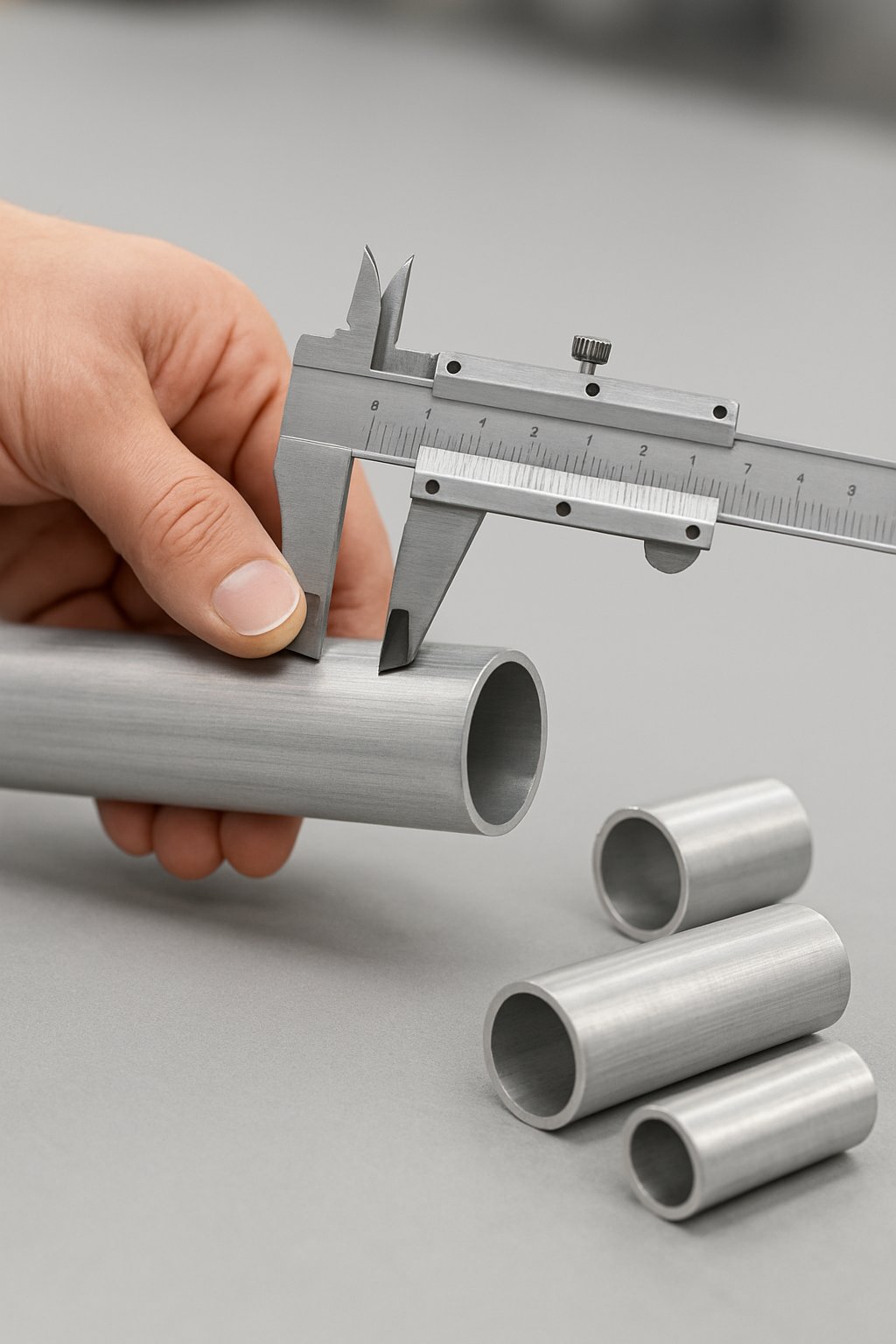
The alloy may be right, but a smart purchase still falls apart if the listing is read too quickly. This is where many buyers get tripped up. A label like 1/4 aluminium tube, 1 inch aluminium tube, or 1.5 inch aluminium tube sounds clear until you realize the supplier may be calling out outside diameter, inside diameter, wall, or even pipe size language.
For tubing, the safest starting point is OD plus wall thickness. Merit Brass notes that tubing is measured by outside diameter and wall thickness, and that the OD is exact. Pipe works differently because nominal pipe size does not necessarily match actual OD. That difference matters when buyers jump between tube and pipe listings.
In round products, OD is the outside measurement and ID is the opening inside. In square or rectangular listings, you are usually reading outside dimensions plus wall thickness. That is why aluminium round tube sizes and aluminium square tube sizes should never be compared by label alone. The shape changes what the size actually describes.
Wall thickness changes more than weight. A thinner wall usually helps reduce mass and may be easier to flare or bend, but it can also feel less rigid and may limit some joining methods. A thicker wall generally adds stiffness, gives you more material for machining or fastening, and often holds up better in handling, but it also increases weight and material cost.
Temper should be read as part of the full material callout, not as a minor suffix. Supplier tables commonly list conditions such as 6061-T6, 6061-T6511, or 6063-T52 in the same size family, so matching the exact designation matters. Tolerance deserves the same attention. The OnlineMetals tolerances tables show that allowable variation depends on form and size. For example, drawn 6061-T6 round tube carries tighter OD tolerances than comparable extruded round tube, which helps explain why fit-critical jobs often treat drawn and extruded products differently.
An aluminium tube size chart is most useful when you treat it like a decoding tool, not a shortcut. The same goes for supplier pages listing aluminium tube sizes. Read every field together before you compare prices.
| Spec field | What it tells you | What it affects | What to double-check |
|---|---|---|---|
| OD | Outside size of round tube | Fit in clamps, sleeves, holes, and mating parts | Make sure the listing is tube, not nominal pipe size |
| ID | Inside opening | Clearance, flow, pass-through space | Confirm it matches the stated wall and OD |
| Height and width | Outside size of square or rectangular tube | Frame fit, nesting, connector compatibility | Check whether dimensions are outside measurements |
| Wall thickness | Material thickness around the hollow section | Stiffness, weight, bend behavior, joining options, cost | Watch for mean wall tolerances on extrusions |
| Temper | Material condition listed with the alloy | Fabrication response and final properties | Match the full alloy-temper callout exactly |
| Tolerance | Allowed size variation | Assembly fit and dimensional consistency | For square and rectangular tube, note corner and non-corner tolerances |
| Stock length | Supplied full length | Shipping, waste, shop handling | Confirm whether cuts are from full lengths or precut pieces |
| Finish | Surface condition stated by the seller | Appearance and prep work before coating or anodizing | Check if cosmetic quality matters for visible parts |
| Cut-to-size | Whether the supplier trims the piece before shipment | Labor savings and usable length on arrival | Verify cut tolerance and whether ends need extra prep |
Once you can read a listing cleanly, an aluminium tube size chart stops being intimidating and starts becoming predictive. You can tell not only what should fit, but also which section is likely to cut cleanly, bend without trouble, weld acceptably, or need a better finish choice before fabrication begins.
A clean spec sheet only gets you halfway there. The same size and alloy can behave very differently once it reaches the shop floor. That is why fabrication needs should shape the purchase early, especially if the part will be cut, formed, joined, or left visible in the final assembly.
If you are comparing options for how to cut aluminium tube, focus on control before speed. A hidden support can tolerate a rougher cutoff than a visible rail or frame member. The machinability comparison between 6061 and 6063 is useful here. 6061 generally machines more cleanly, while softer 6063 can produce stringier chips that may clog tools. In practical terms, alloy choice can influence edge quality before any finish is applied.
Searches for an aluminium tube cutter usually start as a tool question, but the bigger buying issue is whether the chosen wall and alloy suit your cutting method. In other words, cutting aluminium tube is easier to plan when you already know if the part will be machined further, welded later, or left exposed.
Forming puts wall thickness and temper under real pressure. Material on bending behavior shows that 6063 offers better formability and can handle tighter bends, while 6061, especially in harder tempers like T6, is more likely to crack under tight radii. That tradeoff matters in curved rails, trim pieces, and jobs involving bending aluminium square tube where a neat profile matters as much as strength.
Thin walls help reduce weight, but they also leave less margin for shape loss during bending. Thicker walls usually improve stability, though they demand more from the forming process. The safest approach is to buy for the bend quality you need, not just for the strength number on the listing.
Aluminium tube welding brings a different set of tradeoffs. Both 6061 and 6063 are commonly welded with MIG or TIG, but the same welding guidance notes that 6063 is generally easier to weld and less prone to cracking. 6061 can lose significant strength in the heat-affected zone after welding, especially in T6 temper, so joint design matters more in structural work.
Not every joint has to be welded. Brazing aluminium tube uses a lower-melting filler while the base aluminum stays solid, and this brazing guide highlights why it can suit thin, non-structural, or cosmetic assemblies where lower heat and cleaner appearance matter more than maximum joint strength.
Finish should be considered in the same decision chain. If the goal is an anodized aluminium tube, 6063 usually delivers a smoother, more uniform anodized surface than 6061, which helps explain its popularity in architectural and decorative applications.
Shop decisions rarely live in isolation. The best tubing choice is the one whose alloy, wall, joining method, and finish all support the way it will actually be used, which becomes much clearer when you sort options by real application type rather than by catalog labels alone.
A good spec on paper still has to match the real job. In practice, shape and alloy become much easier to choose when you look at the application first. That is where a structural aluminium tube, a cosmetic profile, and a portable support stop looking interchangeable.
For frames, square and rectangular sections usually lead because flat faces make alignment, fastening, and bracket mounting simpler. That is why an aluminium tube frame often starts with square geometry rather than round stock. Uses listed by Bayou include camp chair frames, bed frames, wheelchair frames, and collapsible stretchers, while Chalco highlights scaffolding, display racks, sign supports, and industrial supports for square telescoping designs. Where adjustability matters, a telescopic aluminium square tube is often preferred because its shape helps resist rotation and works well with pins, locks, and brackets.
| Use case | Preferred shape | Likely alloy direction | Key buying consideration |
|---|---|---|---|
| Structural framing | Square or rectangular | 6061 or 6005A | Joint method, anti-rotation, wall consistency |
| Portable and lightweight equipment | Round, or small square telescopic sections | 6063, 7001, or 7005 | Carry weight, ease of extension, handling comfort |
| Outdoor or corrosion-prone service | Round, square, or rectangular based on layout | 6082 or anodized 6063 | Weather exposure, finish durability, maintenance |
| Appearance-focused products | Smooth round or clean square | 6063 | Surface quality, anodizing response, visible seams |
| Guards, signs, modular specialty builds | Round rails or pre-drilled square | 6061 or 6005A | Hole pattern, connector fit, repeatable assembly |
A lightweight aluminium tube earns its place when lower mass improves usability. Bayou lists tent poles, outdoor tables, crutches, hydraulic systems, fuel lines, and HVAC-related parts among common tube and pipe uses. Round profiles are a natural fit for rails, handling parts, and line-style applications because they feel smooth in the hand and suit fluid paths well. In outdoor settings, corrosion resistance also keeps aluminum attractive for furniture, supports, and equipment that cannot tolerate rust problems.
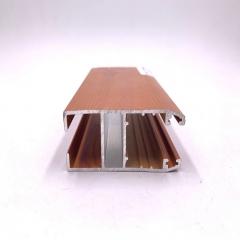
Visible products often lean toward 6063 and cleaner profile shapes because finish quality matters as much as basic strength. Chalco notes 6063 is commonly used in decorative lightweight supports such as furniture legs, lamp arms, and display props. Specialty builds add another twist. A perforated aluminium tube, or a pre-drilled section with matched accessories, can be useful for safety railings, sign structures, modular displays, and designs that benefit from airflow, drainage, or faster pinned assembly. A second telescopic aluminium square tube setup may also make sense when storage space is tight but the assembled structure still needs rigidity.
At that point, the challenge is no longer spotting the right category. It is finding a supplier that can actually deliver the shape, hole pattern, finish, and dimensional consistency your application depends on.
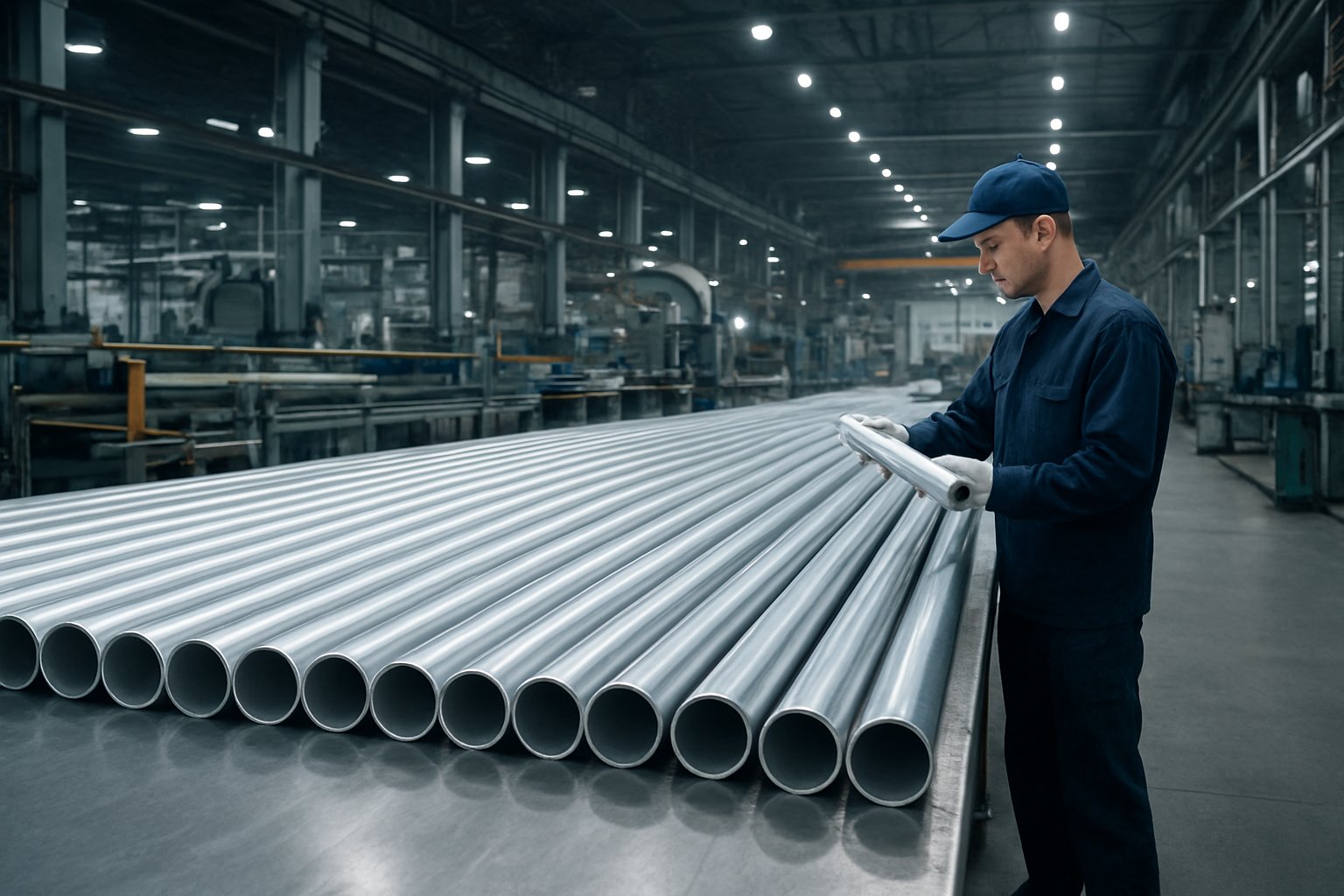
A tube that looks right on a product page can still miss the mark if the supplier cannot hold wall thickness, surface quality, or delivery discipline. That is the real split between basic aluminium tube stock sellers and manufacturing partners. The stronger aluminium tube suppliers can show process control, alloy depth, finishing options, and enough order flexibility to support the job you are actually building.
The audit framework from Aluphant starts with practical checks: years in business, certifications, press range, alloy options, downstream processes, and industries served. For aluminium extruded tubes, also ask for sample inspection reports, dimensional charts, and traceability records. Shengxin's supplier guide adds another useful filter: confirm finishing choices, engineering support, lead time, and export capability, not just price.
| Supplier example or model | Extrusion and alloy scope | Tolerance and wall control | Finishing and custom support | Best fit |
|---|---|---|---|---|
| Shengxin Aluminum | One-stop tubing and custom profiles, with 30 years of experience and press capacity up to 5500 tons | Promotes precise sizing and uniform wall thickness for industrial use | Useful when machining, finishing, and custom profile support matter | Buyers needing repeat supply, custom sections, or tighter process consistency |
| Stock-focused distributor | Usually standard sizes and common alloys | Quality depends heavily on upstream mill control | Limited design input and fewer custom options | Fast replacement buys and simple aluminium tube stock needs |
| Fabricator that outsources extrusion | May offer value-added machining but not full in-house extrusion depth | Consistency can vary across sources | Can help with cut, drill, or assembly work | Projects where post-processing matters more than custom die development |
Capacity is more than press tonnage. Aluphant's checklist looks at die handling, process logging, calibrated measuring tools, alloy verification, and lot traceability. That matters because the Get It Made extrusion guide notes that uniform wall thickness supports efficient extrusion and helps reduce uneven cooling and deformation. In other words, stable capacity protects the production of aluminium tubes, not just the first sample.
If a standard aluminium extrusion tube forces extra machining, awkward adapters, or cosmetic compromises, custom extrusion can be the smarter buy. This is where engineering review, prototype runs, and repeatable finishing earn their keep. That final choice gets even tighter when fittings, connectors, and end details have to match the tube exactly.
A capable supplier helps, but the order still succeeds or fails on the final spec. By this point, the smartest move is to turn all the earlier decisions into a short, practical filter you can use before sending a quote request or purchase order.
This is where many otherwise correct orders get delayed. The product groupings in Easy Fix connectors and tube mounts show how accessory choice depends on profile shape, finish, and system style, not just a rough size label.
Bring in technical support early when the job involves custom profiles, tighter tolerances, special finishing, or production-scale quantities. The supplier checklist from AL Circle points buyers toward the right questions on extrusion capability, alloy range, tolerance standards, finishing options, tooling lead time, MOQ, packaging, logistics, and CAD or prototype support. For buyers who need custom extrusion help or more controlled industrial supply, Shengxin Aluminum is one practical resource to review first. If the requirement is simple stock material, a standard distributor may be enough.
Get those checks right and the spec stops being a guess. It becomes a part you can order with confidence.
Aluminium tube is usually selected by its outside shape and wall thickness, so buyers focus on fit, strength, and fabrication. Pipe is more often specified in flow-service language and may use nominal sizing, which can confuse first-time buyers. If you are matching clamps, connectors, or frame parts, tube specs are typically the clearer way to buy. Rod and bar are different again because they are solid, not hollow.
For most frame builds, square or rectangular tube is the easier choice because flat faces simplify alignment, drilling, fastening, and bracket mounting. Round tube is often better for rails, hand-contact parts, and layouts where smooth appearance or flow matters more than flat-face assembly. The right pick depends on load direction, connector style, and how the tube needs to sit against other parts. If anti-rotation matters, square sections usually make assembly more predictable.
Choose 6061 when strength, machining, and general structural use matter most. Choose 6063 when you care more about a cleaner surface, better anodized appearance, and easier forming for visible parts. If your project leans toward corrosion resistance or high formability, 5052 or 3003 may deserve a closer look instead of staying only in the 6000 series. A good shortcut is to match the alloy to the real shop process, not just the catalog label.
Start with the outside size, then confirm wall thickness, alloy, temper, tolerance, stock length, and finish. For round tube, make sure you do not confuse OD with ID. For square or rectangular sections, confirm whether the listed dimensions are outside measurements and whether your fittings match the profile exactly. This is also where thin-wall versus thick-wall decisions affect stiffness, weight, bend quality, and joining options.
Request custom support when standard stock creates extra machining, awkward adapters, cosmetic compromises, or repeat fit problems. It also makes sense for industrial orders that need tighter dimensional control, uniform wall thickness, special finishes, or steady volume across multiple batches. A manufacturer with in-house extrusion capability and broad press capacity, such as Shengxin Aluminum, can be a practical option when custom profiles or more controlled production matter. For simple replacement pieces in common sizes, a stock distributor may still be enough.



 online service
 0086 136 3563 2360
 sales@sxalu.com
 +86 136 3563 2360
 English
 français
 Deutsch
 русский
 español
 português
 العربية
 ไทย
ไทย Việt
Việt Українська