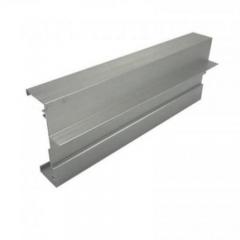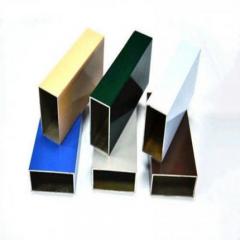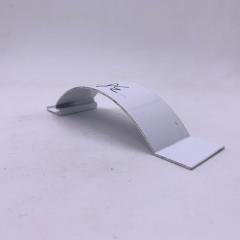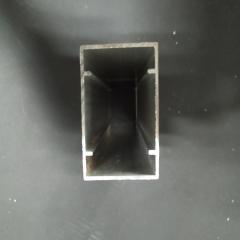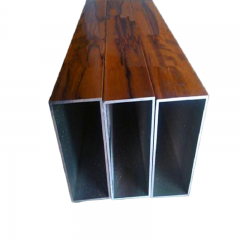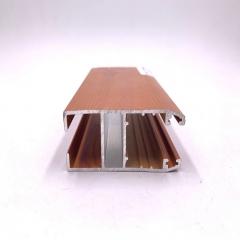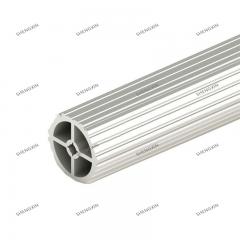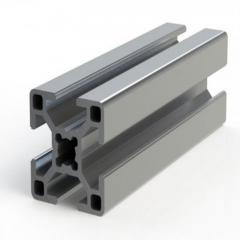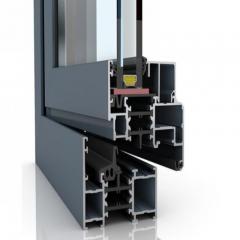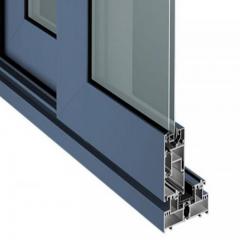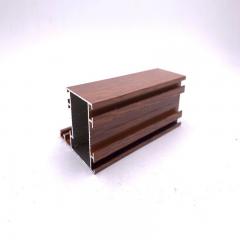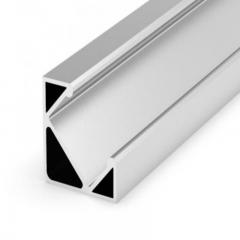
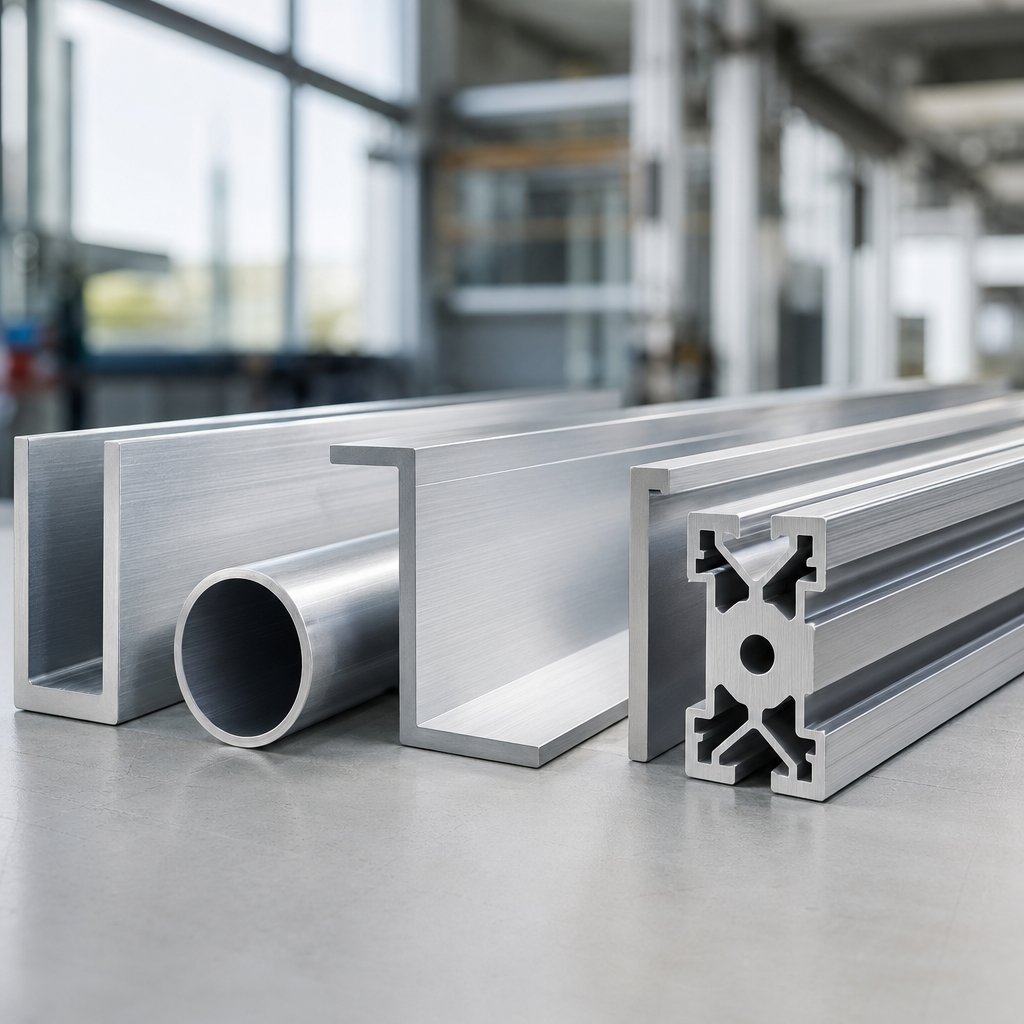
If you have ever opened a product catalog and seen channels, tubes, trims, or framing members, you were likely looking at extruded aluminum profiles. In simple terms, an extruded aluminum profile is a long aluminum part made by pushing heated alloy through a shaped die so the same cross-section repeats along its length.
An extruded aluminum profile is an aluminum section with a continuous, die-formed cross-sectional shape that stays consistent from end to end.
That short definition makes catalog language much easier to read. A profile is the outline you would see if you sliced the part and looked straight at its end. Extrusion is the forming method itself. A shape is the resulting geometry, such as an angle, channel, tube, or T. A framing member is simply a profile used to build or support something, from a machine guard to a façade system. You may also see the term aluminum extruded profile in listings; it usually refers to the same basic product. As explained by Eagle Aluminum, extrusion creates consistent lengths that can later be cut, fabricated, and finished for different uses.
It also helps to separate these parts from other aluminum products. Aluminum profiles aka extruded aluminum are not cast parts poured into a mold cavity, not rolled sheet or plate flattened by rollers, and not fully machined parts carved from solid stock. An extrusion starts with a repeated section first, then gets secondary work only where needed.
The repeated geometry is what makes aluminum extruded profiles so practical. One cross-section can run through a long length, which is ideal for frames, rails, trims, enclosures, and supports used across architecture and industry. Designers can build grooves, slots, corners, and attachment features directly into the section instead of adding them later.
That clean, consistent form may look simple in a catalog, but the manufacturing path behind it is anything but casual, and it strongly shapes what can be made well.
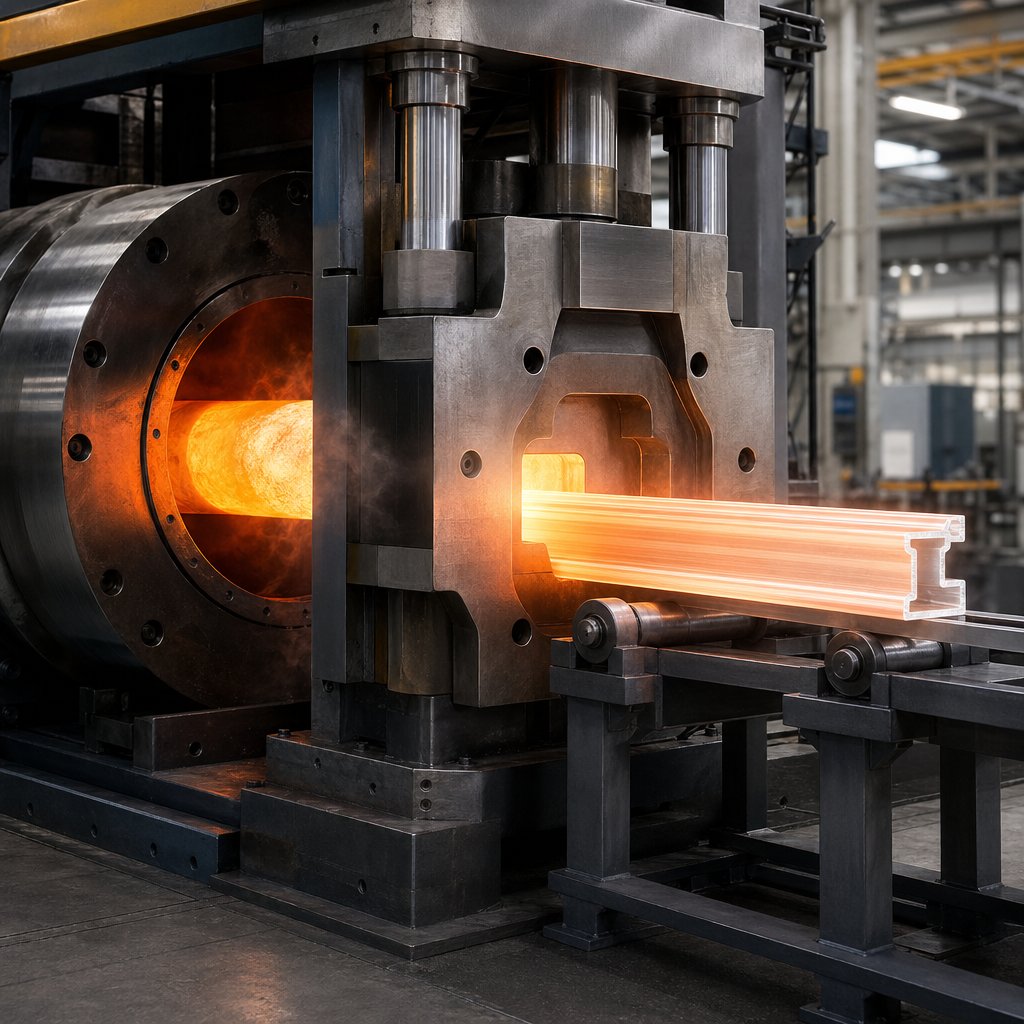
A clean catalog shape starts with heat, pressure, and tooling control. In extruded profile aluminum, the manufacturing route affects far more than the outline. It influences straightness, surface quality, tolerance control, and how easily the part can be drilled, tapped, bent, or assembled later.
Bonnell Aluminum describes extrusion as forcing heated aluminum through a shaped die opening so the metal exits with the same cross-section as the die. Picture firm material being squeezed through a nozzle, but with much tighter control over temperature and pressure.
Good extrusion design balances shape ambition with metal flow, because the die does not just form the profile. It also sets the limits of consistency.
Die type changes how aluminum moves. Eagle Aluminum explains that solid dies make sections with no enclosed voids, hollow dies create one or more closed voids, and semi-hollow dies form shapes that are nearly enclosed. When engineers compare aluminum extruded profiles solid semi-hollow hollow options, they are really comparing different flow conditions inside the die.
Solid shapes such as bars, many angles, and simple channels are usually more forgiving. Hollow tubes and multi-void sections need mandrels and more complex die support, so flow balance becomes more critical. Thin walls beside heavy masses, sharp corners, deep tongues, and tight voids all make extrusion harder. The reference language around aluminum extruded profile dcc vs wall thickness and aluminum extruded profiles dcc vs press size points to the same design reality: the profile's overall circumscribed envelope, wall design, and press capability have to work together.
That is why extruded profiles aluminum are reviewed for manufacturability, not just appearance. A profile that looks efficient on a drawing can still be difficult to run consistently if the geometry fights metal flow. Those tradeoffs also shape a practical sourcing choice, since some needs fit a stocked section, while others clearly justify modular framing or a custom die.
Geometry does not end at the die. It also decides whether a project is better served by a stocked section, a modular framing system, or a purpose-built profile. In practice, the right choice comes down to one question: are you trying to buy material quickly, build something adjustable, or remove repeated downstream work?
Eleanor Aluminium describes standard extruded aluminum profiles as pre-designed shapes made in fixed sizes. That makes them the easiest place to start when your design already fits common forms such as angles, tubes, and channels. They are especially useful for construction, transportation, industrial frames, simple enclosures, and furniture components where the section itself is not highly specialized.
The big advantage is speed of specification. No new die is required, and fabrication can stay simple if the profile already matches the drawing closely enough.
Custom extruded aluminum profiles make sense when stocked shapes force too much cutting, welding, fastening, or machining. A custom section can combine several jobs into one repeatable cross-section, such as screw bosses, panel grooves, wire paths, heat-dissipating fins, or snap-fit details. That is where many custom extruded aluminum industrial profiles create real value: not by being unusual for its own sake, but by reducing part count and simplifying assembly.
Tooling is the tradeoff. Notes on die cost ranges show why custom work is easiest to justify when production volume is meaningful or when the profile removes enough secondary operations to offset the one-time die expense.
T slot extruded aluminum profiles sit between those two extremes. PTSMAKE outlines them as extruded sections with T-shaped channels that accept dedicated nuts, bolts, brackets, panels, and other accessories. That makes them ideal for machine guards, workstations, automation frames, carts, and adaptable enclosures.
The key benefit is modularity. You can reposition brackets, add shelves, mount sensors, or expand a frame without redesigning the profile itself. Buyers who search for bosch extruded aluminum profiles are often really looking for this kind of mature accessory ecosystem, but the practical check is slot series and connector compatibility, not the brand name alone.
| Option | Best use cases | Design freedom | Accessory ecosystem | Fabrication impact | Sourcing considerations |
|---|---|---|---|---|---|
| Stocked standard profiles | Common structural members, trims, tubes, channels, basic enclosures | Low to moderate, limited to existing catalog shapes | Usually general hardware, not system-specific | May need more drilling, brackets, or machining if the section is only a close match | Good when availability and familiar dimensions matter more than integration |
| T-slot framing systems | Workstations, guards, machine bases, automation frames, reconfigurable assemblies | Moderate, based on system families and slot layouts | Strong, with purpose-made connectors, panel retainers, feet, hinges, and mounts | Reduces welding and makes field changes easier; assembly is mostly mechanical | Check slot standard, profile series, and hardware compatibility before mixing sources |
| Fully custom dies | Integrated functional sections, appearance-sensitive parts, part consolidation, specialized industrial components | High, within extrusion design limits | Usually project-specific rather than off-the-shelf | Can sharply reduce secondary machining and simplify final assembly when designed well | Requires drawing review, tooling approval, and a clear case for lifecycle value |
A simple rule helps: choose stock when the shape already works, choose T-slot when the structure must stay adjustable, and choose custom when the section itself can replace extra parts or processes. That decision sets the profile family, but not yet the full specification. Two sections with the same geometry can still behave very differently once alloy, temper, and finish enter the picture.

Alloy choice is where two similar-looking sections start to behave very differently. One profile may lean toward structural duty, another toward cleaner visible surfaces, and a third toward a brighter anodized look. Temper matters too. Gabrian notes that tensile strength varies with temper treatment, so comparing alloys without the temper listed can lead to the wrong conclusion.
For many projects, the main decision is between extruded 6061 aluminum profiles and extruded 6063 aluminum profiles. The difference is practical, not abstract. 6061 is usually chosen when higher strength, good machinability, and solid all-around structural performance matter most. Eagle Aluminum describes it as a versatile, precipitation-hardened alloy used in structural angles, channels, and tubing for applications such as utility boats, bicycle frames, floor framing, and other load-bearing members.
6063 points in a different direction. It is widely used where smoother surfaces, better cosmetic appearance, and easier finishing matter more than maximizing strength. That is why it shows up so often in window frames, door frames, signage, trim, tubing, and furniture. In visible architectural work, the cleaner surface often carries more value than the last increment of mechanical strength.
The property gap helps explain that pattern. Eagle Aluminum lists 6061-T6 at a minimum ultimate tensile strength of 42,000 psi and yield strength of 35,000 psi. For 6063-T6, the same source lists 28,000 psi ultimate and 23,000 psi yield. In plain language, 6061 usually wins the strength argument, while 6063 often wins the finish and appearance argument.
Finish requirements can shift the decision fast. Silver City Aluminum notes that extruded 6005 aluminum profiles are often used for structural members, handrail tubing, ladder structures, and connector stock, while still offering strong corrosion resistance and attractive anodized results. That makes 6005 worth considering when you want a more structural profile without giving up finish quality entirely. In some RFQs, you may also see extruded 6105 aluminum profiles listed alongside other 6xxx options. If that appears on a drawing, confirm the exact alloy and temper instead of assuming it will behave like 6061 or 6063.
Where surface presentation becomes the main priority, extruded 6463 aluminum profiles deserve attention. Silver City describes 6463 as similar to 6063 but even more anodizing-friendly, with strong suitability for bright dip finishing and mirror-like decorative results. That makes it a logical fit for trim, shower door parts, mirror door frames, bathroom trim, and other sections designed to be seen up close.
| Alloy | Typical selection logic | Finish tendency | Common applications | Fabrication notes |
|---|---|---|---|---|
| 6061 | Choose when strength and general structural performance outrank cosmetics | Good corrosion resistance and finishability, but usually not the first choice for the most appearance-sensitive exposed surfaces | Structural members, channels, tubing, building products, piping, bicycle frames | Good weldability and machinability; often favored where drilling, tapping, and stronger load paths matter |
| 6063 | Choose when moderate strength plus a smoother visible surface is the better balance | Known for excellent cosmetic appearance after finishing and strong anodizing acceptance | Window and door frames, architectural trim, signage, tubing, furniture, railings | Good workability and weldability; commonly preferred for custom shapes with visible faces |
| 6005 | Consider when the profile leans structural but still needs good corrosion resistance and finish quality | Performs well with clear or colored anodizing | Structural members, handrail tubing, structural tubing, ladders, automotive connector stock | Silver City notes strong extrusion and fabrication characteristics, with T5 strength comparable to 6061 in that temper |
| 6463 | Choose when decorative appearance is a leading requirement | Especially friendly to anodizing and bright dip finishing | Automotive trim, shower doors, mirror doors, bathroom trim, polished interior components | Best suited to appearance-led parts rather than sections chosen mainly for higher structural demand |
A smart specification rarely starts with alloy alone. Geometry, span, wall thickness, stiffness, and machining allowances can still rule out a section that looked perfect on paper, which is why the technical filters deserve their own close look.
Alloy and finish narrow the field, but the final choice usually depends on geometry and service conditions. A stronger alloy cannot rescue a section that bends too much, twists during assembly, or leaves no material for drilling and tapping. When you compare one extruded aluminum profile to another, the key questions are practical: how is it loaded, how far does it span, how much movement is acceptable, and what has to happen to it after extrusion?
Start with the load path. Is the member acting like a beam between supports, a vertical post, or a cantilever carrying weight off one side? Moment of inertia data matters here because stiffness, not just ultimate strength, often controls the decision. The MAP guide also recommends using a deflection calculator when an unsupported span exceeds 1000 mm under meaningful load or when the frame supports expensive equipment.
Orientation can change performance dramatically. In MAP's example, a 40 x 80 profile oriented tall delivers about 3.7 times the stiffness of the same section laid flat. That is why people searching for aluminum extruded profiles limits are often really asking about span, deflection, vibration, and joint movement, not just whether the metal is strong enough on paper.
Section shape changes how a member resists bending and twist. Extruded aluminum tubing profiles are often preferred when you want a closed section with more balanced stiffness and better torsional resistance. That is also why aluminum extruded tube profiles are common in frames that need cleaner load paths and enclosed geometry for wires, fluids, or fasteners.
Open sections behave differently. Extruded aluminum channel profiles are easy to mount and access, but the open side usually makes them less resistant to twisting than a comparable tube. An extruded aluminum t profile is even more directional. It can work well when the stem and flange line up with the intended load, but it is less forgiving if side bending or off-axis loading shows up later. PTSMAKE's profile guidance makes the broader point clearly: a larger profile family or a better orientation often improves stiffness more effectively than a small wall-thickness increase alone.
Before release, check machining and service demands against the section drawing. Wall thickness affects how much material is available for holes, threads, slots, and end machining. Weight should be estimated from catalog mass per length and finished cut length, then adjusted for connectors, inserts, and attached panels rather than guessed from alloy alone. Assembly method matters too. Slotted framing depends on slot compatibility, connector access, and clamp-up, not only on the profile body.
Tolerances deserve their own review line. Hugh Aluminum lists straightness grades of 0.1, 0.2, and 0.3 mm/m for high, standard, and general precision, along with flatness grades of 0.03, 0.05, and 0.1 mm/m. The same source notes that flatness becomes especially important for heat sinks because uniform contact improves thermal transfer, while straightness and twist matter more for rails, frames, and interlocking assemblies. It also groups angular, shape, and dimensional controls under standards such as EN 755-9 and ASTM B221.
| Selection factor | What it affects | What to verify in drawings or supplier data |
|---|---|---|
| Load path | Bending, compression, joint stress | Support points, load direction, point load versus distributed load |
| Span and deflection | Service stiffness, vibration, alignment | Unsupported length, allowable movement, available load table or calculator data |
| Profile geometry | Moment of inertia, torsional behavior | Section shape, open versus closed section, required orientation in assembly |
| Wall thickness | Local strength, machining allowance, weight | Minimum wall at holes, slots, threads, and cut features |
| Straightness | Rail alignment, frame fit-up | Precision grade and allowable mm/m deviation |
| Flatness | Panel sealing, thermal contact, visible fit | Critical contact faces and flatness requirement |
| Twist and angular accuracy | Assembly accuracy, accessory fit | Twist tolerance, angle tolerance, interlocking feature sensitivity |
| Thermal behavior | Expansion clearance, heat transfer, sealing performance | Operating temperature, contact surface quality, finish requirements |
| Assembly method | Rework ease, hardware compatibility | Slot type, connector family, tool access, joining method |
These filters make the catalog far less confusing. They also reveal why the right section for a machine frame may be completely wrong for an enclosure, a facade detail, or a heat-dissipating part, even before finish and fabrication enter the conversation.
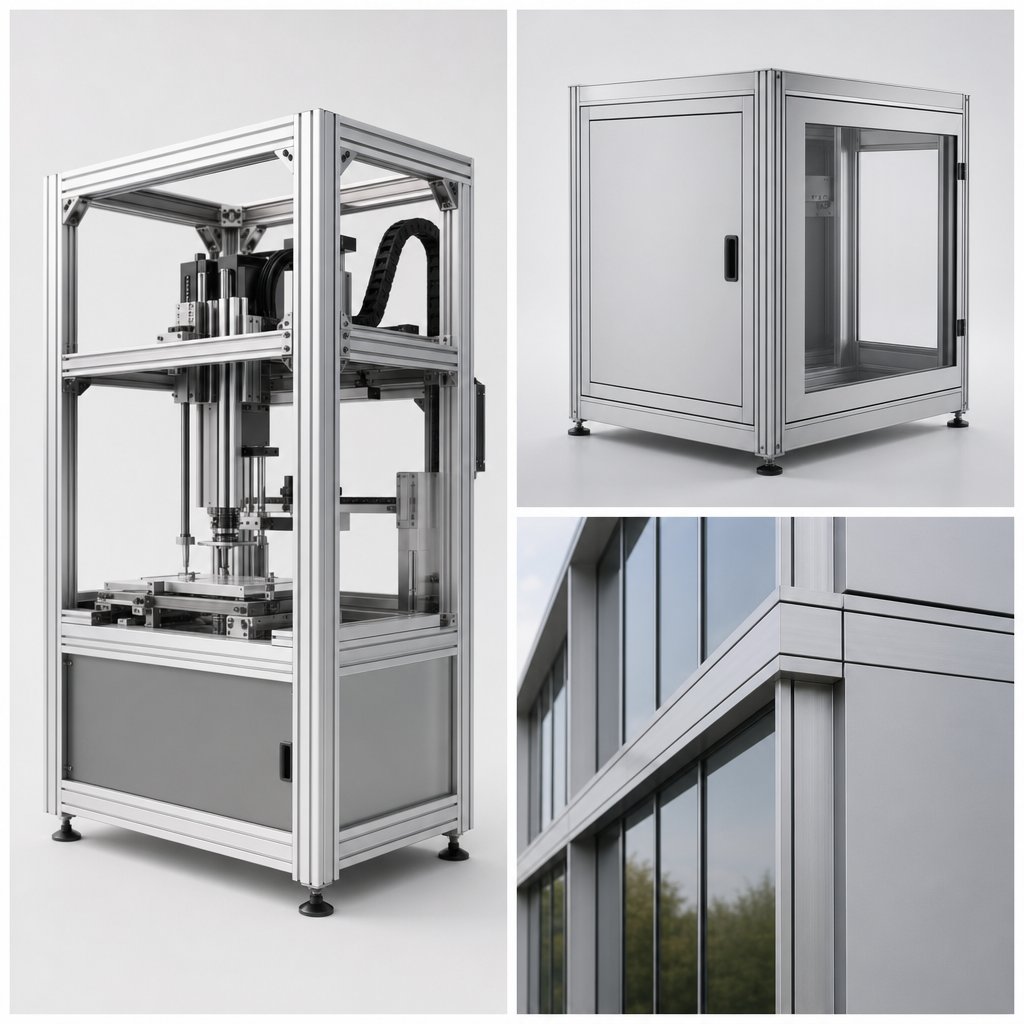
A profile that feels perfect in a machine base can be the wrong choice for a visible facade, a guarded enclosure, or a cooling part. Application changes the selection logic fast. In Proax, common manufacturing uses include workstations, machine guards, conveyors, equipment mounts, and custom machine frames. The selection guide adds the broader pattern: architecture tends to prioritize surface finish and dimensional accuracy, industrial automation leans on modularity and machinability, and electronics-related parts depend on complex geometry and tighter tolerance control.
For guards, cabinets, and framed housings, the best section is not always the heaviest one. It is the one that supports the enclosure system cleanly. Extruded aluminum enclosure profiles usually need dependable panel retention, square assembly faces, and room for hinges, latches, brackets, or cable routing. If you are evaluating one extruded aluminum enclosure profile for a door frame or cover edge, look closely at how panels seat, how hardware mounts, and whether tool access will stay practical after assembly.
This is why modular framing remains common in machine guarding, safety barriers, and power enclosures. T-slots make it easier to add panels, sensor mounts, brackets, and later changes without rebuilding the whole frame. A smoother custom shape can be the better fit when the enclosure needs integrated grooves, fewer loose components, or cleaner exposed faces.
Extruded aluminum profiles for facades are usually judged first by visible quality, finish response, corrosion resistance, and dimensional consistency. The same application family often includes curtain wall members, window frames, cladding supports, and extruded aluminum trim profiles, where clean lines and reliable fit matter as much as basic strength. In exposed architecture, finishing options such as anodizing, powder coating, or PVDF coatings matter because the profile is part of the final appearance, not just the hidden structure.
Extruded aluminum heat sink profiles follow a different rule set. Here, the cross-section earns its place through fin geometry, contact surfaces, and machining access. The source above places heat sinks within electronics-oriented uses where fine surface finish, complex geometry, and tight tolerances matter. For custom extruded aluminum heat sink profiles, flat base areas and consistent fin shapes are often more important than decorative appearance.
Lightweight structural parts, conveyors, and furniture frames land somewhere between those extremes. They still care about corrosion resistance and appearance, but stiffness, weight, and connection reliability usually lead the decision.
The joining method often decides whether a profile family feels efficient or frustrating. Mechanical fasteners and T-slot connectors fit workstations, guards, quality stations, and modular machine frames that may be reconfigured later. Welded or heavily machined assemblies usually benefit from simpler structural shapes with cleaner load paths. Snap-fit or trim-led assemblies often justify purpose-built sections that hold panels, inserts, or covers directly in the profile.
| Application category | Profile features to prioritize | Common finishing needs | Fabrication considerations |
|---|---|---|---|
| Machine frames and automated systems | Stiff sections, rail and sensor mounting faces, modular connection points, machinability | Mill finish for hidden use, anodized where corrosion resistance or easier cleaning matters | End machining, bracket access, straightness, repeatable cut length |
| Workstations and quality stations | T-slots, accessory mounting, adjustability, cable and tool organization features | Anodized or powder coated for appearance and routine cleaning | Connector compatibility, ergonomic add-ons, easy field modification |
| Safety guards and machine barriers | Panel or mesh retention, square door frames, hinge and latch mounting, modular panels | Anodized or powder coated for visible surfaces and plant exposure | Fast assembly, door alignment, panel insert fit, future reconfiguration |
| Enclosures and control housings | Panel grooves, cover retention, hardware mounting faces, clean exterior lines | Anodized or powder coated depending visibility and environment | Cutouts, drilled and tapped features, access for maintenance, cover fit |
| Conveyors and material handling | High stiffness-to-weight ratio, support mounting faces, accessory channels, durable frame geometry | Mill finish indoors, anodized or powder coated for harsher exposure | Roller mounts, guarding interfaces, service clearance, support alignment |
| Facade systems and architectural members | Visible surface quality, corrosion resistance, dimensional accuracy, thermal break accommodation | Anodizing, powder coating, or PVDF for exposed architectural use | Tight cut accuracy, finish consistency, joint detailing, tolerance verification |
| Heat sinks and electronics housings | Fin density and layout, flat contact surfaces, tight tolerance, compact complex geometry | Mill finish or anodized depending appearance and exposure needs | Base machining, cut quality, interface flatness, handling to protect fins |
| Lightweight structural parts, furniture, and desk frames | Balanced stiffness, low weight, clean edges, attractive exposed faces | Anodized or powder coated for touch surfaces and appearance | Concealed connectors, drilled holes, repeatability, edge finishing |
A good application match is really a packaging exercise. Load, finish, mounting, service access, and future changes all have to fit inside the same cross-section. That is also why quote requests become much more useful when drawings spell out not just the shape, but the machining state, finish class, and assembly intent.
A profile can fit the application perfectly and still produce confusing quotes if the RFQ is thin. That happens all the time. One supplier prices raw mill lengths, another assumes cut pieces, and a third includes anodizing and drilling. If you want comparable responses from extruded aluminum profiles suppliers, your request has to define the part at the same level each time.
Verify profile geometry, finish, and machining status before comparing price.
A practical enquiry checklist asks for alloy, finish, length, quantity, fabrication, and packaging. Separate RFQ tips add critical dimensions, tolerances, exposed surfaces, file types, and end use. Put together, they form a solid buyer checklist:
Drawings do more than show shape. They show where cost and risk live. Refined CAD files help a custom extruded aluminum profiles supplier see thin walls, cosmetic faces, drill locations, and finish-sensitive surfaces before quoting. That matters whether you are buying from a custom extruded aluminum profiles factory directly or comparing aluminum extruded profiles wholesale options through a distributor.
Even a sketch or physical sample can start the conversation, but clean documentation shortens the back-and-forth and reduces hidden assumptions. And once your RFQ package is consistent, catalogs stop being overwhelming. They become a practical shortlist tool for checking geometry, fabrication, and finish before you ever ask for the final number.
With a clean RFQ package in hand, catalogs stop feeling like noise. They become a fast filter for shape, finish, machining, and application fit. That matters because a promising listing is only useful if it matches your drawing and the supplier can actually deliver the secondary work you need.
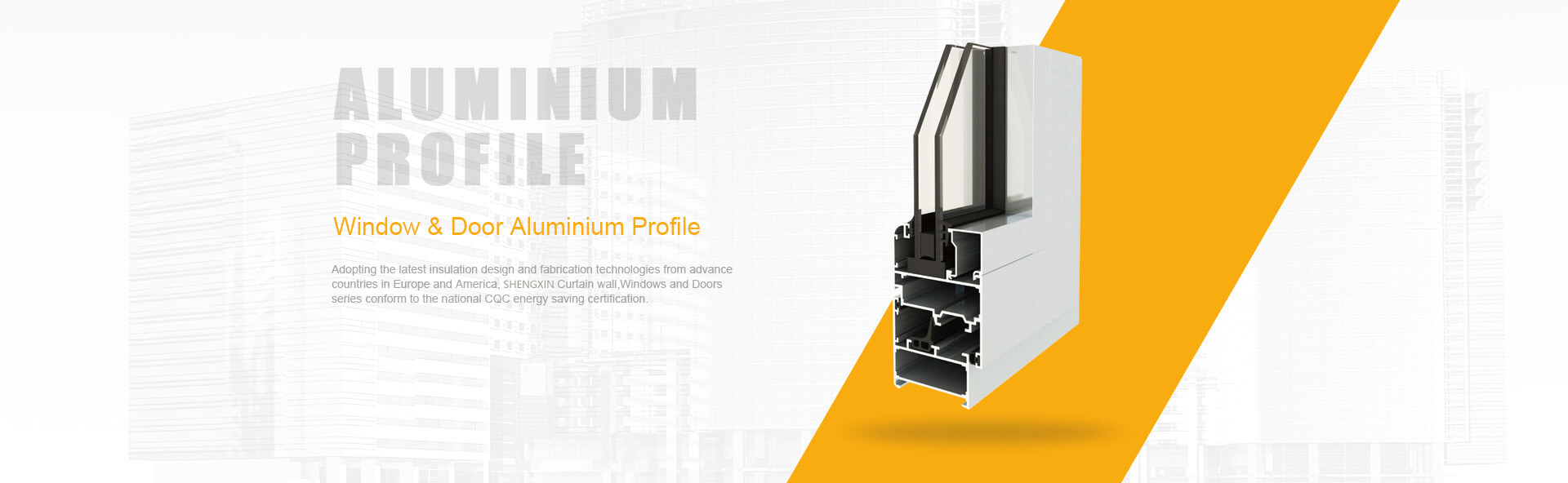
A practical shortlist for custom extruded profiles aluminum should start with visible catalog evidence, not vague sales claims. One useful first stop is the Shengxin Aluminium catalog. It covers architectural and industrial profile categories and gives you a concrete way to check whether anodizing, finish variety, and custom section capability line up with your project. That makes it a reasonable benchmark when you need a custom extruded aluminum profiles manufacturer, not just a trader posting generic shapes.
If you are screening extruded aluminum profiles china sources, this approach keeps the comparison grounded. It also helps you ignore generic pages advertising custom extruded aluminum profiles for sale without alloy, temper, or fabrication detail.
The wider extruded aluminum profiles market is full of lookalike listings, so use catalogs to verify what photos cannot show. Check whether the supplier separates standard and custom offerings, identifies application areas, and supports downstream work such as cutting, CNC machining, or surface treatment. The Shengxin guide and this supplier checklist both reinforce the same point: customized extruded aluminum profiles are easier to source when geometry, finishing, quality control, and logistics are reviewed together. A short, evidence-based shortlist will do more for your final quote than ten unverified tabs ever will.
An extruded aluminum profile is a long aluminum section formed by pushing heated alloy through a die so one cross-sectional shape repeats from end to end. That repeatable geometry makes it useful for frames, trims, enclosures, rails, and structural members because features such as channels, hollows, and mounting faces can be built directly into the section.
Choose a standard profile when a common shape such as a channel, angle, or tube already fits the design well enough. Choose T-slot when the assembly must stay modular, adjustable, or accessory-friendly. Choose a custom extrusion when a purpose-built section can reduce machining, lower part count, improve appearance, or combine multiple functions into one profile.
6061 is typically selected for stronger structural duties and parts that may need more machining or robust load handling. 6063 is often preferred for smoother visible surfaces and cleaner finishing, especially in architectural and decorative applications. If appearance is a leading requirement, finish-oriented options such as 6463 may also be considered.
The key checks are load path, span, acceptable deflection, overall section shape, wall thickness, straightness, flatness, and the final assembly method. Thermal conditions and post-extrusion work also matter, especially if the part will be drilled, tapped, machined, or used as a heat-dissipating component. In many cases, profile geometry and orientation influence performance as much as alloy choice.
A strong RFQ should include a section drawing, CAD file, alloy and temper, finish requirement, cut length, quantity, machining details, tolerance needs, and any packaging or inspection requests. It also helps to review supplier catalogs before asking for price. For example, when screening sources such as Shengxin Aluminium, you can confirm custom profile capability, anodizing or other finish options, and secondary fabrication support before making side-by-side comparisons.



 online service
 0086 136 3563 2360
 sales@sxalu.com
 +86 136 3563 2360
 English
 français
 Deutsch
 русский
 español
 português
 العربية
 ไทย
ไทย Việt
Việt Українська