
You pull back the curtains on a cold morning, and there it is — a foggy film of water droplets streaking down the glass, pooling on the windowsill. Maybe you've grabbed a towel so many times it's become part of your morning routine. If you've ever wondered, "why do my windows have condensation?" the answer is simpler than you might expect, and it has very little to do with your windows themselves.
What causes condensation on windows? It forms when warm, moisture-laden indoor air comes into contact with a glass surface that has cooled below a critical temperature known as the dew point. The dew point is the temperature at which air can no longer hold all of its water vapor, forcing that invisible moisture to transition into visible liquid droplets on cold surfaces. Think of a cold glass of water on a humid summer day — within minutes, the outside of the glass is dripping wet. Your windows experience the exact same physics every time indoor conditions are right.
This article approaches condensation on windows from a building-science perspective, not a manufacturer sales angle. The goal is to help you understand what causes condensation, what it signals about your home, and what you can actually do about it.
Of every surface inside your home — walls, ceilings, floors, furniture — windows are almost always the coldest. Glass conducts heat far more readily than an insulated wall, so its interior surface temperature drops faster and further, especially overnight. That makes your windows the first place where indoor moisture runs out of room to hide.
This is exactly why you might ask, "why is there condensation on my windows inside?" and assume the windows are faulty. In most cases, they're not. They're simply acting as a mirror for a broader issue: too much humidity indoors, not enough ventilation, or both. The condensation you see is a symptom, not the root cause. If you're wondering "why are my windows sweating," the real question to ask is what's happening with the air inside your home.
Rather than treating foggy glass as a mere annoyance, it helps to think of it as a built-in diagnostic tool. Condensation on windows can reveal several things about your living environment:
Window condensation is rarely a window problem — it is almost always an indoor environment problem.
So what does condensation on windows mean for your home? It means the balance between moisture production and moisture removal has tipped in the wrong direction. The good news is that once you understand the underlying science — and learn where all that moisture is actually coming from — most condensation issues are entirely fixable without replacing a single window.
The real key to solving the problem starts with understanding exactly how humidity, temperature, and dew point interact at the surface of your glass — a relationship that, once you see it clearly, makes every condensation pattern in your home instantly explainable.
That relationship between humidity, temperature, and the glass surface isn't complicated — but it does follow a precise set of rules. Understanding these rules turns every case of condensation on glass from a mystery into something entirely predictable.
Imagine the air inside your home as a sponge. At any given temperature, that sponge can hold a specific maximum amount of water. Relative humidity (RH) is simply the percentage of that maximum the air is currently holding. If your indoor air is at 50% RH, the "sponge" is half full.
Here's the critical detail: warm air can hold significantly more moisture than cold air. As air temperature drops — say, right next to a cold window pane — the sponge effectively shrinks. The same amount of moisture now fills a larger percentage of the air's reduced capacity. When the air temperature at the glass surface falls low enough, the relative humidity at that surface hits 100%. The sponge is completely full, and it has no choice but to release the excess. That's why does condensation happen: water vapor transitions into liquid droplets the moment air reaches its dew point against a cold surface.
This is water condensation in its simplest form — and it explains exactly where does condensation occur first. It always appears on the coldest available surface, which in most rooms is the window glass. You'll notice glass with condensation long before moisture shows up on walls or ceilings, precisely because glass loses heat faster than insulated surfaces.
Keeping water from condensing on your windows isn't about eliminating humidity entirely — you need some moisture for comfort and health. The key is matching your indoor humidity to the outdoor temperature. Colder outdoor conditions mean your window glass will be colder, so indoor RH needs to be lower to stay below the dew point at the glass surface.
The following table, based on widely accepted ASHRAE guidance, shows maximum recommended indoor relative humidity levels to minimize condensation risk:
| Outdoor Temperature | Recommended Max Indoor RH |
|---|---|
| Above 50°F (10°C) | 40–45% |
| 32°F to 50°F (0°C to 10°C) | 35–40% |
| 14°F to 32°F (-10°C to 0°C) | 25–35% |
| Below 14°F (-10°C) | 20–25% |
| Below -4°F (-20°C) | 15–20% |
These thresholds assume standard double-glazed windows. Homes with older single-pane glass will need to target the lower end of each range, while high-performance triple glazing allows slightly more humidity before condensation appears.
Numbers in a table are only useful if you know what your home's humidity actually is — and most people have no idea. This is where a hygrometer becomes your single most valuable diagnostic tool.
A hygrometer is a small device that measures the relative humidity and temperature of the air around it. Digital models are widely available for under $15 and typically display both readings on an LCD screen. Some versions track minimum and maximum values over time, which is especially helpful for spotting overnight humidity spikes that cause morning condensation.
Placement matters for accurate readings. Position your hygrometer in the room where condensation is worst — usually a bedroom or kitchen — but keep it away from vents, windows, or exterior doors, as these spots produce skewed results. Place it on an interior wall or shelf at roughly breathing height, and allow at least 30 minutes for the device to acclimate to the room's conditions before trusting the reading.
Once you have a reliable humidity reading, compare it against the table above based on your current outdoor temperature. If your indoor RH exceeds the recommended range, you've identified the driving force behind your glass with condensation — and you have a clear target number to work toward.
Knowing the science, though, raises an immediate follow-up question: if the condensation appears on the inside of your glass, does it mean the same thing as moisture forming on the outside — or fog trapped between the panes? Each location tells a very different story about your windows and your home.
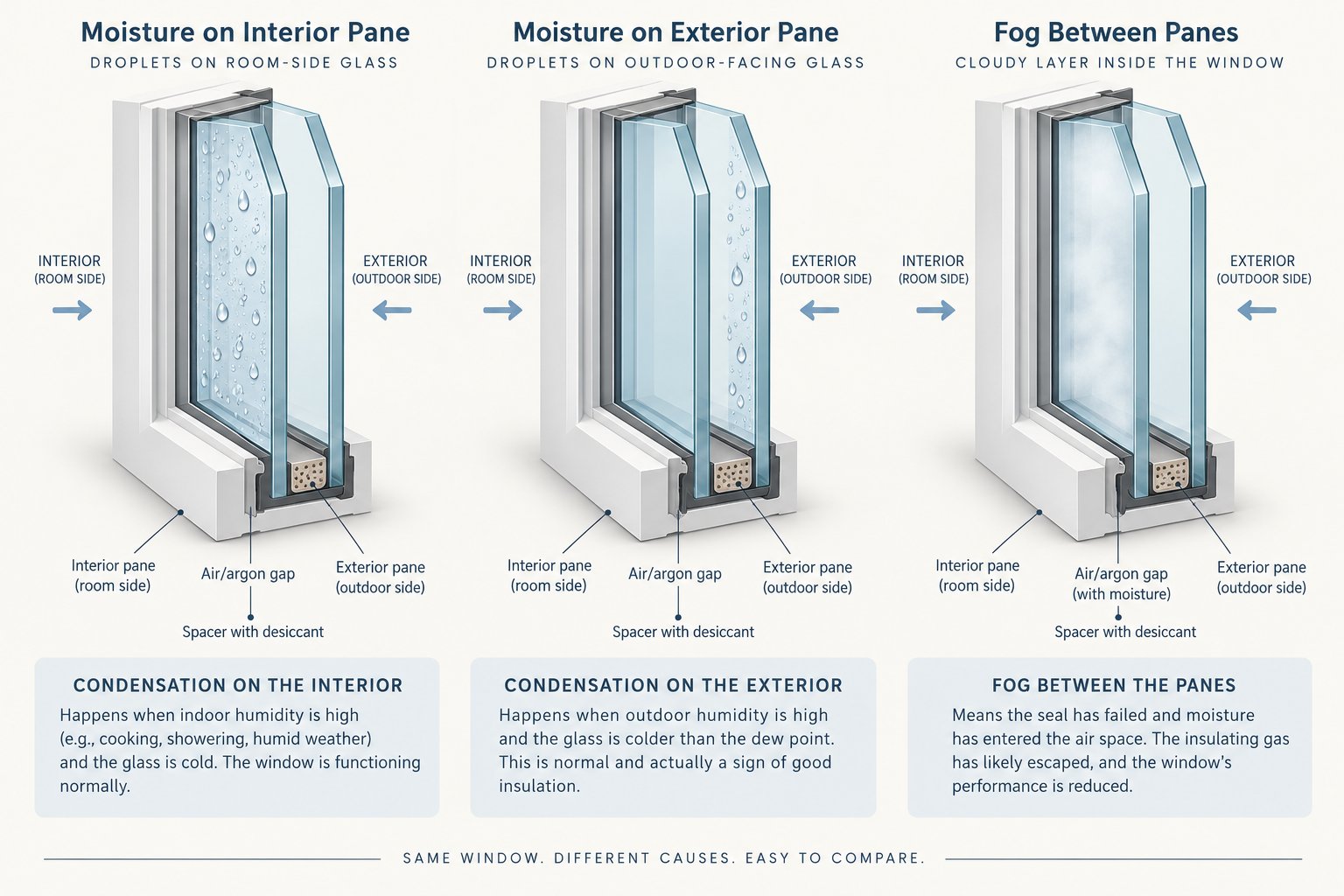
The location of moisture on your window glass changes everything — the cause, the severity, and the response. Condensation on the inside of windows, condensation on the outside, and fog trapped between panes each point to completely different problems. Treating them as one issue leads to wasted money and missed warning signs. Here's how to tell them apart.
This is the type most homeowners encounter, especially during colder months. Condensation on the inside of windows forms when humid indoor air meets glass that has cooled below the dew point — exactly the mechanism covered in the previous section. It's most visible on winter mornings after overnight temperature drops push the interior glass surface to its coldest.
The important thing to recognize? Interior condensation is a household environment issue, not a window defect. It signals that indoor humidity is too high, ventilation is too low, or both. The homeowner bears responsibility for managing it through humidity control strategies — adjusting humidifier settings, running exhaust fans, or improving air circulation. In most cases, seasonal adjustments are all that's needed. Left unchecked, though, persistent moisture on the interior glass can lead to mold growth on frames and sills, which is why it deserves attention rather than just a towel.
Here's a scenario that catches many people off guard: you walk outside on a spring or autumn morning and notice condensation on the outside of window glass — sometimes heavy enough to obscure the view entirely. Your first instinct might be concern, but condensation on exterior windows is actually good news.
Exterior condensation means your window's interior glass pane is so well-insulated from outdoor conditions that very little indoor heat reaches the outer pane. The exterior glass stays cold, drops below the outdoor dew point, and collects moisture from the humid morning air — the same way dew forms on your car's windshield or on grass overnight.
This pattern is most common during transitional seasons when nighttime temperatures dip sharply while outdoor humidity remains high. It's temporary, harmless, and typically burns off as the sun warms the glass. If anything, condensation on the outside of window surfaces confirms that your glazing is doing its insulating job effectively. No action is required.
Moisture between window panes tells a very different — and more serious — story. If you notice a foggy haze trapped inside the glass that you can't wipe away from either side, you're looking at a failed insulated glass unit (IGU) seal.
Modern double- and triple-pane windows are built with a sealed airspace between the glass layers, typically filled with argon or krypton gas for added insulation. A spacer bar along the edge holds the panes apart and contains a small amount of desiccant — a moisture-absorbing material designed to capture any trace humidity sealed inside during manufacturing.
When the perimeter seal degrades over time, outside air and humidity slowly infiltrate that sealed space. The desiccant absorbs the incoming moisture at first, which is why seal failure can go unnoticed for months or even years. Eventually, the desiccant becomes fully saturated and can no longer keep up. That's when visible fogging appears between the panes. In some older units, you may even spot granular material near the bottom edge of the glass — a sign of desiccant leaking from window spacer bars that have deteriorated.
Unlike interior or exterior condensation, condensation between window panes cannot be solved with ventilation or humidity adjustments. The sealed unit itself has failed. The silver lining is that this typically requires only an IGU replacement — swapping the glass unit within the existing frame — rather than a full window replacement, provided the frame remains in good structural condition.
The following table summarizes all three condensation types at a glance:
| Location | Primary Cause | Severity | Recommended Action |
|---|---|---|---|
| Inside surface of glass | High indoor humidity meeting cold glass (below dew point) | Low to Moderate — manageable with behavior and ventilation changes | Reduce indoor humidity, improve ventilation, use exhaust fans |
| Outside surface of glass | Well-insulated glass staying cold while outdoor humidity is high | None — sign of good thermal performance | No action needed; dissipates naturally as temperatures rise |
| Between panes | Failed IGU seal allowing moisture into the sealed airspace | High — indicates loss of insulating gas and ongoing moisture intrusion | Replace insulated glass unit (IGU); replace full window if frame is damaged |
Identifying which type you're dealing with takes only a few seconds: run your finger across the moisture. If you can wipe it off from inside the room, it's interior condensation. If it's on the outdoor surface, it's exterior. If you can't reach it at all, the seal has failed.
With the type diagnosed, the natural next question becomes where is all that indoor moisture actually coming from? Interior condensation — by far the most common and most controllable type — is driven by everyday household activities that produce far more water vapor than most people realize.
Every drop of moisture on windows inside your home started somewhere — a boiling pot, a hot shower, even the simple act of breathing while you sleep. Most homeowners can name one or two obvious culprits, but the full list of moisture sources quietly pumping water vapor into your indoor air is surprisingly long. And when several of these sources overlap in a poorly ventilated space, the result is exactly the kind of moisture buildup on inside of windows that drives people to ask, "why is there moisture on the inside of my windows?"
Three everyday activities dominate indoor moisture production, and all three happen in nearly every household, every single day.
Cooking — especially boiling, steaming, and simmering — releases a substantial volume of water vapor directly into the kitchen. A pot of pasta at a rolling boil can add noticeable humidity to a room within minutes. Frying produces less steam, but any recipe that involves boiling water or uncovered liquids turns your stovetop into a humidity generator.
Showering and bathing are even more significant. A typical shower can release over a pint of moisture into the air in just ten to fifteen minutes. If you enjoy long, hot showers with the bathroom door open, that moisture migrates through hallways and into bedrooms, where it settles on the coldest surfaces overnight. You'll notice windows with moisture every morning, and the bathroom may not even be the worst-affected room.
Drying laundry indoors is the most underestimated contributor of the three. When a full load of wet clothes hangs on an indoor drying rack, all the water that would normally be vented outdoors by a dryer evaporates directly into your living space. A single load can release several liters of moisture as it dries — enough to push an entire home's humidity well above the condensation threshold, especially in winter when windows stay closed.
Beyond the obvious culprits, a surprising number of everyday elements quietly add moisture to your indoor environment. Individually, each may seem minor. Combined, they explain why do my windows get moisture on the inside even when you're not cooking or showering.
The following sources are ranked roughly by their typical moisture contribution:
When you add all of these sources together, it becomes much easier to understand why moisture on inside of house windows can appear even when no single activity seems extreme.
Here's a paradox that frustrates many homeowners: newer, better-insulated houses are often more prone to condensation than older, drafty ones. Why?
Older homes had gaps — around window frames, under doors, through uninsulated walls and roofs. These drafts were uncomfortable and energy-inefficient, but they provided constant, accidental air exchange. Moist indoor air escaped naturally and was replaced by drier outdoor air, keeping humidity levels in check without anyone thinking about it.
Modern building standards have rightly prioritized energy efficiency. Tighter building envelopes, improved insulation, sealed vapor barriers, and high-performance windows dramatically reduce heat loss — but they also dramatically reduce natural ventilation. All of those moisture sources listed above? In a well-sealed home, that water vapor has nowhere to go. It accumulates hour after hour, driving indoor humidity higher and higher until the coldest surfaces — your windows — start dripping.
This creates a situation where the home itself performs exactly as designed from an energy standpoint, yet the occupant faces persistent condensation. The missing ingredient isn't better windows or less insulation — it's deliberate ventilation to replace trapped, humid air with fresh, drier air. That ventilation gap is the single most important factor separating homes that struggle with windows with moisture from those that don't — and addressing it effectively requires understanding which ventilation strategies actually work.
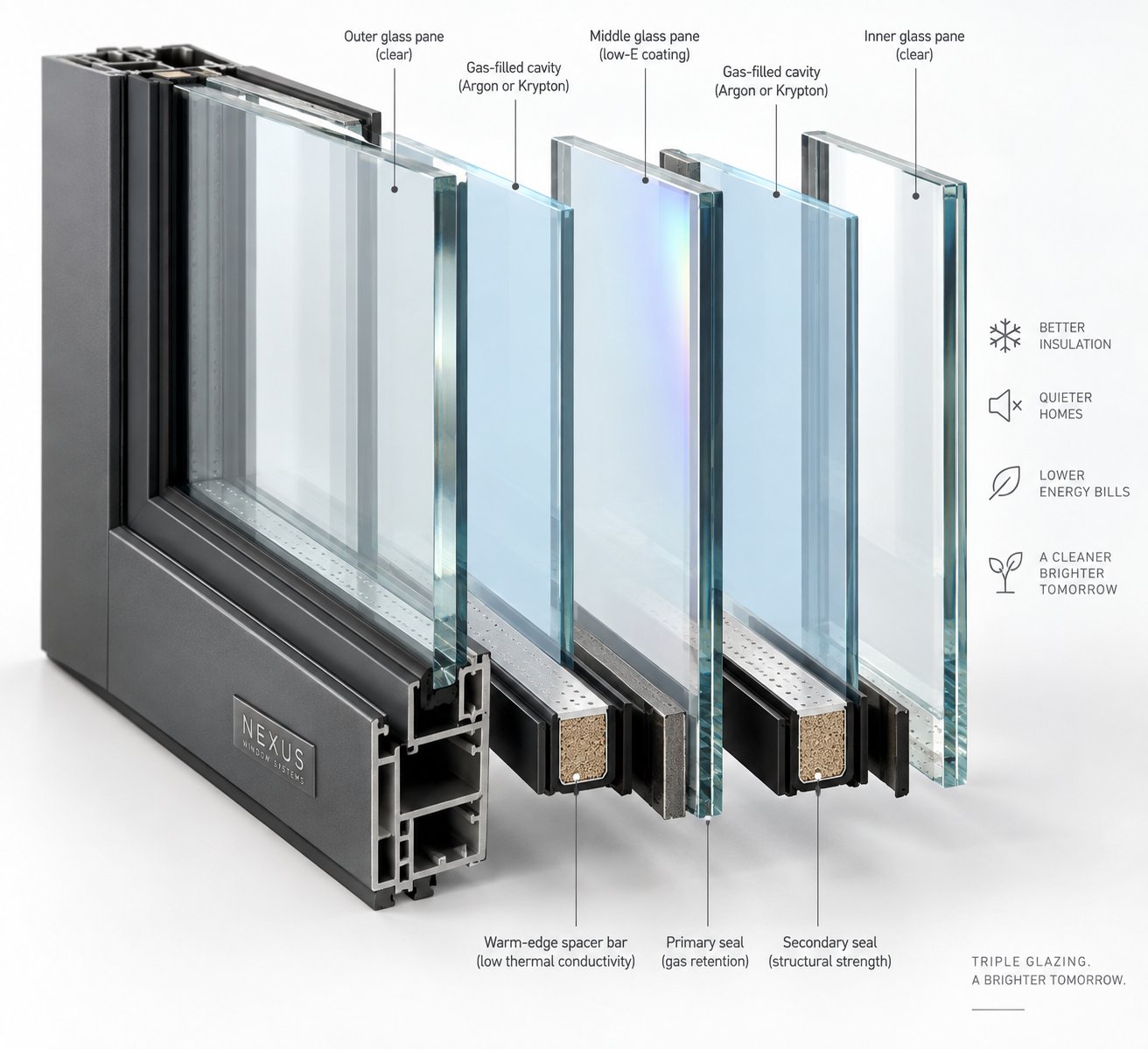
Ventilation controls the moisture in your air — but the window itself determines how cold the interior glass surface gets. Two homes with identical humidity levels and identical ventilation can have completely different condensation outcomes simply because of differences in frame material and glazing technology. If you've ever noticed window condensation in one room but not another, the window's construction may be the deciding factor.
This is the part of the conversation that most manufacturer-published guides skip, because honest comparisons invite scrutiny. Here, the goal is straightforward: understand how each material and technology influences the temperature of the glass surface you touch from inside — and therefore how likely condensation inside the window is to form.
The frame surrounding your glass isn't just structural — it's a thermal pathway. Some materials conduct heat quickly away from the interior surface, creating cold spots along the frame edges where moisture collects first. Others act as natural insulators, keeping the entire window assembly closer to room temperature.
The core difference comes down to thermal conductivity — how readily a material transfers heat. Aluminum, for example, conducts heat roughly 1,000 times more efficiently than uPVC. That's why bare aluminum frames often feel ice-cold in winter and develop condensation on interior windows and frame edges long before the glass center does. This effect is called thermal bridging: the frame essentially creates a direct highway for heat to escape, dragging the interior surface temperature well below the dew point.
The following table compares the most common frame materials and their condensation implications:
| Frame Material | Relative Thermal Conductivity | Condensation Risk | Notes |
|---|---|---|---|
| Vinyl / uPVC | Very Low | Low | Multi-chambered profiles trap air, providing excellent insulation. Inherently resistant to moisture, warping, and rot. |
| Wood | Low | Low | Natural insulator with strong thermal performance. Requires regular maintenance (painting or staining) to prevent moisture damage to the frame itself. |
| Fiberglass | Low | Low | Similar thermal performance to wood and uPVC. Dimensionally stable and low-maintenance, though typically at a higher price point. |
| Aluminum (no thermal break) | Very High | High | Rapidly conducts heat, creating significant thermal bridging. Interior frame surfaces can become cold enough to collect condensation even at moderate humidity levels. |
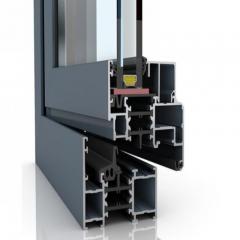
| Aluminum with Thermal Break | Moderate | Moderate | An insulating barrier (typically polyamide) between inner and outer frame sections disrupts heat flow significantly, reducing cold spots while retaining aluminum's strength and slim sightlines. |
If you're dealing with persistent windows condensation inside on the frame edges — not just the glass — the frame material is very likely a contributing factor. Aluminum frames without a thermal break are the most common offender, particularly in older commercial-style windows or budget installations.
The glass itself plays an equally important role, and modern glazing technologies have dramatically changed how warm the interior pane stays. Each of the following innovations works by keeping the inside surface of the glass closer to room temperature — pushing it above the dew point so condensation in glass simply doesn't have the conditions to form.
When these technologies are combined — low-E coating, gas fill, warm-edge spacers, and triple glazing — the interior glass surface stays warm enough to resist condensation even at relatively higher indoor humidity levels. It's a layered defense, and each component contributes.
You'll often see window performance described by two numbers: U-factor and R-value. They measure the same thing — thermal insulation — but from opposite directions.
U-factor measures how much heat passes through the entire window assembly (glass, frame, spacer, and all). A lower U-factor means less heat escapes, which means the interior glass surface stays warmer. For condensation resistance, this is the number that matters most. High-performance windows typically have U-factors between 0.20 and 0.30, while older single-pane windows may exceed 1.0.
R-value is simply the inverse of U-factor (R = 1/U) and measures resistance to heat flow. A higher R-value equals better insulation. Some manufacturers reference R-value in marketing materials, but the practical takeaway is the same: the better insulated your window is, the warmer the interior surface stays, and the less likely condensation on interior windows becomes.
Here's how this translates to real-world outcomes: imagine two homes on the same street, same humidity, same outdoor temperature. One has windows with a U-factor of 0.25; the other has older units rated at 0.65. The high-performance window might keep its interior glass at 62°F while the older window's glass drops to 45°F. At 40% indoor relative humidity, the dew point sits around 44°F — meaning the older window is dripping while the newer one stays completely dry.
That single example illustrates why window technology matters so much for condensation control. It's not about brand prestige — it's about physics. A window with better thermal performance gives you a wider comfort margin before moisture appears, effectively buying you tolerance for the natural humidity your household produces.
Of course, even the best-performing window can't defy physics if conditions are extreme enough. The temperature differential between indoors and outdoors shifts constantly with the seasons, and so does the condensation risk — following patterns that are remarkably predictable once you know where and when to look.
Those predictable patterns follow the calendar closely. Condensation on windows in winter behaves nothing like the moisture you find on exterior glass during a humid July morning — and the window above your stove follows different rules than the skylight in your bathroom ceiling. Understanding these seasonal and location-specific patterns is the difference between chasing symptoms and addressing the actual cause.
Winter is peak season for interior condensation, and three factors converge to make it nearly unavoidable in many homes.
First, the temperature differential between indoors and outdoors reaches its widest. When outdoor temperatures drop to 20°F or below while your thermostat holds steady at 70°F, the interior glass surface — even on double-glazed windows — can plummet into the low 40s or high 30s. That's well below the dew point for most occupied homes.
Second, ventilation drops dramatically. Nobody opens windows when it's freezing outside. Bathroom vents run less frequently, trickle vents get taped shut to save on heating, and the house effectively becomes a sealed container. Every pint of moisture from showers, cooking, and breathing stays trapped inside.
Third, heating systems circulate warm, moist air against the coldest surfaces in the room. Radiators placed beneath windows — a common design in many homes — push heated air directly upward across cold glass. This accelerates the temperature contrast right at the pane surface.
The overnight cycle makes things worse. As outdoor temperatures fall through the early morning hours, the glass gets progressively colder. Meanwhile, you're sleeping in a closed bedroom, exhaling moisture all night. By 6 a.m., conditions are ideal for condensation on the windows in winter to reach its heaviest — which is why so many people discover dripping glass the moment they open their curtains. As the BBC explains, "your room will be full of warm humid air but as the temperature drops overnight and the glass gets colder, a thin layer of air next to the glass window is also cooling down" until water condenses on the pane.
Condensation on windows during winter is manageable, but it requires active intervention — not just wiping the glass each morning. Reducing indoor humidity to the ranges discussed earlier (25–35% RH when it's below freezing outside) and maintaining at least some background ventilation even during cold spells are the most effective strategies.
If winter is the season of interior condensation, summer flips the script entirely. Warm weather condensation almost always appears on the outside of the glass — and it catches homeowners off guard because it seems counterintuitive.
Here's what happens: your air conditioning cools the home's interior, which in turn cools the interior glass surface. That cold glass chills the exterior pane through the window assembly. On a humid summer morning, the outdoor air's dew point may sit in the upper 60s or low 70s (°F). If the exterior glass surface drops below that temperature, exterior condensation on windows forms — a thin, even fog across the outside of the pane, identical to dew forming on grass.
Spring and autumn produce a similar effect through a different mechanism. During these shoulder seasons, clear nights allow the glass to radiate heat and cool rapidly, while morning humidity remains high. You'll often notice a heavy film of moisture on the exterior glass at sunrise that vanishes within an hour or two as the sun warms the surface. This is completely normal and, as discussed earlier, actually signals that your windows are well-insulated.
Interior condensation in summer is rare. If you do spot moisture on windows in winter-like patterns during warm months, something unusual is going on — a malfunctioning humidifier, a significant indoor water leak, an unusually large number of houseplants, or a crawl space venting moisture upward. Summer interior condensation deserves investigation rather than the seasonal shrug you'd give to a foggy January window.
Beyond seasonal shifts, certain rooms create their own condensation microclimates year-round. These high-risk locations generate or trap more moisture than the rest of the house, making their windows perpetually vulnerable.
Kitchen Windows
Bathroom Windows
Skylights
Basement Windows
In every one of these locations, the pattern is the same: condensation appears where high moisture meets cold glass in an enclosed space with limited airflow. The window is simply the messenger. What matters far more — and what most homeowners underestimate — is what happens when that moisture sits unaddressed day after day, slowly working its way into frames, sills, and the surrounding wall structure.
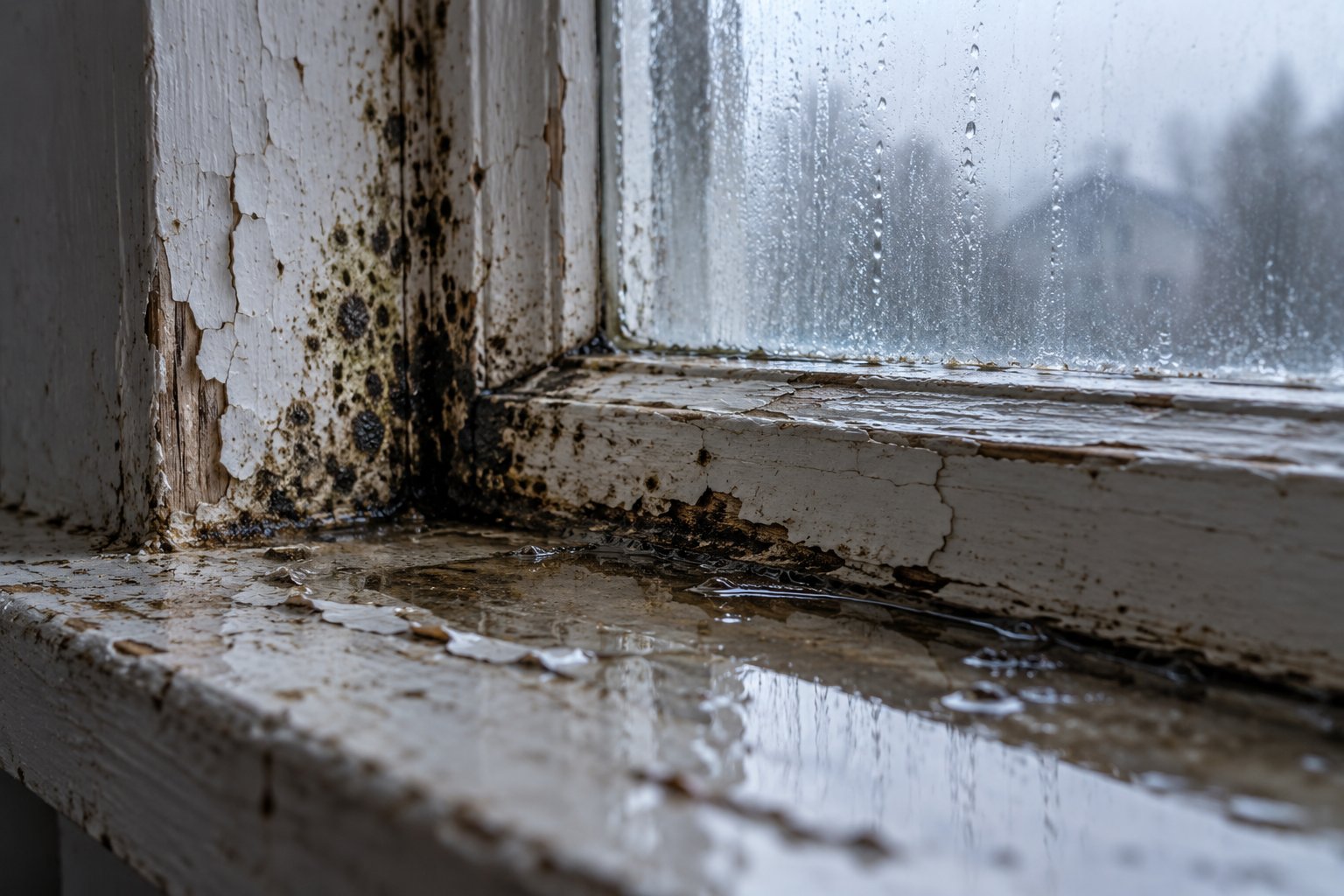
A little water on window glass each morning might not seem like a crisis. You wipe it up, move on with your day, and forget about it — until the black speckles appear along the frame edge, a faint musty smell settles into the room, or paint starts bubbling on the sill. Persistent moisture inside window areas doesn't just look bad. Left unaddressed, it quietly creates conditions that can affect your family's health and compromise the structural integrity of your home.
Mold needs only two things to colonize a surface: moisture and an organic food source. Window frames, sills, timber reveals, and even the dust that collects in corners provide that food source. When water on window surfaces pools or lingers day after day, it saturates surrounding materials and creates the damp microenvironment mold spores need to germinate and spread.
The growth often starts small — a thin line of dark spots in the corner of a frame or along a silicone seal. Without intervention, it can spread across the entire sill, onto surrounding walls, and into the plaster or drywall behind the frame where it becomes invisible but no less problematic.
The American Lung Association links indoor mold exposure to worsening asthma, coughing, wheezing, nasal congestion, sore throat, and sneezing. They also note that even without visible mold, dampness indoors can trigger upper and lower respiratory problems. Children, elderly individuals, and immunocompromised people may be especially vulnerable to these effects. Anyone — with or without existing allergies — can experience irritation of the eyes, skin, nose, throat, and lungs when exposed to airborne mold particles.
If you've been asking, "why are my windows wet on the inside" every morning for weeks or months, the mold condensation windows problem may already be developing behind the scenes. Consult a healthcare professional if you notice persistent respiratory symptoms that seem to worsen at home, and inspect your window frames closely for any signs of discoloration or musty odors.
Moisture on inside windows doesn't just threaten health — it attacks building materials. The damage typically progresses slowly enough to go unnoticed until repair costs escalate.
Persistent condensation is not just a cosmetic issue — it is a building-health warning sign that moisture is actively degrading your home's structure, air quality, and thermal performance.
Here's something most condensation guides never mention: your windows may already have a built-in drainage system designed to handle routine moisture — and it might be completely blocked.
Many window frames include weep holes, small slots or openings located at the bottom of the exterior frame. Their purpose is simple but essential: they provide a pathway for any water that enters the frame tracks or accumulates from condensation to drain safely to the outside, protecting the walls of your home from water damage.
The problem? Weep holes are tiny and easily overlooked. Over time, they become clogged with dirt, dust, dead insects, or even paint from maintenance work. Some are accidentally sealed shut with caulk during exterior resealing. When weep holes are blocked, trapped water has nowhere to go. It sits inside the frame, accelerating wood rot, seal degradation, and mold growth — even from condensation volumes that the window was originally engineered to handle safely.
Maintaining weep holes takes only minutes. The U.S. Department of Energy's Building America Solution Center recommends a straightforward process: locate the weep holes on the exterior bottom of your window frame, check for blockage by pouring a small amount of water into the interior track to see if it drains, and gently clear any debris using a pipe cleaner, straw brush, or thin wire. Recheck drainage after cleaning. Add this to your seasonal home maintenance routine — especially before winter, when moisture inside window frames peaks.
Mold, rot, and structural damage are all consequences of moisture that stays put. The common thread running through every one of these risks is stagnant, humid air that has no way out. Solving the condensation problem at its root — rather than simply managing the damage it causes — requires giving that trapped moisture a reliable exit path from your home.
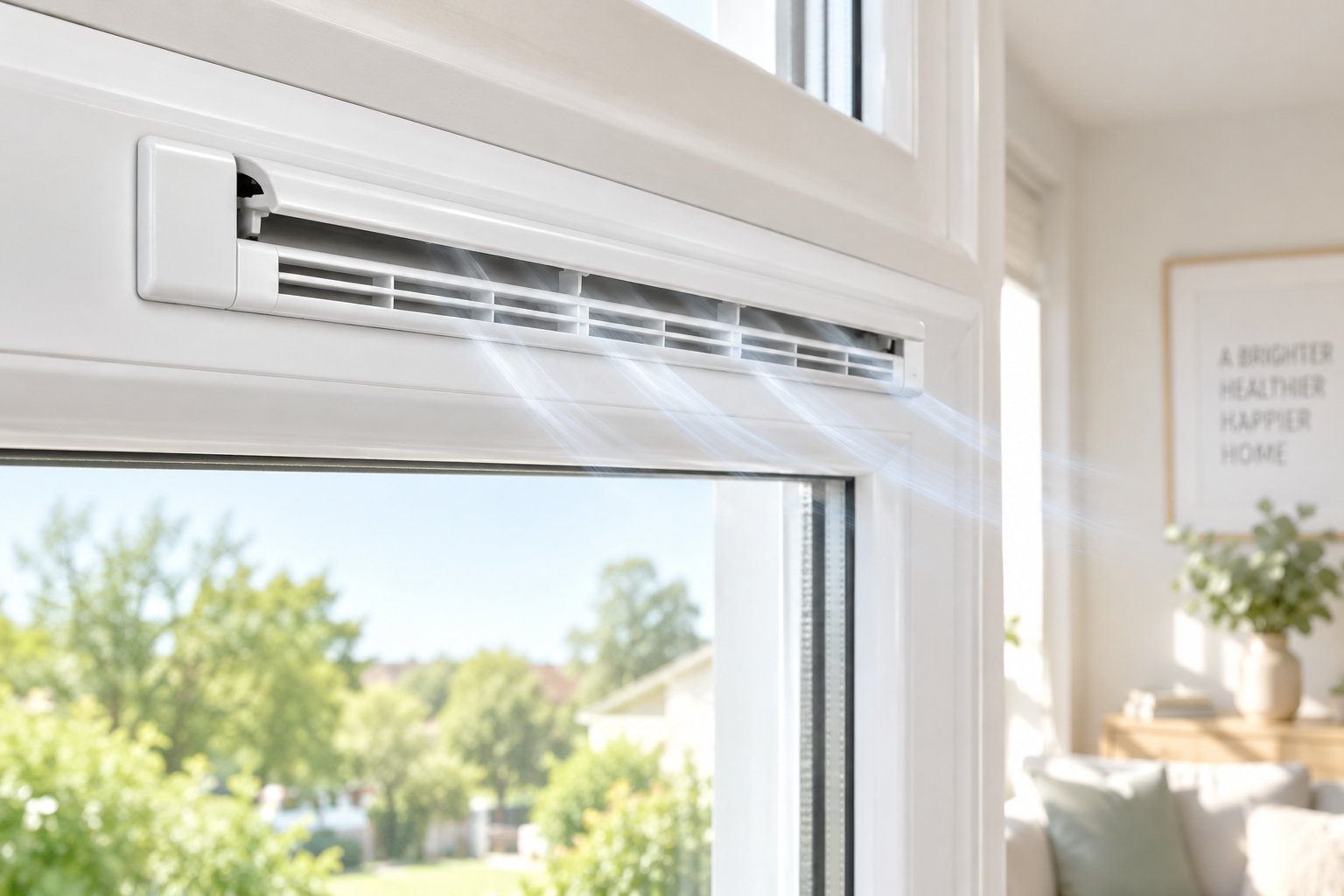
That reliable exit path already exists in many homes — it's just not being used effectively. Ventilation is the mechanism that carries moisture-laden air out and replaces it with drier air from outside. Every other condensation strategy — wiping glass, running dehumidifiers, keeping lids on pots — treats the symptom. Ventilation treats the cause. It's the single most effective long-term answer to how to prevent condensation on windows, and understanding why requires a quick look at how homes have changed over the past few decades.
Picture a house built in the 1950s. Its single-pane windows rattle in the wind. Drafts creep under doors, through electrical outlets, and around poorly fitted frames. Uncomfortable? Absolutely. Energy-efficient? Not remotely. But that constant, accidental air exchange did something valuable: it flushed indoor moisture out before it ever had the chance to accumulate on cold surfaces.
Fast forward to today. Modern construction standards rightly prioritize energy efficiency — tight building envelopes, sealed vapor barriers, insulated wall cavities, and high-performance glazing. These improvements slash heating bills and reduce carbon emissions. They also create a paradox that building scientists have been warning about for years: the better you seal a home, the more moisture it traps.
As Green & Healthy Maine HOMES explains, "a well-sealed home that fails to include mechanical ventilation will likely suffer from moisture issues and a buildup of unwanted contaminants, resulting in an unhealthy interior environment." The moisture from cooking, showering, breathing, and every other source discussed earlier no longer escapes through accidental gaps. It stays indoors, humidity climbs, and cold glass becomes a condensation magnet.
This is why figuring out how to avoid condensation on windows in winter isn't about choosing between comfort and ventilation — it's about replacing uncontrolled air leakage with controlled airflow that removes moisture without throwing your heating energy out the window.
Mechanical ventilation systems actively move air in and out of your home using fans and ductwork. They're the most powerful answer to how to stop moisture on windows in tightly sealed buildings, and they come in several forms depending on scale and budget.
Heat Recovery Ventilators (HRVs) are whole-house systems that continuously exhaust stale, moist indoor air while drawing in fresh outdoor air. The clever part? Inside the unit, outgoing warm air passes through a heat exchanger that transfers up to 70–90% of its thermal energy to the incoming cold air — so you get fresh, dry air without the massive heating penalty of simply opening a window in January. HRVs are ideal for cold climates where winter condensation is the primary concern.
Energy Recovery Ventilators (ERVs) work similarly but also transfer a portion of the moisture between the air streams. This makes them better suited for hot, humid climates or mixed-season regions where you want to prevent overly dry indoor air in winter while still managing summer humidity. For pure condensation control in cold weather, HRVs are generally preferred because they exhaust moisture more aggressively.
Extractor fans in kitchens and bathrooms represent the most common localized mechanical ventilation. A properly sized and correctly vented bathroom extractor fan removes the massive humidity spike from a hot shower before that moisture migrates to bedroom windows overnight. Kitchen range hoods vent cooking steam directly outdoors. These point-source solutions won't ventilate your entire home, but they intercept the biggest moisture bursts right where they happen — and they're far less expensive than whole-house systems.
The limitation of mechanical systems is cost and complexity. An HRV or ERV installation involves ductwork, electrical connections, and professional design. Extractor fans require exterior venting — not just recirculating filters that push humid air back into the room. For homeowners who need a simpler, always-on solution that works quietly in the background, there's a third option that's often overlooked entirely.
Trickle vents are small, slotted openings installed along the top of a window frame that allow a controlled stream of fresh outdoor air to enter even when the window is fully closed and locked. They're unobtrusive — most people don't even notice them — yet they provide continuous background ventilation that prevents the slow, overnight moisture buildup responsible for morning condensation on bedroom and living room windows.
The principle is straightforward. Fresh, typically drier outdoor air enters through the trickle vent at the top of the frame. It mixes with indoor air, slightly lowering the room's relative humidity. Meanwhile, stale, moist air escapes through exhaust points elsewhere in the home — bathroom fans, kitchen extractors, or natural stack effect through higher openings. This gentle, persistent airflow keeps indoor humidity from creeping past the condensation threshold without requiring you to leave a window open, sacrifice security, or lose significant heat.
Trickle vents are particularly effective in bedrooms, where a family member sleeps eight hours behind a closed door, exhaling moisture all night into a room that may have zero other ventilation. They're also valuable in living rooms and home offices — any space where people spend extended periods generating moisture through normal respiration. As Dekko Windows notes, modern living has made buildings more airtight, and "trickle vents offer a practical solution, providing consistent background ventilation without compromising security or thermal performance."
For homeowners exploring replacement windows that address condensation at the design stage — or for fabricators specifying vent components for new installations — products like Shengxin Aluminium's uPVC Window Trickle Vent illustrate how background ventilation can be integrated directly into both aluminium and uPVC window systems. This type of component is designed to fit within the frame profile, providing the continuous airflow that prevents humidity from accumulating to problematic levels — a practical, low-maintenance approach to how do you stop windows from condensation without relying on mechanical systems or occupant behavior.
The following list ranks the primary ventilation methods from simplest and most accessible to most complex, helping you match the right strategy to your situation:
Most homes benefit from a combination rather than a single approach — trickle vents for constant background airflow, extractor fans for high-moisture events, and a whole-house HRV or ERV if the budget and building allow it. The right combination depends on your home's age, construction type, climate, and how severe the condensation problem is.
Ventilation provides the exit path. Humidity control removes the excess. Window performance keeps the glass warm. These three elements — addressed together — are what actually resolve persistent condensation. The question now is how to put them into a practical, step-by-step plan that starts with diagnosis and ends with clear glass.
A practical plan starts with knowing exactly what you're dealing with. Jumping straight to solutions — buying a dehumidifier, replacing windows, sealing drafts — without first diagnosing the root cause wastes time and money. The following checklist walks you through the full condensation-management lifecycle, from initial investigation to targeted action to recognizing when professional expertise is the smartest move.
Before spending a dollar on any fix, work through these five diagnostic steps. Each one narrows the problem and points you toward the right solution.
With the diagnosis complete, match your findings to the most appropriate solution. The table below ranks the most effective strategies for how to stop condensation on windows, organized from lowest cost and effort to highest. Most homeowners find the answer in the first three or four rows — full window replacement is rarely necessary.
| Solution | Estimated Cost Level | Effort Level | Impact on Condensation |
|---|---|---|---|
| Install trickle vents or background ventilation — e.g., Shengxin Aluminium's uPVC Window Trickle Vent for aluminium and uPVC frames | Low | Low (fitted during window installation or as retrofit) | High — provides continuous, always-on airflow that prevents overnight humidity buildup without occupant action |
| Use a dehumidifier in the worst-affected room | Low to Medium | Low (plug in and maintain) | Moderate — effective for localized, short-term relief but limited in range and requires constant maintenance; does not address root ventilation issues |
| Improve extractor fan use (bathrooms and kitchens) | Low (behavioral change) to Medium (new fan installation) | Low to Medium | High — intercepts the largest moisture bursts at the source before they spread through the home |
| Open windows briefly for cross-ventilation (5–10 minutes) | Free | Low (requires daily habit) | Moderate — immediately flushes humid air but impractical in extreme cold, rain, or for security-sensitive situations |
| Upgrade to higher-performance glazing (low-E, argon fill, warm-edge spacers) | High | High (professional installation) | High — keeps interior glass surface warmer, raising it above the dew point and dramatically reducing condensation susceptibility |
| Install an HRV or ERV whole-house ventilation system | High | High (professional design and installation, ductwork required) | Very High — continuous balanced air exchange with 70–90% heat recovery; the most comprehensive solution for tightly sealed homes |
A common question is whether a condensation windows dehumidifier approach alone is enough. In practice, portable dehumidifiers provide temporary, single-room relief — useful for drying out a problem area quickly — but they don't address the underlying lack of fresh air exchange that keeps humidity elevated in the first place. As Vortice UK notes, dehumidifiers have limited coverage, high energy consumption, and require constant tank emptying, making them a poor substitute for proper ventilation. For persistent issues, pair a dehumidifier with at least one ventilation improvement — trickle vents, extractor fans, or both — to tackle the problem from two directions simultaneously. That combination is how to get rid of condensation inside windows in a way that actually lasts.
Wondering how to stop condensation on windows overnight specifically? The overnight pattern — closed doors, sleeping occupants exhaling moisture, falling outdoor temperatures — responds best to always-on solutions that don't depend on someone being awake to act. Trickle vents and properly vented continuous-extraction bathroom fans are the two most effective tools for this scenario, precisely because they operate around the clock without intervention.
Most condensation is a DIY-solvable problem. A hygrometer, better ventilation habits, and basic window maintenance resolve the majority of cases. There are situations, however, where professional assessment is the right call:
Knowing how to fix condensation on windows isn't about finding one magic solution — it's about matching the right combination of strategies to your specific diagnosis. Reduce the moisture going into your air. Give that moisture a reliable way out through ventilation. Keep your glass surface warm enough to stay above the dew point. Maintain the drainage and seals your windows already have.
Those four principles — humidity control, ventilation, thermal performance, and maintenance — cover every condensation scenario this article has explored, from a foggy bedroom window on a January morning to a failed seal on a fifteen-year-old double-glazed unit. The physics hasn't changed since that cold glass of water on a summer day. What changes is whether you let the moisture accumulate — or give it somewhere else to go.
Morning interior condensation forms because overnight temperatures drop the glass surface below the dew point while you sleep in a closed room exhaling moisture. A family of four can produce several pints of water vapor overnight through breathing alone. With windows shut and no active ventilation, indoor humidity climbs steadily. By dawn the glass is at its coldest and the air is at its most humid, creating peak condensation conditions. Keeping a trickle vent open or running a low-level extractor fan overnight breaks this cycle by allowing moist air to escape continuously.
Exterior condensation is actually a positive indicator of strong thermal performance. It means the outer pane is so well insulated from indoor heat that it stays cold enough for outdoor moisture to condense on it, much like morning dew on grass. This pattern is most common during spring and autumn when nighttime temperatures dip while outdoor humidity remains high. The moisture evaporates naturally as the sun warms the glass, and no corrective action is needed.
A portable dehumidifier offers temporary, single-room relief by pulling excess moisture from the air, but it does not solve the underlying ventilation deficit that keeps humidity elevated. Dehumidifiers have limited coverage, consume energy continuously, and require regular tank emptying. For lasting results, pair a dehumidifier with a ventilation improvement such as trickle vents integrated into your window frames or properly vented extractor fans that physically exchange stale indoor air for drier outdoor air.
A failed insulated glass unit seal produces a foggy haze trapped between the two or three panes that you cannot wipe away from either side. Early on, a built-in desiccant absorbs infiltrating moisture, so failure can go unnoticed for months. Once the desiccant saturates, persistent fogging appears. You may also notice granular material near the bottom edge of the glass from deteriorated spacer bars. This type of condensation requires an IGU replacement rather than humidity or ventilation adjustments, though the existing frame can usually be retained if it remains structurally sound.
The target depends on outdoor temperature. When it is above 50 degrees Fahrenheit, aim for 40 to 45 percent relative humidity indoors. Between 32 and 50 degrees Fahrenheit, reduce to 35 to 40 percent. Below freezing down to 14 degrees Fahrenheit, keep it at 25 to 35 percent, and in extreme cold below 14 degrees Fahrenheit, 20 to 25 percent is recommended. An inexpensive digital hygrometer placed on an interior wall in the worst-affected room gives you an accurate baseline reading within about 30 minutes.



 online service
 0086 136 3563 2360
 sales@sxalu.com
 +86 136 3563 2360
 English
 français
 Deutsch
 русский
 español
 português
 العربية
 ไทย
ไทย Việt
Việt Українська