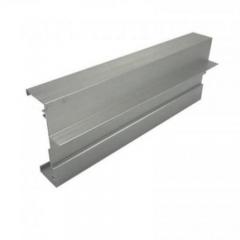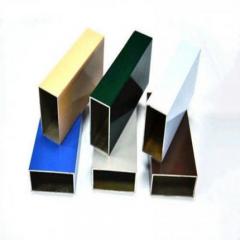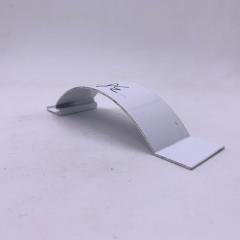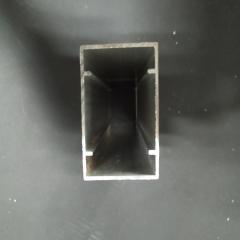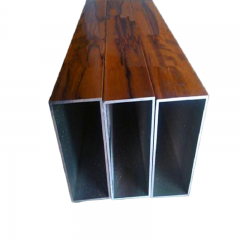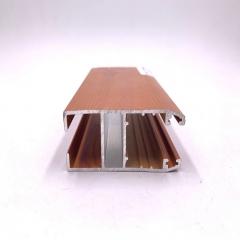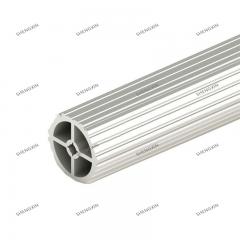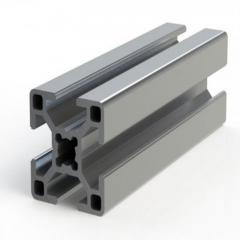
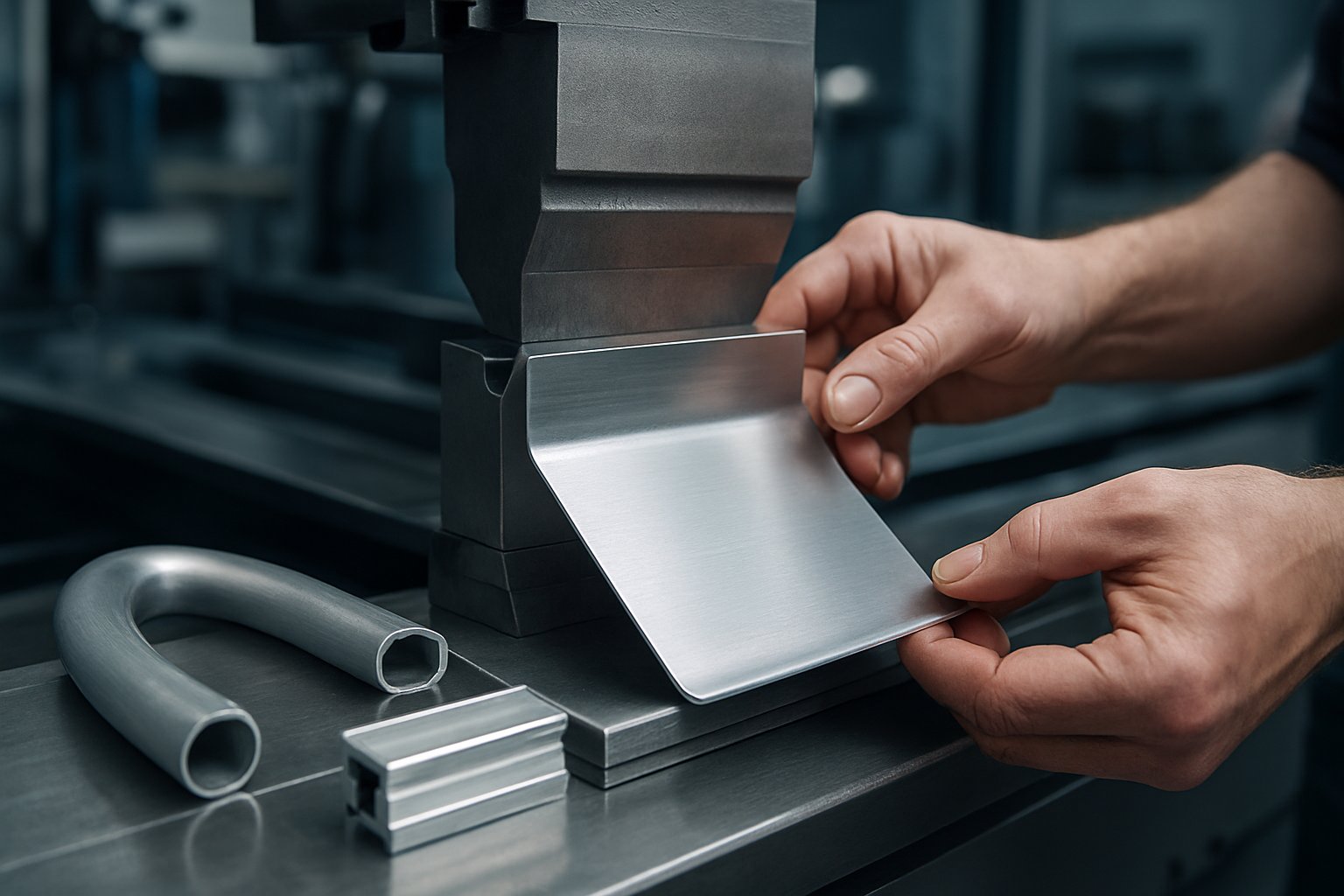
Aluminum bending is the controlled forming of aluminum into an angle or curve by applying force without breaking the part. It is not one single method, but a group of forming processes used on sheet, plate, tube, pipe, and extrusions.
If you have ever asked, can you bend aluminum, the short answer is yes. The better answer is that results depend on the material, the temper, and the way the part is being formed. A practical ALEKVS guide describes the process as shaping aluminum with external force while preserving structural integrity. That sounds straightforward, but aluminum can react very differently from steel under the same basic bend. This article is designed to work as both an educational overview and a repeatable shop-floor reference.
In fabrication, aluminum bending covers more than one machine or setup. Flat stock may be formed with a press brake. Plate can be rolled. Tube and pipe may be shaped with rotary, push, or compression methods. Extrusions often need profile-specific support to keep their cross-section from distorting. So when someone asks how to bend aluminum, the first real question is what form the material takes and what final geometry the part must hold.
Compared with steel, aluminum is generally lighter and more ductile, which can make it easier to form. It also work-hardens quickly, so repeated or overly aggressive forming can raise the chance of cracking. Springback is another major issue. In sheet forming research, springback is treated as a core challenge because the part relaxes after the load is removed, changing the final angle. Guidance from 1CUTFAB also notes that aluminum often shows more noticeable springback than beginners expect.
Before any bend, review the variables that decide whether the part forms cleanly or starts to fail:
That mix of variables explains why good results rarely come from force alone. Material choice sits at the center of the whole process, which is why alloy and temper deserve a closer look before any radius or tooling decision is made.
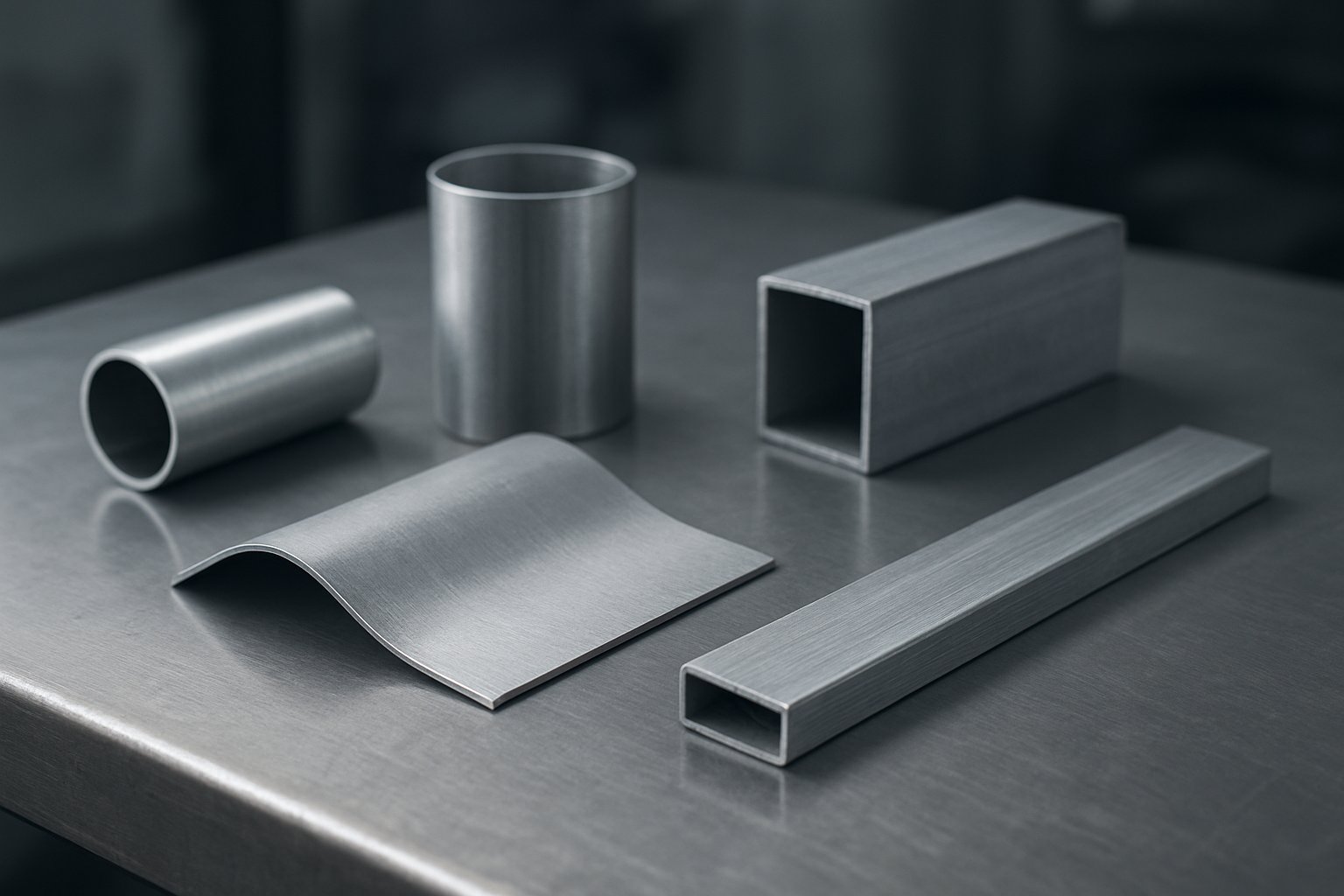
Material choice is where many bending problems quietly begin. Two parts can share the same thickness, yet one folds cleanly while the other cracks or springs back harder than expected. If you are trying to choose the best aluminum for bending, start with alloy family first, then narrow the decision by temper.
Guidance from Hydro places the 3xxx and 5xxx series among the most bend-friendly families, with some 6xxx alloys workable in the right condition. In that group, 3003 is often treated as a top general-purpose choice because it offers very good cold workability and high elongation. 5052 is close behind, adding more strength and strong corrosion performance. By contrast, 6061 is often selected for structural value, but it is less forgiving in hard tempers. Bayou specifically notes that 5052-H32 is usually preferred over 6061-T6 for custom sheet metal because it forms more easily.
That is why 3003 aluminum bending comes up so often in shop conversations. It sits in a useful middle ground: easier to form than many strength-first grades, but still practical for everyday fabricated parts.
Radius notes below are example minimum inside radii for 90 degree cold forming at 1/8 in. thickness, expressed as multiples of thickness t, based on Cumberland data republished from the Aluminum Association.
| Alloy | Common tempers to evaluate | Relative bendability | Typical applications | Radius note | Key cautions |
|---|---|---|---|---|---|
| 1100 | Soft tempers, often O | Very high | Light-duty formed parts, trim, simple shapes | Use as a formability-first screening option | Low strength, so it is rarely the first pick for structural demands |
| 3003 | O, H12, H14, H16 | Excellent | General sheet metal and formed parts | H12: 1/2t, H14: 1t, H16: 1.5t | Harder work-hardened tempers need more radius than softer ones |
| 5052 | O, H32, H34 | Very good to excellent | Fuel tanks, automotive parts, marine work | H32: 1.5t, H34: 2t | A strong sheet choice, but bendability drops as temper gets harder |
| 6061 | Annealed, T4, T6 | Moderate in soft temper, poor in T6 | Structural applications where strength-to-weight matters | T6: 2.5t | Higher cracking risk and more setup sensitivity in hard tempers |
| 6063 | T4, T6 and other softer forming conditions | Moderate to good | Extruded profiles and appearance-sensitive sections | No specific value in the cited sources | Good option in some cases, but harder tempers still reduce formability |
| 7075 | T4 if forming is unavoidable, harder tempers are difficult | Low in strength tempers | Strength-driven parts where bending is secondary | No specific value in the cited sources | Usually treated as a strength-first, not bend-first, choice |
Temper can change the same alloy from manageable to frustrating. Hydro notes that non-heat-treatable 3xxx and 5xxx alloys are easiest to bend in O temper. For heat-treatable 6xxx and 7xxx alloys, T4 is generally preferred when forming is possible because the yield strength is lower. T6 is the hardest to bend. That is the heart of the difference between bending 6061 aluminum in a softer condition and bending 6061 T6 aluminum in a production setting.
There is a catch. T4 can show springback variation over time because of natural aging. T6 is tougher to form, but it avoids that same variation issue. In real shop planning, that means temper affects not only crack risk, but also consistency.
For tight bends and general sheet work, 3003 or 5052 is often the safer starting point. If the part needs a better balance of strength, corrosion resistance, and formability, 5052 is a common choice. If the design is more structural, 6061 may still be the right answer, but it usually wants a larger radius and more caution. 6063 fits many profile-based jobs, while 7075 belongs in a much narrower, strength-driven lane.
So the best aluminum for bending is rarely a universal winner. It is the alloy and temper pair that matches the bend radius, part function, and risk tolerance of the job. Even strong 3003 aluminum bending performance can be undermined when the planned inside radius is too tight, which is exactly where radius and grain direction start to matter most.
Alloy and temper narrow your options, but crack risk usually shows up at one line on the drawing: the inside radius. A bend that looks small on paper can stretch the outer face of the metal much harder than expected. That is why radius planning is not just a design detail. It is an early screening step for whether the part is likely to form cleanly.
During a bend, the inside of the material compresses and the outside stretches. Make the inside bend radius too tight, and that outside surface sees more tensile strain. Push it far enough, and cracking starts on the outer radius. Published minimums from Cumberland, based on Aluminum Association data for 90 degree cold forming, show the same pattern seen in the shop: softer tempers tolerate tighter bends, while harder tempers need more room.
The quick reference below works as an aluminum bend radius chart for screening common sheet and plate conditions. Values are minimum inside radii expressed as multiples of thickness t.
| Alloy | Temper | Up to 1/16 in. | 1/8 to 1/4 in. | 3/8 to 1/2 in. | Planning note |
|---|---|---|---|---|---|
| 3003 | H12 | 0t | 1/2t to 1t | 1.5t to 2t | Very formable, but radius still grows with thickness |
| 3003 | H14 | 0t | 1t to 1.5t | 2t to 2.5t | Common choice when tighter bends are needed |
| 5052 | H32 | 0t to 1t | 1.5t | 1.5t to 2t | Good balance of strength and bendability |
| 5454 | O | 0t to 1t | 1t to 1.5t | 1.5t to 2t | Soft temper helps reduce cracking risk |
| 6061 | T6 | 1t to 1.5t | 2.5t to 3.5t | 4.5t to 5t | Hard temper needs much more radius |
If you are checking bend radius 6061 T6 aluminum, that last row is the warning sign. A 0t entry elsewhere does not mean zero risk, either. It only reflects the published minimum for that condition, not a promise that every tool setup or cosmetic surface will tolerate a sharp bend.
Radius is only part of the picture. Sheet also has a rolling grain, and The Fabricator notes that bending with the grain means the bend line runs parallel to that grain direction. That orientation is more prone to cracking, especially at small radii. Bending across the grain, where the bend line is perpendicular to the grain, is usually stronger and less likely to split, though it can take more force.
For many sheet jobs, cold bending aluminum is the normal starting point, and the radius data above is built around that assumption. The bigger mistake is treating heating aluminum to bend as a universal shortcut. Guidance from Hydro and The Fabricator points to a more disciplined approach: some heat-treatable alloys form more easily in a softer condition, such as annealed temper or T4, and may be brought to a harder condition later if the specification allows it.
That means heat is not the first answer to a bad bend. Material condition, radius, and grain direction usually deserve attention first. Even when those choices prevent cracking, another variable still shapes the final part: how much the metal springs back and how the flat pattern should be calculated before the brake ever closes.
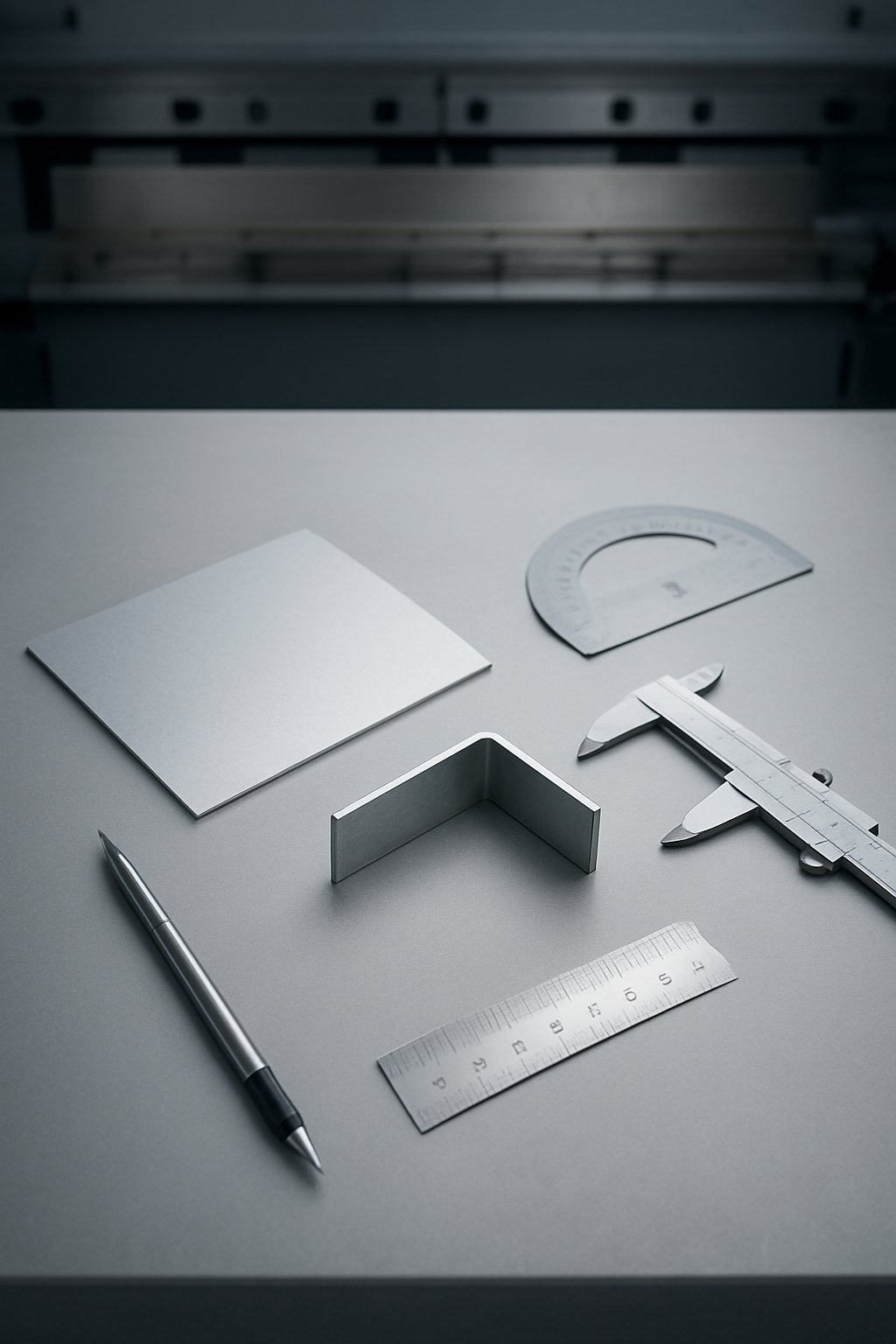
A safe radius does not guarantee an accurate part. In bending aluminum, many problems appear only after the bend looks clean: the angle opens up, the legs measure long, or the blank was cut wrong before the press brake ever touched it. If your question is how do you bend aluminum with repeatable accuracy, the answer starts on the drawing and in the flat pattern, not at full tonnage.
Springback is the amount a part relaxes after forming pressure is removed. Aluminum often springs back more than beginners expect, which means the angle under load is not always the angle you keep after the tooling releases. That is why operators often need to overbend slightly, adjust depth, or fine-tune the program after a first sample.
Tooling and forming method matter just as much as the material. In air forming, the inside radius is created as a percentage of the die opening rather than being forced only by the punch nose. The guidance in The Fabricator stresses that calculations change with material type, forming method, and the relationship between inside radius and thickness. That is a big reason one proven setup cannot simply be copied from steel or from a different aluminum job.
Springback compensation is material and tool dependent, not a fixed universal rule.
When you bend aluminum, the inside of the bend compresses and the outside expands. Between them sits the neutral axis, the zone that does not change length. During forming, that neutral axis shifts toward the inside surface. That shift is why the part elongates through the bend and why flat size must be calculated instead of guessed.
Bend allowance is the length of material used in the bend, measured along that neutral axis. Bend deduction is the value subtracted from the outside dimensions to find the flat blank. K-factor describes where the neutral axis sits within the thickness. The same bend calculation basics reference shows a common bend allowance formula:
BA = [(0.017453 x inside radius) + (0.0078 x material thickness)] x complementary bend angle
That version uses a common default K-factor of 0.446, but it is only a starting point. The Fabricator also notes that K-factor values often fall between 0.3 and 0.5, and they change with the forming conditions. Bend deduction then follows a simple relationship: BD = (OSSB x 2) - BA, where OSSB means outside setback. In plain language, BA helps tell you how much material lives in the bend, while BD helps you back into the flat size from outside dimensions.
Anyone asking how do I bend aluminum more accurately usually finds the same answer: good parts are planned, not rescued. And because flat-pattern numbers depend on how the radius is actually created, process choice becomes the next factor that can make or break the job.
A clean flat pattern still depends on the right forming method. The DEK guide and Wiley extrusion guide both point to the same practical rule: geometry decides the process. A general aluminum bender is rarely universal, because flat sheet, round tube, square tube, pipe, and extrusions do not react the same way under load.
An aluminum bending brake, sometimes called an aluminum brake bender, is the right choice when the material is sheet or plate and the bend is a straight line rather than a continuous curve. In press brake work, the part is formed between a punch and die, which makes this method well suited for accurate angles, flanges, channels, and repeatable linear bends. DEK notes that press brake bending is fast and produces clean bends, especially on larger or thicker flat stock.
It is not the right answer for every shape. A sheet-focused setup does not wrap material around a radius the way tube tooling does, and direct tool contact can matter on finish-sensitive parts if the surface needs to stay mark-free.
| Method | Suitable material forms | Typical strengths | Common limitations | Finish sensitivity | Best curvature type |
|---|---|---|---|---|---|
| Press brake bending | Sheet and plate | Accurate, clean, straight-line bends | Not suited to continuous curves or hollow sections | Moderate to high | Angles and linear bends |
| Roll bending | Sheet, plate, and some larger sections | Consistent large-radius forming, good for broad curves | Less suitable for very small or very thin work | Moderate | Large radii and sweeping arcs |
| Rotary draw bending | Tube, pipe, and some section shapes | Tight radii, accurate angles, smooth transitions | Specialized tooling and setup | Moderate | Tight, fixed-angle bends |
| Mandrel-supported tube bending | Thin-wall tube and pipe | Better shape retention inside hollow sections | More setup complexity and tool matching | Moderate | Tighter bends with added internal support |
| Stretch forming | Extrusions and long profiles | Good repeatability, controlled length, low surface marking | Best for large radii, not ideal for small or thin pieces | Low | Large-radius curves |
| Profile bending | Extrusions, channels, and shaped sections | Matches curved architectural and structural profiles | Shape-specific distortion risk, especially in asymmetric or hollow sections | Varies by support method | Arcs, rings, and long radiused forms |
For aluminum tube bending, the tooling changes completely. An aluminum tube bender wraps the section around a die instead of pressing a straight line into flat stock. DEK describes rotary draw bending as a method that can produce tight radii and accurate angles, while Wiley explains that hollow sections tend to buckle inward without support. That is why mandrel-assisted setups are often chosen when wall support matters and shape retention is more important than speed alone.
Roll bending belongs in a different lane. It is better for larger radii, sweeping curves, and even circular forms. So an aluminum bending machine built for sheet is not interchangeable with an aluminum tube bender, even if both are described casually as a bender on the shop floor.
Extrusions bring another layer of difficulty because the section itself has to survive the bend. Wiley notes that symmetrical profiles are easier to form when the symmetry lines up with the bend, while asymmetric profiles are much harder to bend without distortion. Hollow extrusions can also buckle inward unless the shape is supported or designed with features that resist collapse.
That is where aluminum profile bending and stretch forming stand out. Stretch forming is useful for large-radius work with good repeatability and little surface marking. Profile bending, including roller-based methods, is often the better fit for architectural curves, rings, and long sweeping radii in shaped sections.
Method choice narrows the tooling, but sheet work still lives or dies by setup discipline. On a brake, small decisions about tool selection, surface protection, and the first test bend usually decide whether the run becomes repeatable or frustrating.
That setup discipline matters most when the job is flat stock. Whether you are bending aluminum sheet or bending aluminum sheet metal for brackets, covers, or enclosures, repeatable results come from a written routine. If you are searching for how to bend aluminum sheet, start before the ram moves. Good sheet work is built on material checks, tool selection, surface protection, and one controlled test bend, not on forcing the part and hoping it lands on size.
Basic press brake practice still applies here. Guidance from METMAC stresses inspecting tooling, confirming alignment, and securing the workpiece properly. Aluminum just punishes small setup mistakes faster, especially when the surface has to stay clean or the bend radius is tight.
When bending aluminum with a brake, tooling controls more than angle. It also affects inside radius, springback, and surface condition. Aluminum-specific die guidance from ADH recommends a punch radius that meets or exceeds the material's minimum inside bend radius. The same source treats V-die opening as an alloy-driven choice, not a fixed rule. For general press brake work, TZR gives a common starting point of about 8 to 10 times sheet thickness, while more aluminum-focused die selection often narrows to roughly 6T for softer alloys and 8T to 10T for harder grades such as 6061-T6. Those are starting references, not universal answers.
The first part tells you whether the setup is real or just close. METMAC recommends visual inspection and checking the bend with a gauge or protractor. That simple step is what separates disciplined work from trial and error.
That workflow gives flat stock a repeatable path, whether you are making one enclosure or production bending aluminum sheets all day. Once the material stops being flat, though, the setup changes with it. Tubes, pipe, and profiles bring distortion problems that sheet metal never sees, which is why the next part of this guide treats them as their own category.
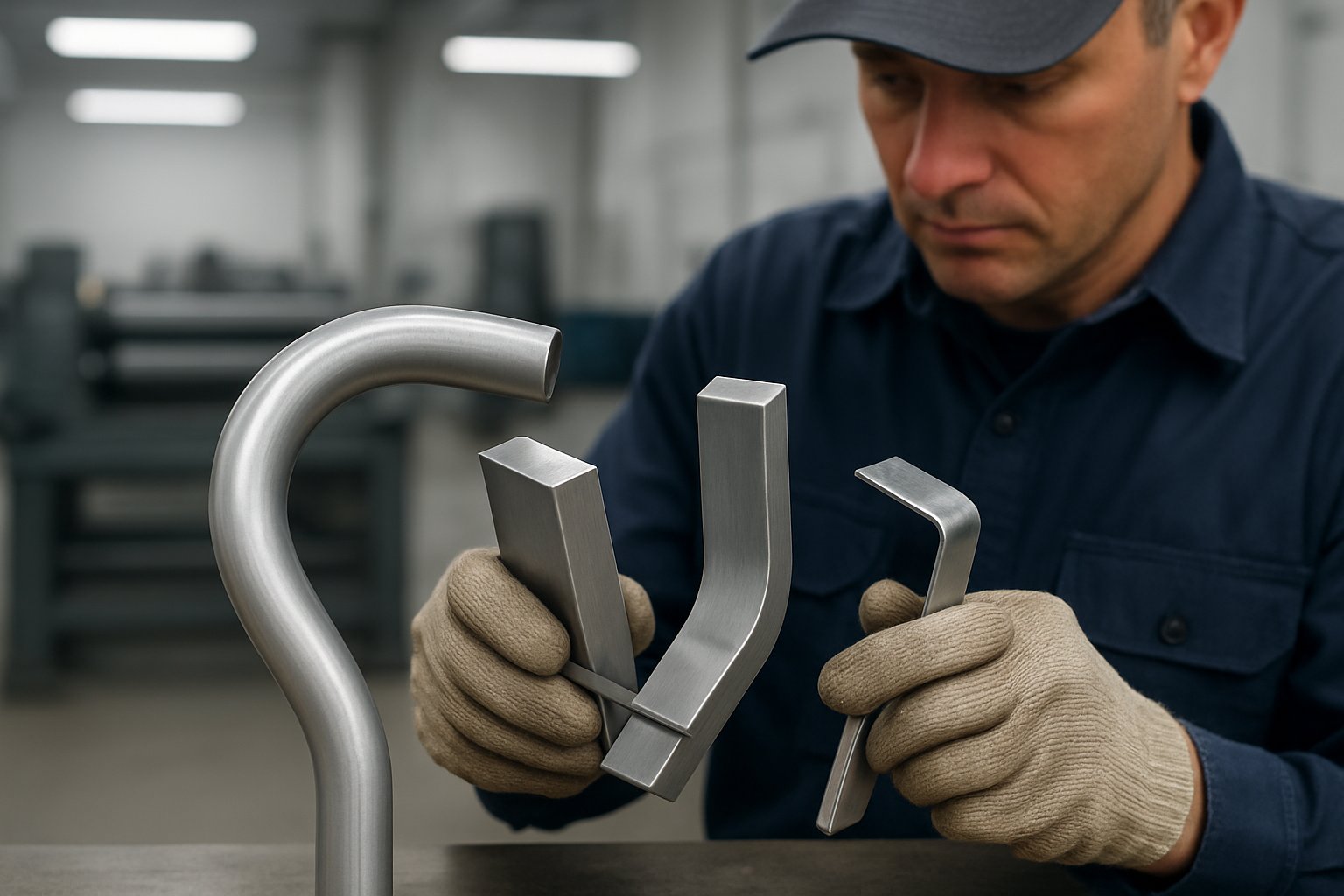
Flat blanks reward angle control. Hollow forms ask for something different: they need the cross-section to survive the bend. That is why bending aluminum tubing, pipe, or extrusions cannot be set up like sheet work. Round sections can ovalize, square sections can collapse at the corners, and profiles can twist because one side of the shape resists the bend differently than the other. For fabricators and sourcing teams alike, this is also why a bent tube quote is judged by more than angle alone.
In extrusion bending, The Fabricator notes that wall thickness, symmetry, and temper all affect whether a section bends cleanly. Many aluminum extrusions are 6000-series alloys, and harder tempers such as T6 are less forgiving than softer forming conditions. On hollow sections, geometry matters just as much as alloy. Square internal corners can become stress points, and inadequate wall thickness can let the inside face go concave under load.
If the practical question is, how do you bend aluminum tubing without flattening it, support is the heart of the answer. In rotary draw bending, a full tool set can include the bend die, clamp die, pressure die, wiper die, and mandrel. Guidance on mandrel setup explains that the mandrel supports the tube through the bend radius and helps hold it in the bend die groove. The same source warns that poor tooling setup can lead to wrinkles, kinks, buckling, bulging, and tube collapse.
Inspection on hollow forms is part of setup, not just final quality control. Some customers may accept a hidden tube with modest distortion, while a visible or fit-critical part may require a much cleaner section. That is why bending aluminum tubing is quoted and inspected differently from bending a simple flat flange.
Those visual clues matter because hollow aluminum rarely fails in only one way. A wrinkle, a flat spot, a twist, or a tool mark usually points to a specific cause, and reading those symptoms correctly is what turns setup knowledge into reliable troubleshooting.
Those visual clues at the machine only help if you know how to read them. A crack, wrinkle, flat spot, or drifting angle is usually the final symptom of a few upstream choices going wrong at once. Defect patterns summarized by Inductaflex and root-cause guidance from The Fabricator point to the same practical rule: work backward from what you see on the part, not from a guess about force.
Cracking usually starts on the outside radius because that surface is being stretched. If the inside bend radius is too tight for the alloy and temper, the outer fibers can exceed the material's ductility and split. Hard tempers, unfavorable grain direction, inconsistent stock, and overly aggressive forming all raise the risk. When bending aluminum plate or sheet on a brake, cracks that appear along with heavy die marks can also suggest excessive pressure, sharp tooling, or a setup that is damaging the material instead of guiding it.
On hollow sections, the same logic applies. During bending aluminum tube or bending aluminum pipe, outer-wall cracking often points to too much tensile strain from a tight radius, poor support, or worn tooling.
Wrinkling is the opposite side of the strain story. The inside radius is in compression, so the wall can buckle into ripples if the section is thin, the bend is tight, or the support is weak. Tube-focused defect guidance from Heat Exchange highlights the usual suspects: inadequate mandrel or wiper support, poor lubrication, mismatched tooling, and bend severity that is simply too aggressive for the section.
Flattening and ovality show up when round sections lose shape under unbalanced forces. With bending square aluminum tubing, distortion often appears as corner collapse or a concave face. Twist is common in profiles and asymmetrical sections when tooling is misaligned or one side of the shape flows differently from the other.
| Symptom | Likely causes | Practical corrections |
|---|---|---|
| Cracking on the outside radius | Radius too tight, hard temper, bend line with the grain, excessive outer-wall stretch, inconsistent material | Increase inside radius, confirm alloy and temper, recheck grain direction, inspect stock quality, reduce bend severity |
| Wrinkling on the inside radius | Too much compression, thin wall, insufficient mandrel or wiper support, poor lubrication | Improve support, verify tool position, use appropriate lubrication, consider a larger radius or softer condition |
| Tube flattening or ovality | Inadequate internal support, poor die fit, thin wall, excessive pressure | Match tooling to the section, add mandrel or plug support if needed, reduce bend severity, run a test bend |
| Square section distortion | Unsupported flats and corners, tight radius, wall-thickness variation, tooling mismatch | Add section-specific support, ease the radius where possible, verify section consistency, validate on a sample piece |
| Twist in tube or profile | Tool misalignment, asymmetric profile, uneven pressure or feed | Realign tooling, restrain the section correctly, adjust in small increments, consider staged forming |
| Tool marks or surface scratches | Dirty or worn tooling, excessive pressure, lack of surface protection, galling | Clean and inspect tools, reduce unnecessary pressure, add film or non-marring protection, protect cosmetic faces |
| Inconsistent final angle | Springback variation, material inconsistency, unstable setup, skipped first-article validation | Confirm material and thickness, standardize tooling, make a controlled test bend, correct angle gradually and document the result |
Surface defects and angle defects need different thinking. Marks usually come from contact problems such as dirty tooling, galling, or pressure that is higher than the job requires. Angle drift is more about repeatability. Springback changes with alloy, temper, thickness, radius, and tool condition, so a part that looks fine on one setup can open up on the next if the inputs shift even slightly.
Change one variable at a time. If radius, pressure, tooling, and support all move together, the real cause stays hidden.
That troubleshooting mindset does more than save scrap. It also shows where the problem is no longer a simple setup issue but a capability gap. When tight radii, cosmetic surfaces, complex profiles, and repeatability all need to land at once, many teams decide the smarter move is to bring in a specialist rather than keep chasing defects in-house.

That capability gap is where outsourcing starts to make sense. If repeated test bends, surface damage, or section distortion are eating time and material, outside support can cost less than more scrap. It matters even more when a part needs custom aluminum bending across several operations, not just one bend at one machine.
Specialist help is usually worth considering when the job involves hollow sections, architectural profiles, tight cosmetic standards, or bend-sensitive extrusions that need more than basic shop tooling. For buyers searching aluminum bending near me, location can help with freight and communication, but proximity alone is not a quality standard. Alubend points to expertise, service range, equipment, quality control, material knowledge, and project management as core selection factors. SinoExtruder also emphasizes asking about alloy compatibility, tolerances, tooling charges, inspection reports, and springback control before placing an order.
The best aluminum bending suppliers behave like manufacturing partners, not quote-only vendors. Ask what alloys and tempers they form most often, what shapes they support, and whether they validate springback with sample parts. Lead time should be discussed in stages, including tooling, production, finishing, and packing. When comparing aluminum bending services, a low price can still become expensive if inspection, rework policy, or surface protection is unclear.
Some parts begin as profiles, then move through machining, finishing, and controlled forming. For that mix, an integrated supplier can reduce handoffs between vendors. Shengxin Aluminium is one resource worth reviewing for extrusion-based work because its published capabilities include more than 30 years of manufacturing experience, 35 extrusion machines, precision CNC processing, and multiple anodizing and powder coating lines.
| Supplier type or resource | Best fit | What to verify | Practical note |
|---|---|---|---|
| Shengxin Aluminium | Extrusion-based projects that also need CNC work and finishing | Profile alloy and temper, bend sequence, sample approval, finish timing | Most relevant when one source handling profile processing end to end reduces risk |
| Local brake-focused shop | Straightforward sheet parts and quick local turnaround | Tooling condition, cosmetic protection, first-article process | Often a better fit than a large supplier for simple formed sheet work |
| Tube or profile bending specialist | Round tube, square tube, and distortion-sensitive sections | Support tooling, mandrel use, section distortion control | Useful when geometry control matters more than basic proximity |
If the job is only a simple local bend, a nearby shop may be enough. If it combines extrusion supply, secondary machining, surface finish control, and custom aluminum bending, integrated capability becomes much more valuable. The right partner is the one whose actual process matches the part on the print.
For many sheet metal jobs, 3003 and 5052 are the usual starting points because they generally form more easily than strength-first grades. 3003 is often chosen for tighter bends and general fabrication, while 5052 offers a stronger balance of bendability and service performance. 6061 can still be the right material for structural parts, but it usually needs a larger bend radius and closer process control, especially in harder tempers.
Yes, but it is far less forgiving than softer alloys or tempers. Success usually depends on using a larger inside radius, paying attention to grain direction, making a test bend, and avoiding overly sharp tooling. If the design allows it, forming 6061 in a softer condition and then moving to the final required state can be a safer route than forcing a tight bend in T6.
Not always. Many aluminum parts are cold formed successfully when the alloy, temper, radius, and tooling are matched correctly. Heat should be treated as a material-specific process choice, not a default fix, because some alloys respond better to being bent in a softer temper rather than simply being heated at the machine.
Start before the first stroke. Confirm the alloy, temper, actual thickness, grain direction, target radius, and surface requirements, then choose tooling that supports the planned bend instead of sharpening it too much. A controlled sample bend is the key step because it reveals real springback, lets you fine-tune angle correction, and helps you lock in a repeatable setup for production.
Outsourcing makes sense when the part includes hollow sections, cosmetic surfaces, asymmetrical profiles, or multiple linked processes such as extrusion, machining, and finishing. Tube and profile jobs often need specialized support methods to limit flattening, wrinkling, or twist, so a capable supplier can reduce scrap and shorten development time. For extrusion-based projects that also need CNC work and surface finishing, an integrated resource such as Shengxin Aluminium may be worth reviewing because its published capabilities combine profile processing, machining, anodizing, and powder coating in one supply chain.



 online service
 0086 136 3563 2360
 sales@sxalu.com
 +86 136 3563 2360
 English
 français
 Deutsch
 русский
 español
 português
 العربية
 ไทย
ไทย Việt
Việt Українська