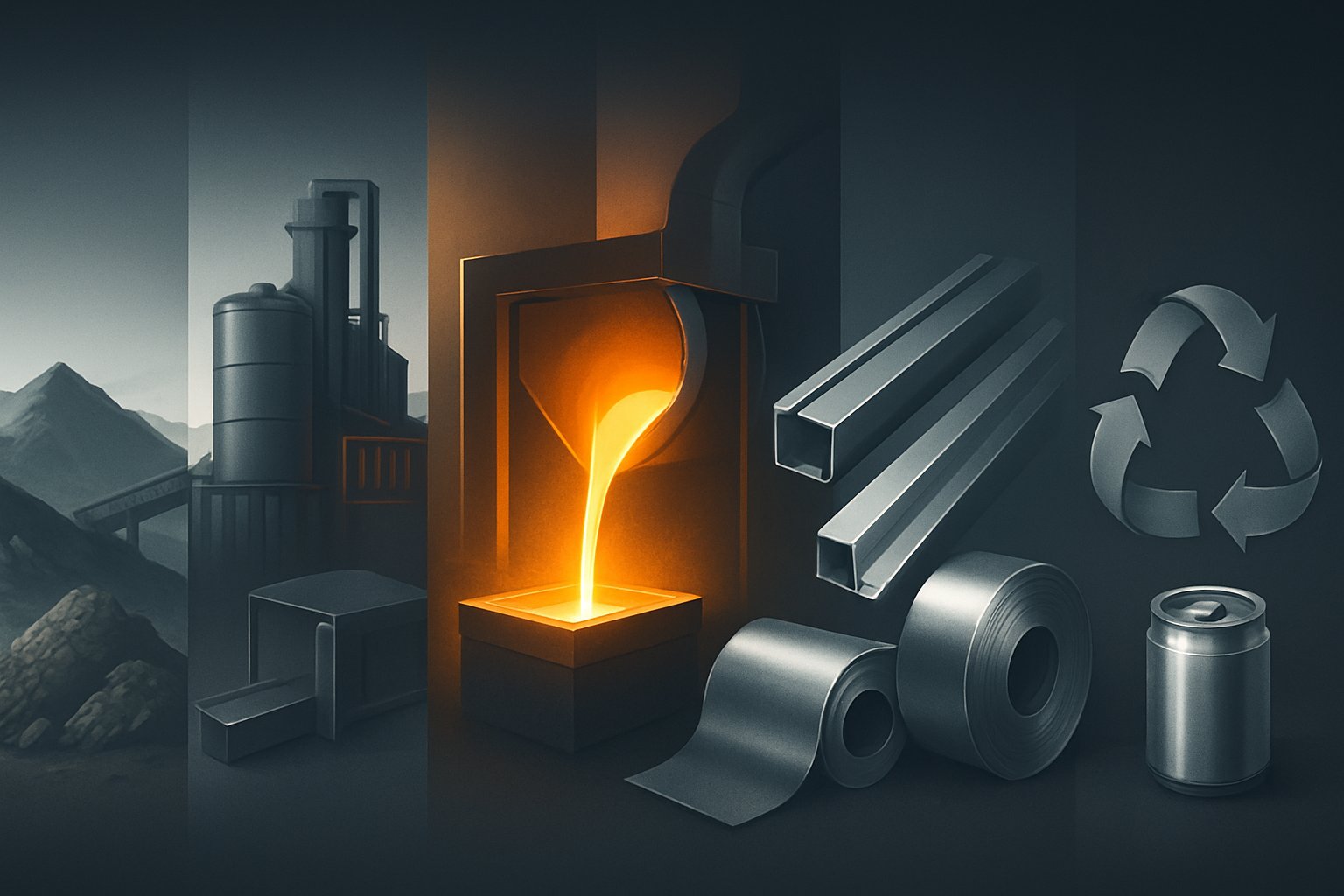
Aluminum processing is the complete chain of operations that turns bauxite ore into usable metal products. If you are asking how is aluminum made, the short answer is this: bauxite is refined into alumina, alumina is smelted into molten aluminum, and that metal is then cast, formed, finished, and often recycled into new products. In practical terms, this is also how aluminum is formed, from raw mineral feed to engineered part.
This term covers far more than one furnace or one factory step. It includes upstream activities such as mining and alumina refining, midstream metal production through the Hall-Heroult method, and downstream manufacturing steps like casting, rolling, extrusion, machining, joining, finishing, and recycling. Searches written as how aluminum made or questions such as how is aluminum created usually expect a simple answer, but the reality is a staged industrial system. Each stage changes the material into a new form, and that new form determines what can happen next.
Primary production makes the metal itself. Downstream manufacturing gives that metal its geometry, tolerances, surface condition, and end-use performance. Cleaner smelter output improves casting quality. The right cast form supports efficient rolling or extrusion. Alloying and finishing then decide how the part behaves in service, whether it becomes a can body, heat sink, window frame, or structural component.
Process sequence matters because every step affects cost, metal quality, manufacturability, and the properties available in the final part.
The chain begins much earlier than most readers expect, in the ore body itself. Bauxite quality and preparation already influence refining efficiency and later smelting behavior, so the story of aluminum starts at the mine.
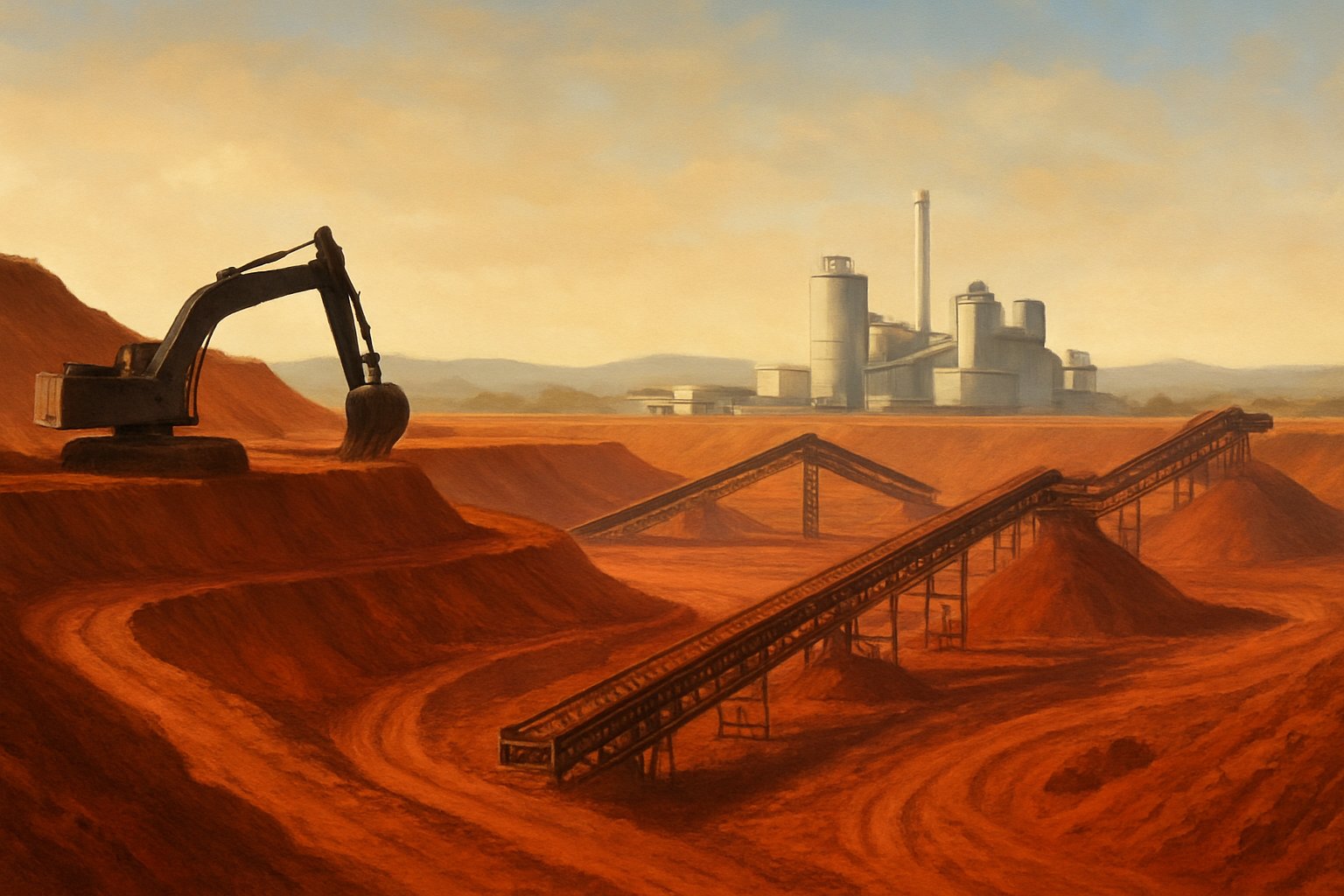
Aluminum is not mined as ready metal. If you are wondering what is aluminum made from, the upstream answer is bauxite, a rock rich in alumina-bearing minerals that must be refined before any metal exists. The Aluminum Association identifies bauxite as the world's primary source of aluminum, while a detailed process review describes it as the principal ore of alumina. In simple terms, where does aluminium come from? It starts in the ground as bauxite, not as usable metal.
So where is aluminum found in nature? Most commercial bauxite deposits occur in tropical or subtropical regions and are commonly close to the surface, which is why surface mining is widely used. The ore forms through long periods of intense weathering and typically contains alumina compounds along with silica, iron oxides, and titanium dioxide. Industry sources from the International Aluminium Institute place major bauxite production in countries such as Guinea, Australia, China, Brazil, India, Indonesia, and Vietnam.
The mining of bauxite is really a preparation job. The goal is to deliver a stable, refinery-ready ore stream. A typical aluminum mining sequence includes:
Not all bauxite behaves the same. Deposits can differ in mineral mix, including gibbsite, boehmite, and diaspore, and some ores contain more clay than others. That difference matters because refinery conditions must match the ore being processed. The same review notes that digestion temperatures in alumina refining vary with bauxite type, and some ores need washing before they ever enter the refinery circuit. So when people ask what is aluminum made from, the better answer is prepared bauxite of suitable quality. Feed consistency shapes refining efficiency, residue handling, and the quality of the alumina that will later move to smelting. Inside the refinery, that ore is turned into a white intermediate material, and that transformation is where the chemistry becomes much more precise.
Prepared ore only becomes useful to a smelter after refining. In industrial terms, the Bayer method is the main alumina process used to convert bauxite into alumina, a white aluminum oxide powder that serves as the chemical feed for primary metal production. If you are looking up how to make alumina, this is the route used for nearly all commercial production of alumina. The International Aluminium Institute notes that roughly two to three tonnes of bauxite are needed to produce one tonne of alumina, and more than 90 percent of global output goes on to aluminum production.
The starting inputs are crushed and washed bauxite, caustic soda, water, and often lime or recycled process liquor. The job is simple in principle but demanding in practice: dissolve the aluminum-bearing minerals, separate unwanted solids, recover aluminum hydroxide crystals, then heat those crystals into smelter grade alumina. The final alumina material is not metal. It is the refined oxide that will later enter electrolytic reduction.
Alumina is aluminum oxide, not aluminum metal. The Bayer process makes the oxide powder. Smelting turns that powder into liquid metal.
| Stage | Inputs | Key action | Outputs | Connection to the next stage |
|---|---|---|---|---|
| Digestion | Bauxite slurry, caustic soda, heat | Dissolves aluminum-bearing minerals into sodium aluminate liquor | Pregnant liquor plus insoluble residue | Creates a dissolved stream that can be cleaned up in clarification |
| Clarification | Pregnant liquor and residue | Settling, washing, and filtration remove solids and recover caustic | Clean liquor and separated residue | Cleaner liquor reduces contamination during crystal growth |
| Precipitation | Clear sodium aluminate liquor, seed crystals, cooling | Crystallizes aluminum hydroxide from solution | Hydrate crystals and spent liquor | Produces the solid precursor needed for washing and thermal conversion |
| Washing | Aluminum hydroxide crystals, wash water | Removes residual caustic soda | Cleaner hydrate | Helps calcination produce a more suitable smelter feed |
| Calcination | Washed hydrate, high heat | Drives off chemically bound water | Smelter grade alumina powder | Provides the oxide feed that must dissolve and perform properly in reduction cells |
Not all alumina behaves the same inside a smelter. Particle structure, moisture, residual hydroxyl, and surface area influence how the alumina material dissolves in molten electrolyte and how it handles gas treatment. The MDPI paper notes that smelter grade alumina commonly has a large surface area that helps dissolution, while excess moisture or hydroxyl can also affect fluoride-related emissions. That means the Bayer stage is not just about making powder from bauxite into alumina. It is about making the right powder for electrolysis. And once that white oxide reaches the reduction cell, chemistry gives way to current, carbon, and liquid metal.
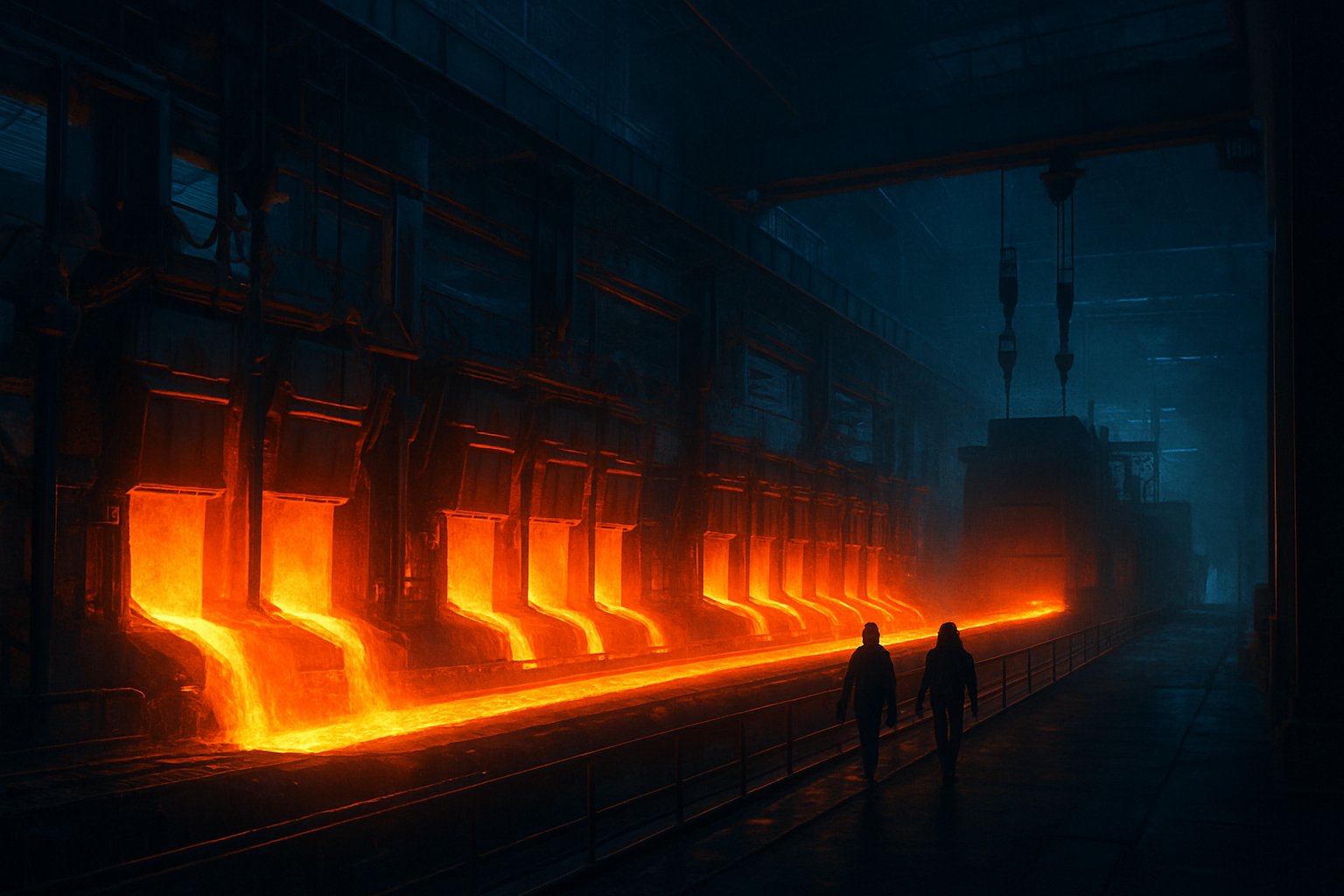
Inside the reduction cell, alumina finally becomes metal. The hall heroult process, often written Hall-Heroult or Hall-Héroult, remains the sole industrial route for primary aluminum smelting, as outlined in the IAI reduction guide. In an aluminium smelter, refined alumina is dissolved in a molten fluoride bath, and electric current drives the reaction that produces liquid aluminum.
Whether you see Hall-Héroult or simply hall heroult, the operating idea is the same. Modern smelters use long potlines filled with connected cells, or pots. Each pot is a carbon-lined container that acts as the cathode. Carbon anodes are lowered into a molten electrolyte made mainly of cryolite, with alumina dissolved into it. The bath is typically held around 960 to 980 C, and aluminum fluoride is added to help control the bath properties, as described by the IAI reduction guide and the Kvande review.
| Stage | Inputs | Process action | Equipment context | Outputs | Why it matters downstream |
|---|---|---|---|---|---|
| Bath preparation | Alumina, cryolite-based electrolyte, aluminum fluoride, heat | Creates a molten medium that can dissolve alumina and support reduction | Carbon-lined pot acts as cathode; anodes hang above the bath | Stable working bath | Bath chemistry affects energy use, cell stability, and metal consistency |
| Alumina dissolution | Smelter grade alumina | Feeds oxide into the bath at a controlled rate | Automatic feed points in covered cells | Dissolved alumina ions in electrolyte | Poor feeding can trigger anode effects and upset cell performance |
| Electrolytic reduction | Direct current, dissolved alumina, carbon anodes | Separates aluminum from oxygen | Potline supplies high current across connected cells | Molten aluminum plus gaseous by-products | Stable reduction supports cleaner metal and predictable tapping practice |
| Metal tapping | Molten aluminum from cell bottom | Siphons or taps liquid metal from the pot | Vehicles move hot metal from potroom to cast house | Liquid primary aluminum | Transfer conditions influence temperature, oxidation, and inclusion risk |
| Gas treatment and handoff | Cell gases, fumes, tapped metal | Captures process emissions while metal moves to casting furnaces | Hoods, dry scrubbing, and gas treatment systems | Treated fumes and cast-house feed metal | Good control reduces losses and prepares metal for alloying and casting |
Smelting is the hinge between refining and fabrication: it creates the first liquid metal that can actually be cast into billets, slabs, and ingots.
This heroult process does more than complete a chemistry step. It establishes the starting quality of every later form. The Kvande review notes that when alumina concentration gets too low, cells can enter anode effects, raising resistance and creating unwanted emissions. Clean transfer matters too. Practical casthouse guidance highlights hydrogen, alkali metals, and inclusions as major cleanliness concerns, especially when metal will be cast into slab for can sheet or foil. In other words, steady aluminum electrolysis is not just about making metal. It helps determine whether that metal can be cast, rolled, extruded, or forged with fewer quality problems later on. Freshly smelted metal often heads straight toward those primary cast forms, but it is not the only source feeding the industry. Aluminum's recycled stream returns to many of the same downstream routes, which makes the comparison between primary and secondary metal impossible to ignore.
Fresh metal from a smelter is only part of the supply story. In aluminum processing, primary aluminum starts with bauxite, alumina refining, and electrolytic smelting. Secondary aluminum starts with scrap that is collected, sorted, cleaned, remelted, and cast again. That difference matters because the starting aluminum raw material changes the energy demand, impurity risk, and alloy-control work needed before the metal can move into fabrication.
Primary metal begins with ore and reaches the cast house as a relatively clean base for ingots, billets, or slabs. Secondary metal skips mining and electrolysis, but it does not skip control. Scrap may come from factory offcuts, demolished products, vehicles, or packaging. People often ask, are cans pure aluminum? In recycling practice, used cans are treated as a valuable but coated scrap stream, not as automatically ready-to-melt metal. They still need sorting, pretreatment, and chemistry adjustment before reuse.
This aluminium recycling process is much more technical than a simple melt-and-pour operation. A typical route includes:
| Factor | Primary aluminum | Secondary aluminum |
|---|---|---|
| Feedstock | Bauxite-derived alumina converted to metal by smelting | Manufacturing scrap and post-consumer aluminum scrap |
| Process path | Refining, electrolysis, then casting | Collection, sorting, cleaning, remelting, purification, alloy adjustment, then casting |
| Alloy-control challenge | Build the target composition from a cleaner starting point | Separate mixed alloys, control contaminants, and correct chemistry before reuse |
| Typical starting forms for fabrication | Ingots, billets, slabs, and other cast starting forms | Secondary ingots and cast feedstock, sometimes blended into more tightly controlled downstream routes |
| Sustainability discussion | Higher footprint because mining, refining, and electrolysis are energy-intensive | A technical review puts recycled production at about 5% of the energy of primary aluminum and roughly 2.1% of the CO2 emissions |
The big takeaway is simple: recycled metal is not a lesser side stream. It re-enters the same industrial chain, but with stricter attention to scrap chemistry, contamination, and alloy separation. Those controls decide whether the metal is best suited for cast products, packaging, or more tightly managed feed for later forming. And once the melt has been cast into the right starting shape, the real part-making choices come into view: rolling, extrusion, forging, and machining.
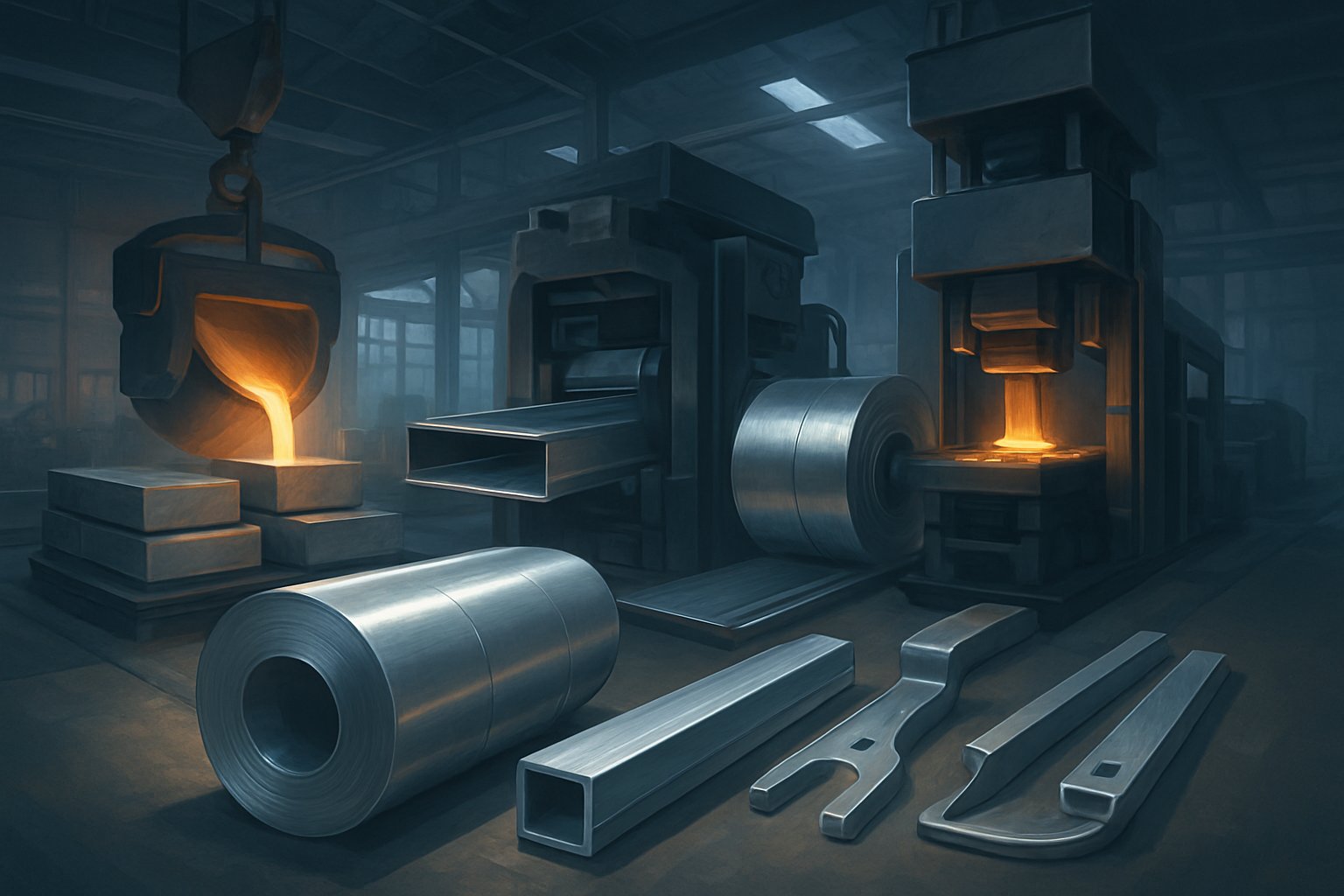
A cast house rarely makes the final part all by itself. More often, it creates the starting stock that later operations can actually shape. In practical aluminum processing, metal is first solidified into forms that presses, rolls, and dies can handle, then turned into sheet, profiles, forgings, and finished components. Industry summaries in this fabrication overview and this process guide group casting, extrusion, rolling, and forging as the main forming routes, each chosen for a different mix of shape, cost, and performance.
That first solid form matters. Billet is the usual feed for extrusion, while slabs or billets move into the rolling of aluminum to make flat products. Casting can also create near-net parts directly when complex geometry is the main goal. The key difference is simple: some cast metal is meant to be shaped again, and some is already close to the final form. Many things made from aluminium begin as semifinished stock rather than as a finished product straight from the mold.
| Process | Geometry freedom | Production scale | Tolerance approach | Mechanical priority | Common outputs |
|---|---|---|---|---|---|
| Casting | Very high, especially for complex shapes and mold-defined details | Repeatable with dedicated molds or dies | Often near-net shape, with limited follow-up machining when needed | Best when shape complexity matters most | Brackets, housings, covers, complex formed parts |
| Extrusion | High for complex but constant cross-sections | Efficient for long runs of the same profile | Good consistency along length, smooth surfaces suit later finishing or machining | Best for profile efficiency and surface quality | Frames, rails, channels, heat sinks, architectural profiles |
| Rolling | Low in shape variety, strong for flat products | Well suited to large-volume sheet, plate, and foil production | Thickness is reduced step by step, with later cutting or forming as needed | Best for versatile flat stock that will be further fabricated | Plate, sheet, foil, can stock, panels |
| Forging | Moderate, less complex than casting but stronger in demanding shapes | Strong fit for repeat production once tooling is justified | Near-net shape, usually by limited machining for critical features | Best for fatigue resistance, impact resistance, and strength | Wheels, pistons, gears, heavy-duty structural parts |
Rolling reduces thickness by passing slabs or billets through sets of rolls again and again. That is how plate becomes sheet, and how sheet can become foil. If you have ever wondered how is aluminum foil made, the short answer is repeated rolling until the material reaches foil thickness. Those rolled products are then easy to bend, form, or machine into cans, panels, roofing, and heat-exchanger parts.
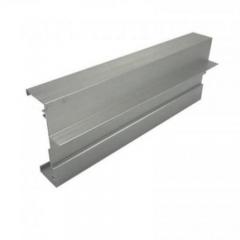
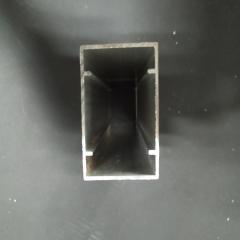
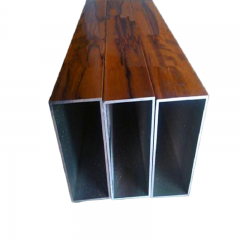
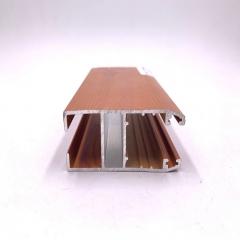
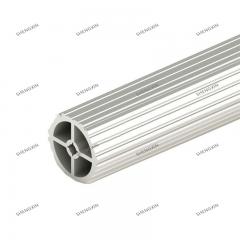
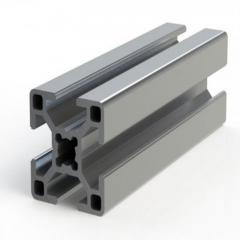
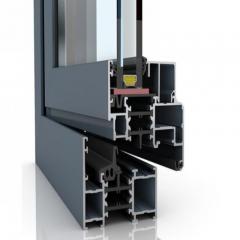
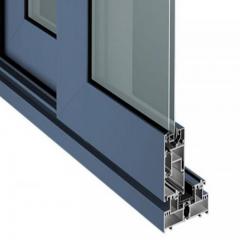
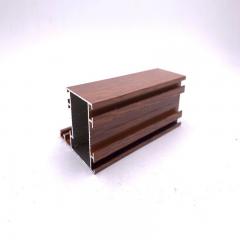
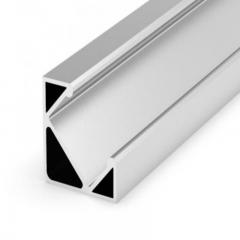
Extrusion works from a different logic. A ram pushes a heated billet through a die, so the product keeps the die's cross-section along its full length. That makes it ideal for constant-section shapes such as window frames, handrails, enclosure channels, and heat sinks. When people ask what is made out of aluminium, many everyday profiles come from this route.
Aluminium forging relies on pressure rather than flowing metal into a mold. Heated metal is pressed or hammered into shape, often in open or closed dies. A forging guide points out why designers choose it for stronger parts: forged components typically offer better impact and fatigue resistance than cast ones. That is why wheels, pistons, and other hard-working parts often follow the forging route instead of a purely cast one.
Bulk forming gets the shape close. Machining gets it exact. The same forging guide describes machining as precise and capable of excellent surface finish, but also slower and subtractive. That makes it a strong secondary step for holes, pockets, faces, and assembly features after the main shape already exists. In other words, fabricating aluminum is usually most efficient when rolling, extrusion, casting, or forging creates the bulk geometry first, and machining is saved for the features that truly need precision.
That is also why process choice never stops at geometry alone. Two parts may look similar on paper yet behave very differently once alloy family, temper, and finishing requirements enter the decision.
Bulk shaping gets a part close, but alloy and temper decide whether it can actually be bent, welded, machined, or finished without trouble. In aluminum processing, two parts with the same geometry can need very different routes once strength, corrosion exposure, and appearance enter the picture. Searches for the hardness of al often treat hardness like a fixed number. In practice, it comes from the alloy family plus the temper condition.
The common wrought families do not behave alike. Fabrication guidance from AZoM shows that 1xxx alloys offer excellent formability, weldability, and corrosion resistance but low strength. 2xxx alloys are strong and machine well, yet they are less friendly to forming, welding, and corrosion. 3xxx and 5xxx grades are often chosen when formability, weldability, and corrosion resistance matter most. 7xxx alloys bring high strength and good machinability, but weldability and corrosion resistance are more limited. That is why the best route is never chosen by shape alone. A thin panel, a marine bracket, and a high-load machined part may all start from aluminum, but they should not be processed the same way. Put simply, the alloys of aluminum set the boundaries for what later operations can do well.
Temper codes add the second half of the decision. Hydro explains that F means as fabricated, O means annealed for maximum workability, H means strain hardened for non-heat-treatable alloys, W is a temporary post-solution condition, and T marks heat-treated products after quenching and aging. So one alloy can feel soft and easy to form in one temper, then become much less suitable for bending in another. The same temper shift also changes punching, welding, and machining behavior.
Machining adds another filter. AZoM notes that aluminum's high thermal expansion and friction call for suitable tool geometry, lubrication, and process control. So a profile that looks fine coming off the press may still need careful CNC planning to hold tight dimensions and surface quality.
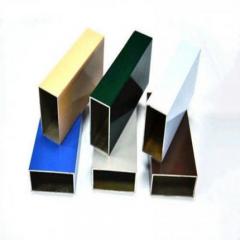
Finish is not just cosmetic. It can change corrosion behavior, coating adhesion, wear response, and the final look of a part. AZoM describes anodizing as an electrolytic process that thickens the oxide layer and typically produces films around 5 to 25 microns, depending on end use. Hydro also notes that alloy chemistry and temper can affect how a part looks after anodizing. That matters when color consistency or clean aluminum luster is part of the specification. Mechanical polishing may preserve aluminum luster, while anodizing, conversion coatings, paint, or powder coating are often chosen when durability and appearance must work together.
The best process route matches alloy behavior, temper condition, and part requirements at the same time.
This is where selection stops being theoretical. Real projects succeed when the chosen route can be repeated with consistent temper control, machining accuracy, and finish quality across production, which is exactly what separates a merely available supplier from a truly capable one.
By this stage, the real question is less how aluminum is made in theory and more how well each production step is controlled in practice. Modern aluminum manufacturing is moving in two directions at once. Smelters are working to lower power-related emissions, and inert-anode technology is being developed to cut the direct process emissions created by carbon anodes. Reporting from Canary Media notes that carbon anodes account for almost one-sixth of the greenhouse gases tied to new aluminum, and Elysis has already operated a commercial-size 450 kA inert-anode cell that releases oxygen instead of greenhouse gases. For buyers reviewing the aluminum production process, carbon intensity is now a practical question to ask, not just a branding claim.
Process maturity also shows up inside the plant. Strong suppliers track press conditions, monitor temperature and pressure, control machining calibration, document finishing results, and maintain lot traceability from billet to shipment. The supplier audit framework from Aluphant points to useful checkpoints such as automated press control, extrusion logs, ERP or MES support, FAI or PPAP capability, and corrective-action records. That is the practical answer behind searches like how is aluminum manufactured when the goal is repeatable quality, not just output.
| Supplier view | Extrusion support | CNC machining depth | Anodizing and powder coating | Quality consistency | Single-source coordination |
|---|---|---|---|---|---|
| Shengxin Aluminium | 35 extrusion presses support a broad profile range | Precision CNC machining is available in-house | Multiple in-house anodizing and powder coating lines | One facility can manage flow from raw material to finished product | Useful when custom profiles need machining and finishing with fewer handoffs |
| Any shortlisted supplier | Verify press range, alloy fit, die capability, and profile size match | Check machine list, calibration status, fixturing, and tolerance evidence | Confirm finish capacity, color control, coating thickness checks, and adhesion testing | Ask for traceability records, inspection reports, and nonconformance response | Map where subcontracting starts and who owns delays or defects |
As a working example, Shengxin combines extrusion, CNC, anodizing, and powder coating in one operation, backed by more than 30 years of manufacturing experience. That kind of setup can simplify communication for construction, automotive, and industrial parts, especially when surface finish and dimensional control have to stay aligned. Even so, the same rule applies to every factory aluminium source: ask for evidence, not just equipment counts.
In the end, the best partner is the one whose controls stay as disciplined as the metal path itself. That is where the story of how aluminum is made becomes better parts, steadier supply, and fewer surprises on the shop floor.
Aluminum processing includes the full industrial path from bauxite mining to finished parts and recycled metal. It starts with ore preparation, continues through alumina refining and aluminum smelting, then moves into casting, rolling, extrusion, forging, machining, and surface finishing. Recycling is also part of the same chain. Looking at these steps together is important because material quality, alloy chemistry, and cleanliness at one stage can directly affect cost, formability, and final part performance at the next.
Alumina and aluminum are not the same material. Alumina is aluminum oxide, a refined white powder made from bauxite in the Bayer process. Aluminum is the metal produced later when alumina is reduced in Hall-Heroult cells. A simple way to remember it is this: alumina is the feedstock for smelting, while aluminum is the usable metal that can be cast, extruded, rolled, forged, machined, and finished into products.
Recycled aluminum returns through the secondary route rather than the mining and smelting route. Scrap is collected, sorted by type, cleaned to remove coatings and contaminants, remelted, filtered, degassed, and adjusted to meet target alloy chemistry. After that, it can be cast into new feedstock for foundry or wrought applications. The biggest challenge is not simply melting scrap, but controlling mixed alloys, coatings, and unwanted elements so the final material still meets downstream forming and performance needs.
The best method depends on the part requirements. Rolling is ideal for flat products like sheet, plate, and foil. Extrusion works well for long parts with a constant cross-section, such as frames, rails, and heat sinks. Casting is useful when shape complexity is the main priority. Forging is often chosen for parts that need higher strength and better fatigue resistance. In many real projects, one of these bulk forming methods is by CNC machining to add precise holes, pockets, faces, and assembly features.
Start by checking whether the supplier can support your alloy, shape, tolerance, finish, and volume requirements. Then verify process depth: extrusion capability, CNC machining, anodizing, powder coating, inspection, and traceability. In-house coordination usually reduces delays and quality drift between steps. For example, Shengxin Aluminium offers 35 extrusion presses, precision CNC machining, and multiple finishing lines in one operation, which can be useful for projects that need custom profiles, controlled surface treatment, and fewer handoffs between vendors.



 online service
 0086 136 3563 2360
 sales@sxalu.com
 +86 136 3563 2360
 English
 français
 Deutsch
 русский
 español
 português
 العربية
 ไทย
ไทย Việt
Việt Українська