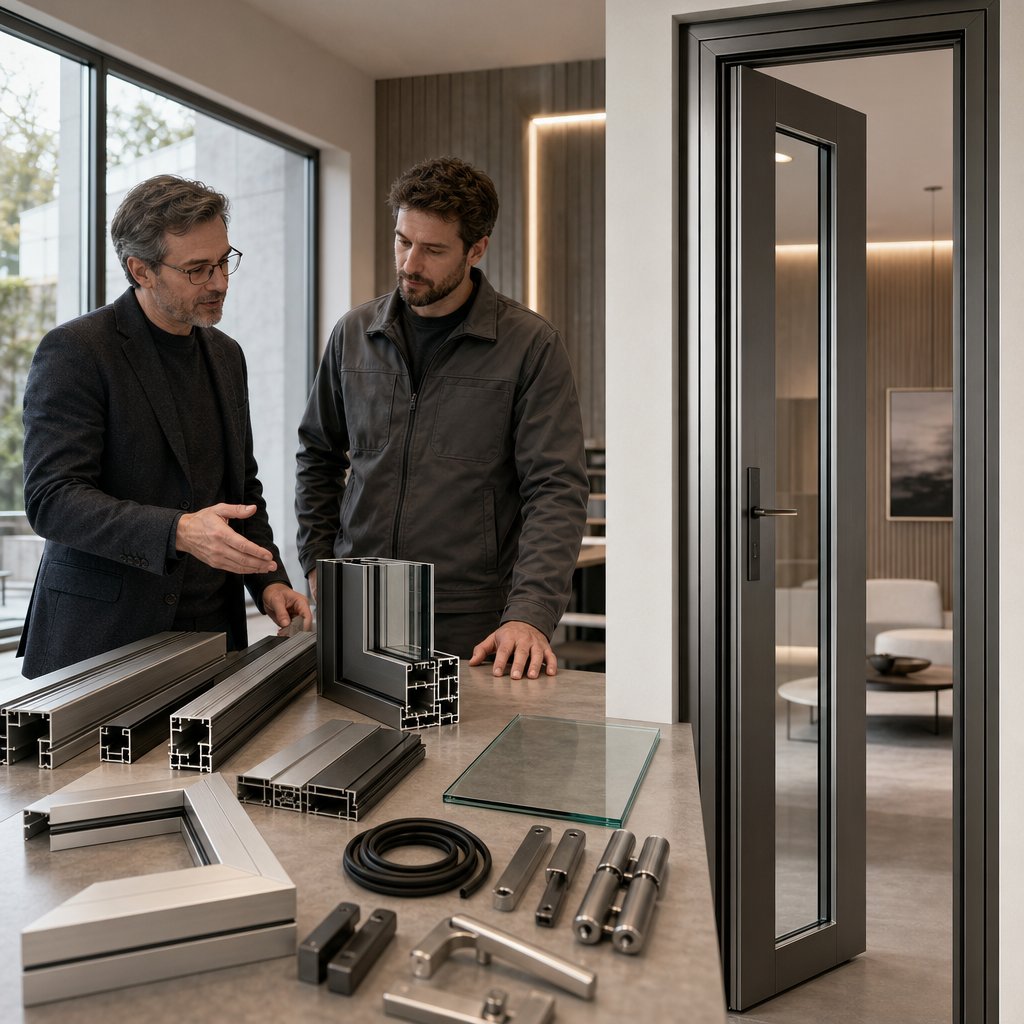
If you are comparing products, one small term can cause a lot of confusion. People often use profile, frame, sash, and even full door interchangeably, but they are not the same thing.
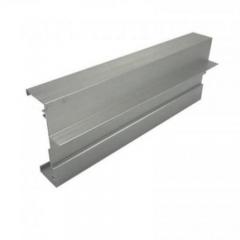
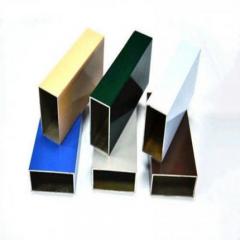
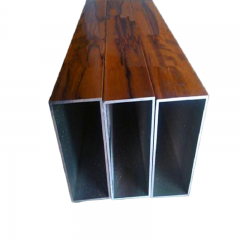
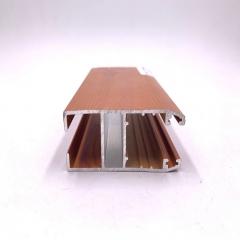
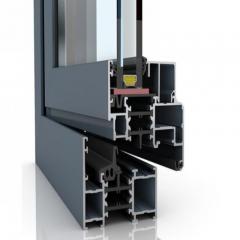
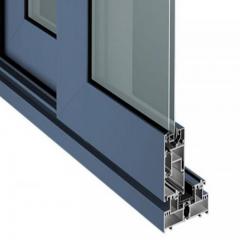
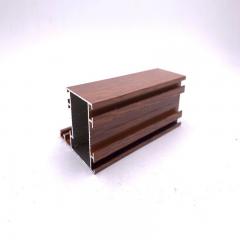
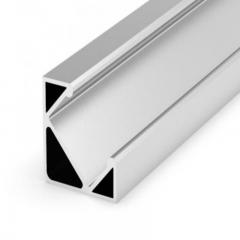
An aluminum door profile is a shaped aluminum section, usually made by extrusion, that becomes one part of a door assembly such as the frame or the moving sash.
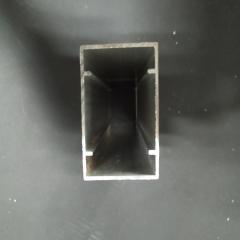
In search results, terms like profile aluminum, aluminum profiles, and door profile are often used loosely. The clearest way to separate them is by job. An extrusion process pushes heated aluminum through a die to create a consistent cross-section. That cross-section is the profile. It is the building block, not the finished door.
Industry terminology also distinguishes between the frame, which is fixed to the wall, and the sash, which is the movable part. Both can be made from profiles. In glazed systems, separate glazing beads or similar retaining pieces may also be profiles.
A frame is the fixed perimeter. A sash is the part that opens. A complete door system includes those pieces plus infill or glass, seals, hardware, and fabrication details that allow everything to work together. That matters because a well-designed section can still underperform if the wrong hardware is used or the opening is installed poorly.
For example, an interior partition may favor slim sections and clean lines, while a residential entry door may need more support for weathering and locking hardware. A commercial entrance may face heavier traffic and more frequent cycles.
The profile geometry drives more than appearance. Depth, wall layout, and internal chambers influence stiffness, visible sightlines, glazing capacity, drainage paths, and hardware mounting. Sources on architectural aluminum also note that aluminum allows relatively thin, strong sections that are valued for durability, corrosion resistance, and low maintenance when properly specified and installed.
That is why one aluminum section can make sense in a cabinet-style application yet be completely wrong for a storefront or exterior entry. The useful comparison starts with application, not just material.
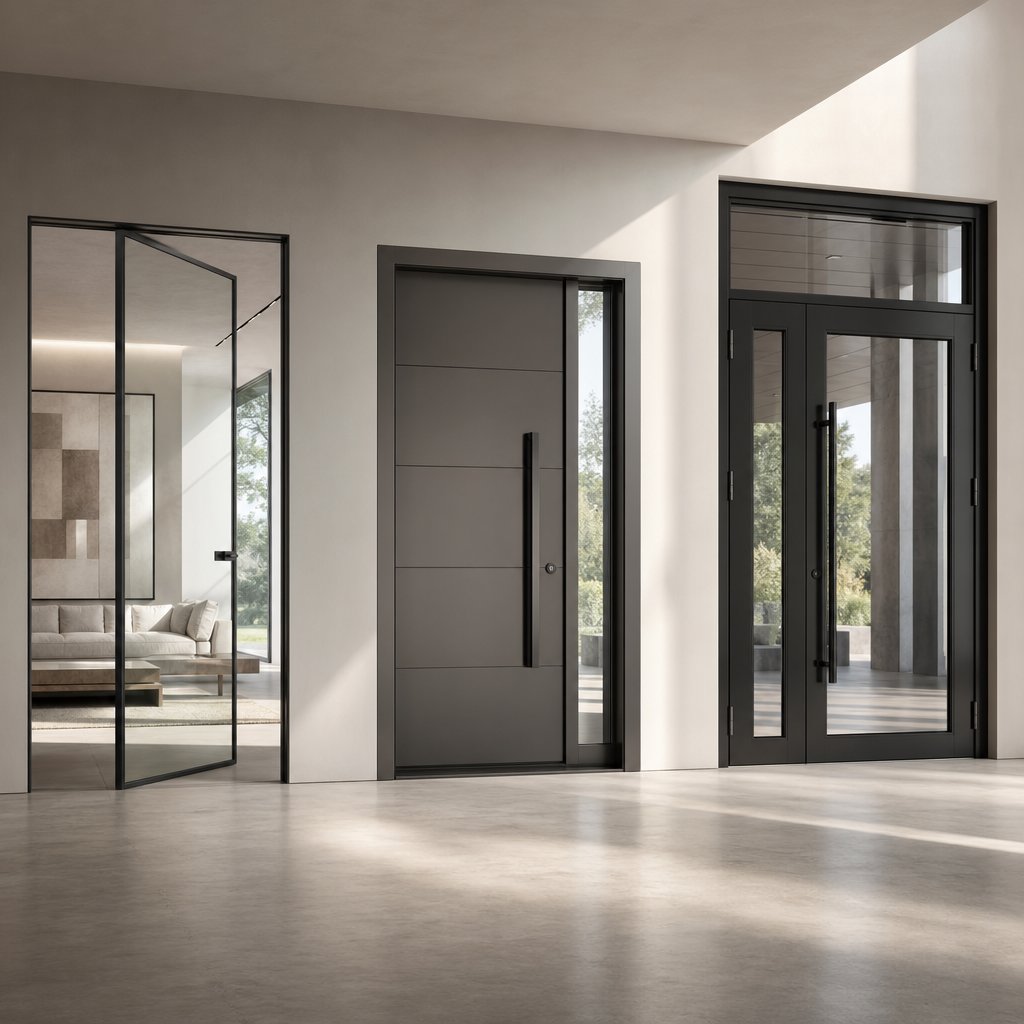
Application is where classification gets practical. A slim section that works beautifully on a wardrobe shutter may struggle at a busy entrance, while a robust commercial stile can feel oversized indoors. Looking at aluminum door profile types through actual use helps filter options much faster than comparing shapes alone.
Many interior aluminum door profiles are borrowed from cabinet and partition logic. In modular kitchens, wardrobes, and light interior shutters, visible frame widths commonly run from 18 mm to 35 mm, with slim versions around 18 mm to 22 mm and heavier cabinet sections around 28 mm to 35 mm, as outlined in this cabinet profile guide. These systems often prioritize appearance, moisture resistance, and easy cleaning over high security or extreme traffic durability.
That overlap matters. Cabinet-style and interior partition profiles can suit low-demand spaces, especially where the goal is a light look with glass, acrylic, or MDF infill. The gap appears when doors get taller, heavier, or more heavily used. At that point, hinge loads, alignment, and frame rigidity become much more important.
Exterior and storefront systems follow a different logic. They face weather, repeated opening cycles, stronger locking demands, and stricter structural expectations. The commercial door guide notes that commercial primary stiles and rails commonly use wall thicknesses from 0.090 to 0.125 inches, while lighter residential sections often fall between 0.050 and 0.080 inches. Commercial narrow stiles may range from 1.5 to 2.5 inches, but the slim look still depends on engineering for hardware, wind, and glass weight.
This is where alumi profile doors for exteriors diverge sharply from interior products. Thresholds, seals, drainage, reinforcement, and security prep become part of the profile family selection, not optional extras.
Glass-focused systems sit between interior elegance and architectural performance. Partition profiles may use widths from 25 mm to 50 mm, and U-channels may have depths from 25 mm to 40 mm depending on glass thickness. Cabinet systems often support 4 mm to 5 mm glass, while partition systems commonly support 8 mm to 12 mm glass. Narrow sightline framing emphasizes transparency and daylight, but slimmer framing does not remove the need for structural support, code checks, or compatible hardware.
| Application type | Design priorities | Depth and width considerations | Load expectations | Weather exposure | Hardware demands | Insert or glass compatibility |
|---|---|---|---|---|---|---|
| Cabinet and light interior shutters | Slim appearance, low maintenance, moisture resistance | Visible widths often 18 mm to 35 mm | Moderate | Low | Basic hinges and pull integration | Commonly 4 mm to 5 mm glass, acrylic, MDF, laminated panels |
| Interior partitions and glass dividers | Transparency, alignment, clean detailing | Profile widths often 25 mm to 50 mm, U-channel depth 25 mm to 40 mm | Higher than cabinet profiles | Mostly indoor exposure | Sliding or fixed glazing support, alignment-sensitive fittings | Often 8 mm to 12 mm toughened glass |
| Residential exterior doors | Weathering, thermal comfort, appearance | Lighter wall sections often 0.050 to 0.080 inches | Moderate to high | High | Locks, hinges, seals, threshold coordination | Glass or insulated panel options depend on system design |
| Commercial entrances and storefront swing doors | Frequent use, stronger security, larger glazing, code compliance | Primary stiles and rails often 0.090 to 0.125 inches, narrow stiles 1.5 to 2.5 inches | High | High | Heavy-duty closers, locks, panic hardware, reinforcement | Larger glass areas and heavier infill, subject to system engineering |
These categories narrow the field, but they still do not answer the most expensive questions. Those usually live in the specification sheet, where dimensions, tolerances, alloy, finish, and glazing details can turn a promising profile into a workable one, or rule it out immediately.
A profile that looks clean in a catalog can still create problems in fabrication. The reason is simple. The drawing and the aluminum profile specification sheet decide whether the part can actually be made, finished, fitted, and installed the way the project expects.
Start with the basic geometry. On an aluminum door frame profile, dimensions describe the cross-section shape, overall depth, widths, pocket sizes, and leg locations. Those door frame profile dimensions tell you what can fit inside the section and what must connect to it. A good spec sheet also separates nominal dimensions from toleranced dimensions, because the printed size is not the same as the acceptable manufacturing range.
Materials come next. The alloy and temper line matters because different alloys balance finish quality, strength, and manufacturability differently. Silver City Aluminum highlights 6063 for windows, doors, and trim because it offers an excellent surface finish, while 6061 is harder to extrude but provides moderate mechanical strength and good machinability. If the sheet lists finish type, finish thickness, glazing details, drainage paths, or hardware prep, treat those as performance fields, not fine print. They affect appearance consistency, water management, fit-up, and what hardware or infill the section can realistically support.
An attractive profile still may not suit the job if the specification omits compatibility, tolerances, or finishing details.
Wall thickness is not just a weight issue. It influences rigidity, fabrication behavior, and how consistently the metal flows during extrusion. The same Silver City guidance notes that more uniform wall thickness helps aluminum flow more evenly, while unequal sections can raise the risk of twisting or bending during production.
Tolerances deserve the same attention. Engineers Edge, summarizing industry standards tied to ANSI H35.2 and Aluminum Standards and Data, notes that exact tolerances depend on profile size, shape complexity, location of the dimension, and alloy. Its rough estimates include straightness of 0.0125 inches per foot, twist of 0.5 degrees per foot, flatness of 0.004 x width, and wall thickness at +/-10 percent. Those are planning guides, not automatic acceptance limits. Tightening tolerances can require die changes, slower extrusion, more inspection, and higher rejection risk, which is why special requirements should be agreed before purchase.
Finish notes translate directly into how the final door will look and age. Ref2 lists common post-extrusion options such as anodizing, painting, and powder coating, plus cut to length, drilling, deburring, and assembly. If a finish field is vague, you cannot reliably judge color match, coating expectations, or downstream handling. The same logic applies to temper and alloy. A beautiful finish on the wrong alloy choice will not fix a mismatch between structural need, machining demand, and visual quality.
Read this way, the sheet stops being technical clutter and becomes a forecast of fabrication risk. A section can be dimensionally correct and still feel wrong in service if thermal separation, sightline goals, or opening direction were never resolved at system level.
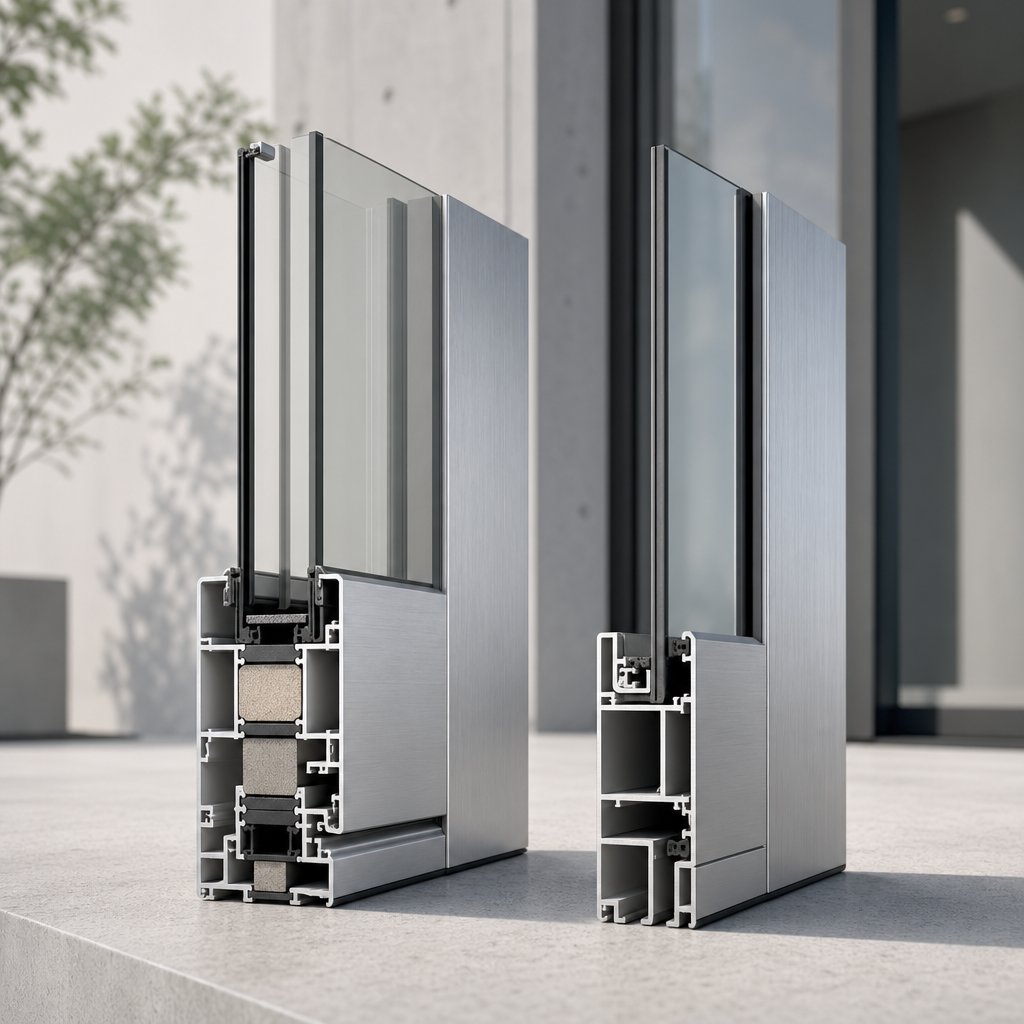
A spec sheet can tell you what a section is made of. Daily comfort is a different question. The same aluminum door profile may look identical on paper, yet perform very differently once climate, noise, and swing clearance enter the job. Thermal separation, opening direction, and sightline width usually drive those differences first.
A thermal break aluminum door profile uses two aluminum sections separated by an insulating strip, commonly PA66 polyamide, rather than one continuous metal path. A thermal break comparison lists PA66 at about 0.3 W/(m.K), while common 6000-series aluminum is about 200 to 235 W/(m.K). That large gap is why thermally broken sections are favored for conditioned exterior doors, exposed lobbies, and climates with strong indoor-outdoor temperature differences. They help keep interior-facing metal warmer or cooler as needed, which can reduce condensation risk and improve comfort.
Non-insulated profiles still make sense in some places, especially interior partitions, utility rooms, and other non-conditioned spaces. Still, the extrusion is only one part of the story. Glazing, gaskets, threshold design, installation quality, and the surrounding wall build-up all affect thermal behavior and acoustic results.
| Comparison | Option A | Option B | Practical outcome |
|---|---|---|---|
| Insulation strategy | Thermally broken profile | Non-insulated single profile | Usually better for envelope performance, interior surface temperature, and condensation control. Non-insulated sections are simpler and often adequate where climate control is not critical. |
| Opening direction | Inward opening | Outward opening | Inward-opening doors typically compress well against seals and are easier to clean from inside, but they need interior swing space. Outward-opening doors save interior room and can support public egress, but outside clearance and exposed hardware need more attention. |
| Sightline width | Narrow sightline | Wider sightline | Narrow frames reduce visible metal and suit minimalist facades, but they can leave less room for drainage, larger insulated glazing, and heavier hardware. Wider sections often offer more margin for stiffness, hardware prep, and coordinated detailing. |
Opening type guidance highlights the everyday tradeoff clearly. Inward-opening doors usually favor seal compression and easier maintenance access. Outward-opening doors protect interior floor area and may better suit evacuation routes in public settings. Neither is automatically better. The right choice depends on traffic, weather exposure, furnishing layout, and threshold conditions.
Sightlines introduce a separate design tension. Slim framing can be the right visual move when a door must align with an adjacent aluminium window profile or an aluminum window frame profile in the same facade. But thinner-looking is not always better-performing. Reference material on extruded framing shows that frame depth is what makes room for thermal breaks, glazing accommodation, and structural stability. Clean facade alignment usually comes from matching depth, glazing plane, and finish across the door and window package, not just choosing the thinnest section.
Those warning signs usually become harder to ignore when inserts, glass thickness, hinges, locks, and thresholds are reviewed together. That is where profile selection shifts from style preference to compatibility.
Compatibility issues usually show up at the edges first. A section can look slim and well proportioned, yet still fail the job if the pocket, gasket, or hardware prep does not match the infill. That is why an aluminum door profile is never judged by appearance alone.
An aluminum door profile glass insert detail is really a fit-and-load question. The glazing pocket, bead shape, and gasket approach decide what can seat securely inside the leaf or frame. In the glass guide, common glass for aluminum doors and windows ranges widely: single-layer glass is typically 3 mm to 5 mm, tempered glass is commonly 5 mm, 8 mm, 10 mm, or 12 mm, double-glazed units often run 18 mm to 27 mm, and triple-glazed units 28 mm to 44 mm. That spread matters because a profile sized for a thin interior lite may not accept a thicker insulated build-up.
Weight matters just as much as thickness. The same source notes that larger panes and thicker glass increase structural demand, and the selected profile and hardware must carry that load. Solid inserts, louvers, and decorative panels raise similar questions about seating depth, edge support, and seal compression.
Searches for hinge aluminum profile often focus on the hinge itself, but the fixing zone around it is just as important. Heavy glass, tall leaves, and frequent use all increase stress at hinges, locks, and closers. The closer guide describes commercial door closers as precision hydraulic devices, not simple add-ons. It also notes that concealed closers need accurate cavity space and mortising, while surface-mounted overhead models are easier to install and maintain in high-traffic work. Most commercial aluminum doors fall into EN3 to EN5 closer sizes depending on glazing weight, and heavy-duty models need reinforcement in the frame or leaf.
That is where aluminum door hardware compatibility becomes a drawing issue, not a shop-floor guess.
| Category | Must-check items | Why it matters |
|---|---|---|
| Glass | Glass type, thickness, pocket width, bead detail, gasket compression, panel edge support | Prevents poor fit, rattling, overload, and mismatched insulation or safety performance |
| Hardware | Hinge fixing area, closer type, reinforcement plates, lock prep, closer power range, usage frequency | Reduces sagging, slamming, latch failure, and premature wear |
| Weathering | Seal path, bottom rail geometry, threshold condition, drainage route, swing direction | Helps the door close, seal, and shed water as intended |
| Security | Tempered or laminated glass choice, lock preparation, multi-point hardware space, frame stiffness in vulnerable zones | Supports impact resistance, access control, and more reliable forced-entry performance |
Even a well-matched package should be verified against supplier drawings, hardware schedules, and project-specific opening details before approval. Small differences in frame depth, threshold build-up, or handing can change what actually fits once material is cut.
Most ordering mistakes are small at first. A missed handing note, one unchecked threshold condition, or a glazing thickness copied from the wrong detail can easily turn into rework. For any aluminum door profile, a careful field check and disciplined drawing review usually prevent the biggest surprises.
A solid aluminum profile drawing review usually begins at the cover sheet, then moves through plan views, elevations, and details. That review sequence is common in glazing practice because errors often hide in coordination points, not in the main elevation.
Cut to size aluminum profile usually means a standard section is supplied in the required lengths with limited secondary processing. Stocked profiles are off-the-shelf sections available in standard forms. Custom extrusion means the cross-section itself is purpose-designed for the project. That difference matters because each path changes who controls geometry, lead time, and fabrication risk. Before ordering, make sure the drawing shows exactly what is being supplied, what is being machined, and what still depends on field coordination. Those sourcing choices tend to shape the next round of decisions more than many teams expect.

A precise field measure solves only part of the problem. The next decision is where the section will come from, and in what state. Some buyers need raw extrusions. Others need machining, finishing, thermal treatment, or more complete components. That sourcing path shapes schedule, drawing responsibility, and how much rework risk stays with the supplier versus the project team.
Silver City Aluminum describes both standard and custom extrusion for doors and windows, along with in-house painting, anodizing, powder coating, and thermal filling or de-bridging. That is the practical split. Custom aluminum door profiles offer the most design freedom when the project needs a unique sightline, hardware zone, or glazing detail. Stocked alu profiles are usually simpler to source, but they limit geometry and often push more adaptation work to the fabricator.
| Supply path | Design flexibility | Drawing control | Fabrication responsibility | Lead-time considerations | Finish options | Best suited to |
|---|---|---|---|---|---|---|
| Partially configured door and window components, such as Shengxin Aluminum | Medium to high within an established system family | System-based, so supplier drawings matter | Shared between supplier, fabricator, and installer | Can reduce coordination steps compared with starting from bare extrusion | Typically broader, with customization in colors and styles | Builders and architects who want coordinated doors and windows, structural strength, thermal and sound insulation, multi-point locking support, and corrosion-resistant options |
| Custom extrusion | Highest | Highest, because the section is purpose-designed | Project team and extrusion partner define more details up front | Longest path because die development and approvals may be required | Broad if the supplier also handles finishing | Architects, system developers, and complex projects |
| Stocked profiles | Low to medium | Limited to existing cross-sections | More adaptation shifts to the fabricator | Usually the fastest route when the profile already fits | Often limited to standard finishes or available inventory | Builders, maintenance teams, and repeatable details |
| Cut-to-size supply | Medium within an existing section | Control stays with cut lists, machining notes, and orientation details | Supplier may cut or prep material, but final fit still depends on the reviewed drawing set | Between stock and full custom | Depends on whether cutting, machining, and finishing are bundled | Fabricators and contractors who want less waste and simpler shop handling |
Cut-to-size works well when the cross-section is already proven and the job mainly needs accurate lengths and agreed secondary operations. The supplier checklist in Rogenilan's buying guide emphasizes verified business history, certifications, clear communication, and detailed quotes. The same discipline matters here. Pre-cut material saves time only when hardware prep, handing, finish sequence, and packing instructions are fixed before release.
A reliable aluminum profile supplier for doors should make those answers easy to document, not difficult to uncover. When the source path matches the drawing package and project risk level, the shortlist gets much clearer, and the final selection becomes a focused decision instead of a catalog hunt.
A clear supplier quote starts with a clear shortlist. That is where an aluminum door profile checklist earns its value. Instead of beginning with catalog photos, begin with the opening, the climate, and the way the door will actually be used.
If you are working out how to choose aluminum door profile options, test every nice-looking section against long-term use. In practice, the phrase best aluminum door profile for project needs only makes sense after durability, sealing, hardware support, and finish exposure have all been checked together.
The best profile is the one that matches the full door assembly, installation method, and project constraints.
The safest choice is usually the one with fewer unanswered questions. Look for clear drawing review, finish support, hardware compatibility, and direct communication on corrosion risk and coordination with adjacent window systems. If you want one concrete resource to review, builders and architects can look at Shengxin Aluminum, especially when the shortlist calls for structural strength, thermal and sound insulation, multi-point locking compatibility, customization in colors and styles, and corrosion-resistant solutions. Keep the decision tied to the checklist above, and rework becomes much less likely.
An aluminum door profile is one shaped section used to build part of a door, such as a frame member, sash piece, or glazing retainer. A complete door system includes those profiles plus glass or panel infill, seals, hardware, fabrication details, and installation conditions. That is why a strong-looking profile alone does not guarantee good weathering, security, or long service life.
A thermal break is usually worth considering when the door separates conditioned indoor space from outdoor weather or a highly exposed lobby. It helps limit heat transfer through the metal and can reduce interior surface condensation in demanding climates. For interior partitions or unconditioned spaces, a non-insulated profile may still be practical if comfort, sealing, and acoustic demands are modest.
Start with the basics: section dimensions, wall thickness, tolerances, alloy, temper, and finish. Then confirm the practical fields that often cause ordering mistakes, including glazing pocket size, hardware prep, drainage paths, machining notes, and any cut-to-size requirements. If those items do not match your actual glass, hinges, locks, threshold, and opening conditions, the profile can become a costly mismatch even if the shape looks right.
Sometimes, but only when the profile family is designed for that range of loads and infill types. Glass thickness, bead design, gasket approach, hinge fixing zones, closer reinforcement, and lock preparation all need to align with the intended use. A slim profile that works well for a light interior panel may not have the right pocket geometry or structural support for thicker glazing or high-cycle entrance hardware.
The right path depends on how much control, speed, and coordination your project needs. Custom extrusion gives the most freedom for unique sightlines, hardware zones, or facade alignment, while stocked profiles are often faster when an existing section already fits the job. Cut-to-size supply works well when the profile is proven and the main need is accurate lengths and agreed machining. If you want fewer unknowns across doors and windows, a system-oriented supplier can be helpful; builders and architects can review Shengxin Aluminum as one example when structural strength, thermal and sound insulation, multi-point locking support, finish customization, and corrosion resistance are important.



 online service
 0086 136 3563 2360
 sales@sxalu.com
 +86 136 3563 2360
 English
 français
 Deutsch
 русский
 español
 português
 العربية
 ไทย
ไทย Việt
Việt Українська