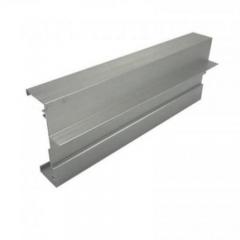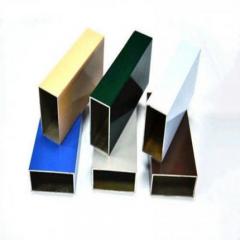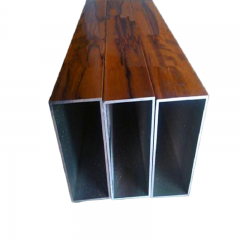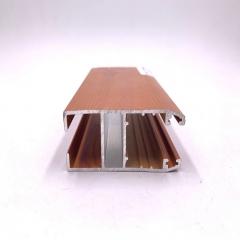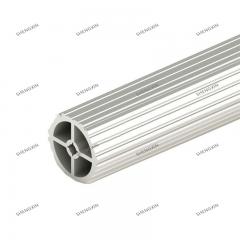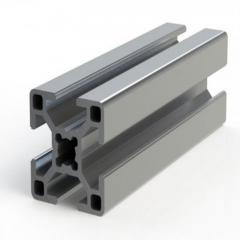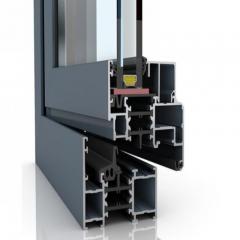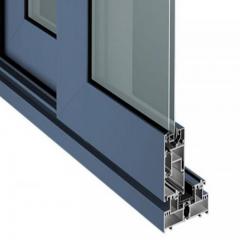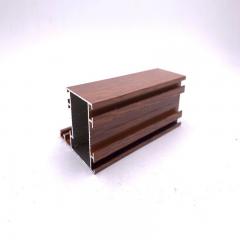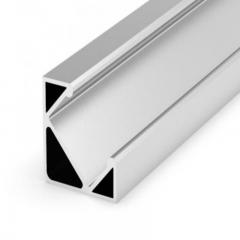
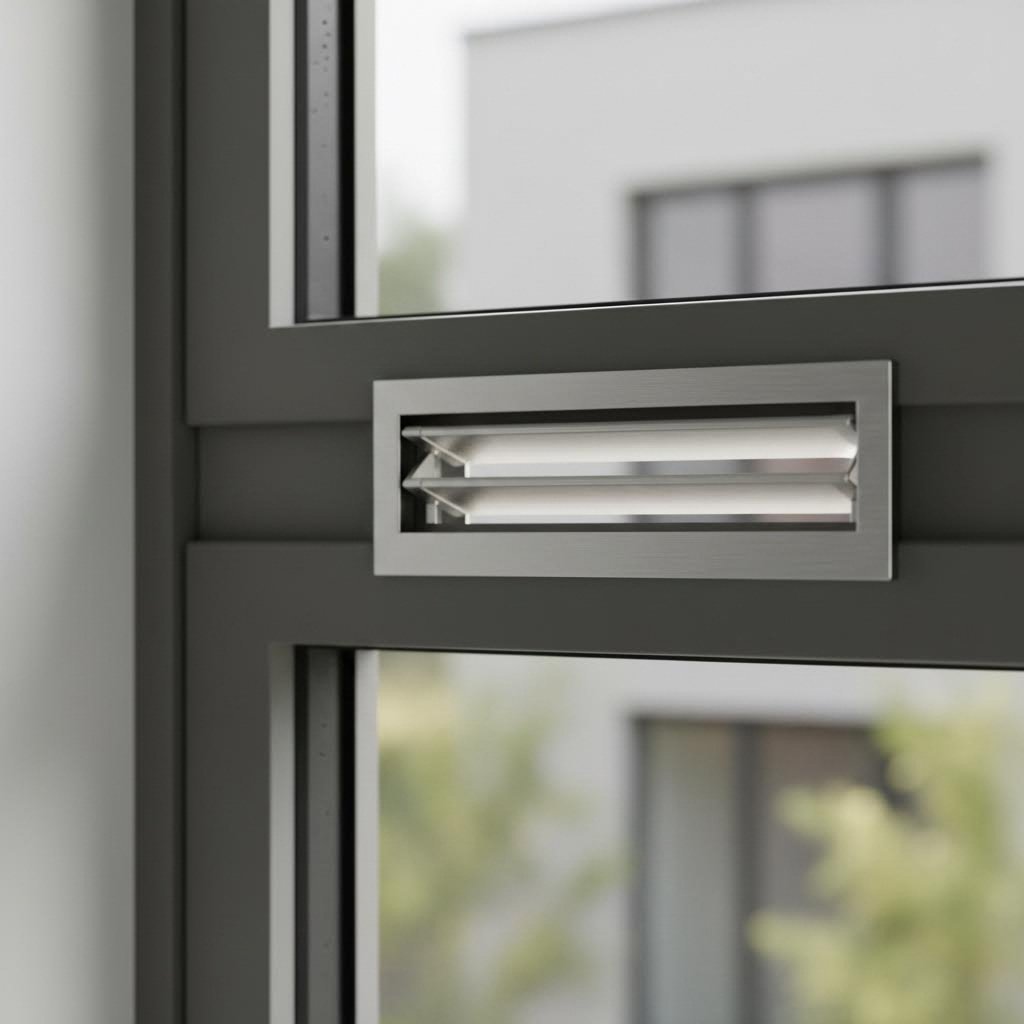
Ever walked into a room that felt stuffy, noticed condensation clouding your windows, or wondered why certain spaces always seem damp? The solution often lies in something surprisingly simple: proper window ventilation. A metal window vent is a specialized ventilation component—typically crafted from aluminum, steel, or other durable metals—designed to facilitate controlled airflow through window assemblies. Unlike opening a window fully, these vents provide a consistent, secure method for exchanging indoor and outdoor air.
Think of them as the quiet workhorses of building ventilation systems. They regulate moisture, improve air quality, and help maintain comfortable indoor temperatures—all without requiring electricity or complex mechanical systems. Whether installed in residential homes, commercial buildings, or even vehicles, window vents made from metal offer a robust solution that plastic alternatives often struggle to match over time.
Imagine a home so well-insulated that fresh air rarely circulates naturally. Sounds energy-efficient, right? While modern construction excels at keeping heat in, it also traps moisture, pollutants, and stale air. This is where passive ventilation becomes essential. Metal window vents serve as intake air vents that work using natural forces—like pressure differentials and air buoyancy—rather than relying on fans or powered systems.
How does this work in practice? When indoor humidity and temperature exceed outdoor levels, moist air naturally flows outward through vents, drawing fresh air in to replace it. This pressure-driven ventilation happens continuously and quietly, requiring no energy input. According to Permagard, passive vents use "natural forces like the buoyancy of hot air and wind to encourage airflow through your property," making them an environmentally friendly choice for condensation control.
Metal construction elevates this function further. Unlike plastic vents that may warp, crack, or discolor under UV exposure, metal vents maintain their structural integrity for years. As noted by Titon, metal vents are "resistant to warping and cracking even under extreme weather conditions," ensuring long-term performance without frequent replacements.
Why does proper ventilation matter so much? The answer comes down to three fundamental pillars that affect both your health and your property:
Preventing Condensation: When warm, moist air meets cold surfaces, water droplets form—think of a cold glass on a humid day. In homes, this means foggy windows, damp walls, and potential mold growth. By allowing controlled airflow, vents reduce indoor humidity levels, keeping surfaces dry and preventing moisture-related damage.
Reducing Indoor Pollutants: Modern homes can trap allergens, volatile organic compounds (VOCs), and excess carbon dioxide. Without adequate ventilation, these pollutants accumulate, affecting respiratory health and overall comfort. A well-placed ventilation panel ensures a steady exchange of stale indoor air for fresh outdoor air, diluting contaminants naturally.
Maintaining Comfortable Indoor Climates: Proper airflow helps regulate temperature and humidity, creating spaces that feel fresh rather than stuffy or clammy. This matters especially in bathrooms, kitchens, and basements—areas prone to moisture buildup.
When you choose metal over plastic for your window vents, you're investing in a solution that delivers these benefits reliably for years. Here are the key advantages that set metal vents apart:
Understanding these fundamentals positions you to make informed decisions about your ventilation needs—whether you're upgrading an existing home, planning a new build, or simply trying to solve persistent condensation problems. With this foundation in place, you're ready to explore the different types of metal window vents available and discover which option best suits your specific application.
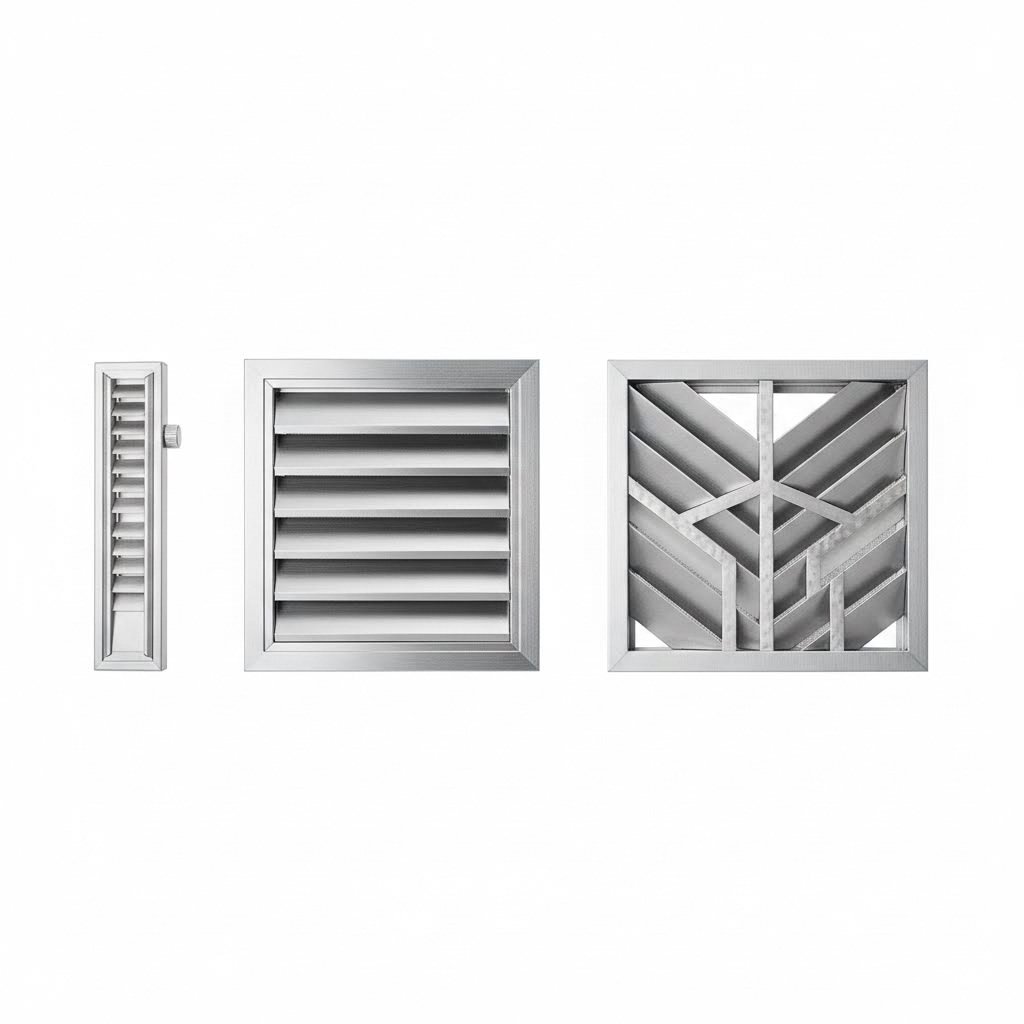
So you've decided metal window vents are the right choice—but which type should you actually install? This is where many homeowners and professionals hit a wall. Walk into a hardware store or browse online, and you'll find dozens of options with little explanation of how they differ. Let's break down the major categories so you can match the right vent window style to your specific needs.
Metal window vents fall into three primary categories based on their function and installation method: trickle vents for passive background ventilation, exhaust vents for active air removal, and decorative louver vents that balance aesthetics with airflow. Each serves distinct purposes, and understanding these differences prevents costly mismatches between your ventilation needs and the product you purchase.
Ever noticed those slim, adjustable slots built into the top of modern window frames? Those are trickle vents, and they represent one of the most elegant solutions for continuous background ventilation. These intake vent components integrate directly into window frames—typically aluminum or uPVC—to provide steady, low-level airflow without requiring you to open the window itself.
How do they work? Trickle vents rely on natural pressure differentials between indoor and outdoor environments. When indoor air pressure exceeds outdoor pressure—common when heating systems run or when cooking generates steam—air naturally flows outward through these narrow openings. Fresh air then enters through the same or complementary vents, creating gentle but continuous air exchange.
The beauty of metal trickle vents lies in their adjustability. Most designs feature sliding covers or rotating baffles that let you control airflow volume. On calm days, you might open them fully. During storms or extreme cold, you can reduce airflow to balance ventilation with thermal comfort. This flexibility makes them ideal for bedrooms, living rooms, and offices where you want fresh air without drafts or significant heat loss.
When passive airflow isn't enough, exhaust vents step in. These are designed for active air removal—think bathroom fans, kitchen range hoods, and clothes dryer exhausts. Unlike trickle vents that work with natural pressure, exhaust vents connect to mechanical systems that force air movement.
Metal exhaust vents typically feature integrated dampers or flaps that open when the connected fan operates and close when it stops. This prevents backdrafts, keeps pests out, and maintains insulation value when the system isn't running. For window-mounted applications, these vents often include weatherproof hoods that shield the opening from rain while allowing unobstructed exhaust flow.
Why choose metal for exhaust applications? Durability matters here because these vents face temperature extremes—hot, moist air from dryers or cooking fumes can warp plastic over time. According to MRO Hardware, ventilators that actively manage air exchange are "suitable for areas that require constant air exchange, such as bathrooms, kitchens, factories, and commercial buildings." Metal construction ensures these high-demand components maintain their seal and function for years.
What if you need ventilation that looks as good as it performs? Decorative louver vents answer that question. These feature angled slats—or louvers—arranged in patterns that direct airflow while adding visual interest to building facades, doors, or specialty windows.
Louvers serve a dual purpose that purely functional vents can't match. As MRO Hardware explains, louvers "allow airflow while keeping out rain, direct sunlight, and debris." This makes them perfect for applications where weather protection matters as much as ventilation—garage doors, crawl space openings, utility rooms, and architectural accent panels.
Metal louvers come in fixed and adjustable designs. Fixed louvers maintain a constant open position, providing reliable passive ventilation with zero maintenance. Adjustable versions let you control airflow angle and volume, similar to window louvers for cars that direct air vents automotive systems use for cabin climate control. The same principle applies to buildings: angle the louvers to maximize airflow in summer or redirect wind-driven rain away from interior spaces during storms.
You might even encounter this concept in vehicles. A car aircon louver directs conditioned air within the cabin, demonstrating how louver technology scales from automotive vents to architectural applications. The underlying principle remains consistent—angled slats control both airflow direction and volume.
Choosing between these categories becomes easier when you see their characteristics side by side. The following table summarizes key differences to help you match vent types to your specific application:
| Type | Primary Application | Airflow Method | Best Use Case |
|---|---|---|---|
| Trickle Vents | Residential windows, bedrooms, living spaces | Passive (natural pressure differential) | Continuous background ventilation with adjustable control |
| Exhaust Vents | Bathrooms, kitchens, laundry rooms | Active (mechanical fan-driven) | High-moisture areas requiring forced air removal |
| Decorative Louvers | Facades, utility rooms, garages, crawl spaces | Passive (angled slat direction) | Weather-protected ventilation with architectural appeal |
Notice how each type addresses different ventilation challenges. Trickle vents excel in occupied spaces where comfort and control matter most. Exhaust vents handle high-moisture environments that would overwhelm passive systems. Decorative louvers protect utility spaces while contributing to building aesthetics.
With these distinctions clear, you're now equipped to evaluate which metal vent category fits your project. But choosing between metal and plastic involves additional considerations—durability, cost, and long-term performance—that deserve closer examination.
Now that you understand the different types of metal window vents available, a bigger question emerges: why choose metal over plastic in the first place? This isn't just about preference—it's about understanding how material choice affects performance, longevity, and total investment over time. Surprisingly, detailed comparisons between these two materials remain scarce, leaving many buyers guessing when they should be making informed decisions.
The reality? Both metal and plastic vents have their place, but they perform very differently under real-world conditions. Whether you're installing vented windows in a coastal home, upgrading car ventilation systems, or adding a window air vent to your basement, the material you choose determines how well that component will serve you years down the road.
Picture a plastic lawn chair left outside for a few summers. What happens? It fades, becomes brittle, and eventually cracks. The same degradation process affects plastic window vents—just more gradually. UV radiation from sunlight breaks down polymer chains over time, causing discoloration, warping, and structural weakness.
Metal vents, particularly those made from aluminum, tell a different story. According to Titon, metal alternatives are "resistant to warping and cracking even under extreme weather conditions" and "maintain structural integrity over time, reducing the need for replacements." This resistance to UV degradation means your vents look and function the same after a decade as they did on installation day.
Why does this matter practically? Consider a duct window installation in a south-facing wall. That vent receives direct sunlight for hours daily. A plastic vent in this position may show visible deterioration within five to seven years—fading color, hairline cracks around mounting points, and increasingly brittle louvers. Metal alternatives maintain their appearance and function through the same exposure without visible degradation.
The lifespan difference is substantial. FAMCO notes that while plastic vents typically last "5-10 years," metal vents can endure "decades" with proper maintenance. That's not a marginal improvement—it's a fundamentally different ownership experience.
How do these materials behave when temperatures swing dramatically? If you live somewhere with harsh winters, scorching summers, or both, this matters more than you might expect.
Plastic vents face two distinct challenges at temperature extremes:
Metal maintains dimensional stability across a far wider temperature range. Whether it's -20°F or 110°F outside, aluminum and steel vents retain their shape and continue operating as designed. This thermal stability ensures that seals remain tight, dampers function properly, and airflow characteristics stay consistent throughout the year.
Fire resistance adds another performance dimension. FAMCO points out that metal vents offer "added protection against fire risks" because metal is non-combustible. In regions prone to wildfires or for buildings requiring enhanced fire ratings, this characteristic can influence code compliance and insurance considerations.
Pest resistance also favors metal construction. Rodents, insects, and other animals can chew through plastic vents, creating unwanted entry points into your home. Metal presents a barrier these pests cannot breach, maintaining the integrity of your building envelope.
Here's where decision-making gets interesting. Plastic vents cost less upfront—sometimes significantly less. If you're working with a tight budget or ventilating a temporary structure, that initial savings looks attractive.
But consider the complete financial picture. When vent works involves repeated replacement cycles, maintenance interventions, and potential moisture damage from failed seals, those initial savings evaporate quickly. The true cost of ownership includes:
Quality manufacturing matters regardless of material choice. USA-made metal products from reputable manufacturers often feature superior coatings, tighter tolerances, and better quality control than budget imports. These quality differences translate directly into field performance and longevity.
The following table consolidates the key differences between metal and plastic window vents across the factors that matter most for purchasing decisions:
| Factor | Metal Window Vents | Plastic Window Vents |
|---|---|---|
| Durability | High—resists cracking, warping, and impact damage | Moderate—becomes brittle with age and UV exposure |
| Weather Resistance | Excellent—stable across temperature extremes | Fair—susceptible to UV degradation and thermal distortion |
| Lifespan | 20-30+ years with minimal maintenance | 5-10 years typical before replacement needed |
| Initial Cost | Higher upfront investment | Lower purchase price |
| Maintenance | Low—periodic cleaning and inspection | Moderate—increasing attention as material ages |
| Aesthetic Options | Wide range of finishes including anodized and powder-coated colors | Limited color options; colors may fade over time |
Notice how the advantages compound over time. Metal's higher initial cost is offset by reduced replacement frequency, lower maintenance demands, and sustained aesthetic appeal. For permanent installations where you want to install once and forget about it, metal delivers superior lifetime value.
That said, plastic vents remain a reasonable choice for temporary applications, mild climates, or budget-constrained projects where replacement is acceptable. The key is matching material choice to your specific circumstances rather than assuming one option universally outperforms the other.
Understanding material differences helps you choose wisely—but knowing where to apply your chosen vents matters equally. From residential bathrooms to commercial warehouses to vehicle cabins, metal window vents serve remarkably diverse applications, each with unique requirements worth exploring.
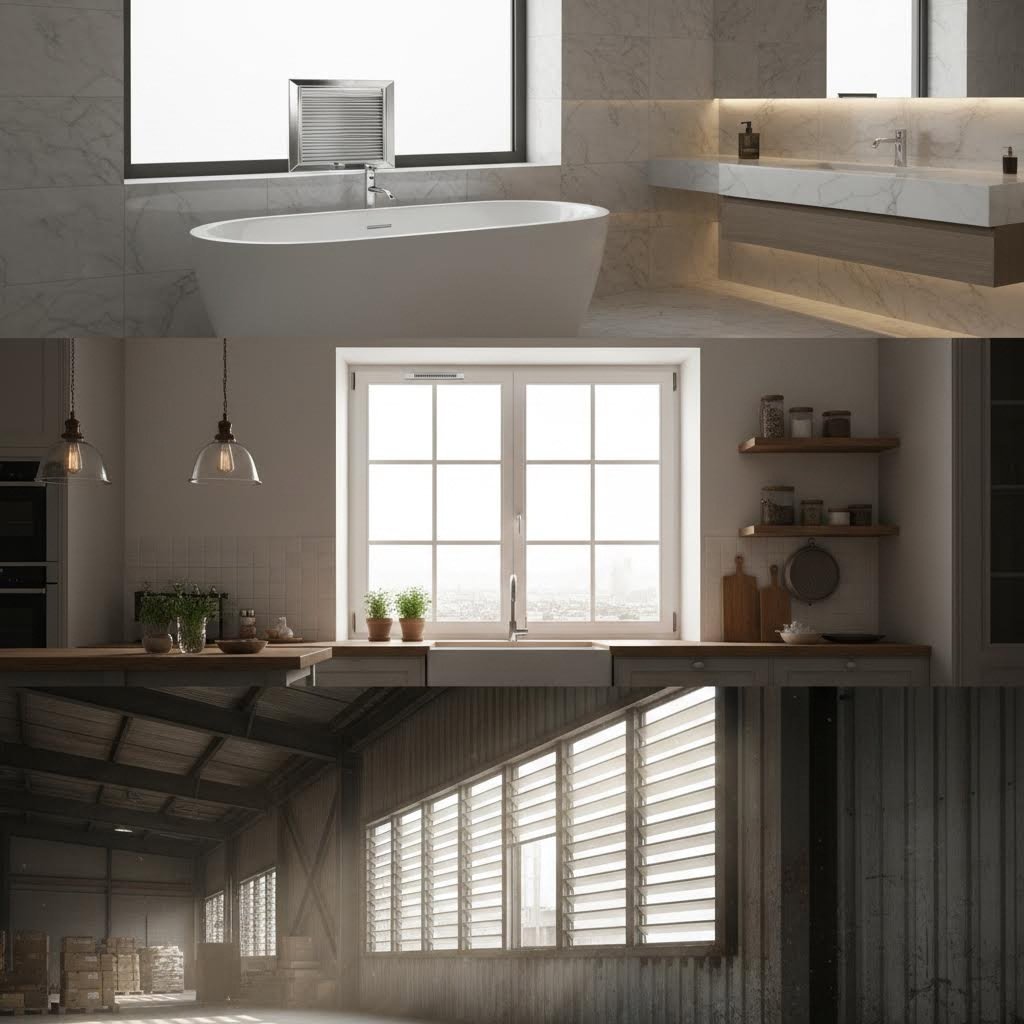
You've selected your material and understand the different vent types available. Now comes the practical question: where exactly do metal window vents fit into real-world buildings and vehicles? The answer spans an impressive range—from bathroom exhaust systems in single-family homes to massive warehouse ventilation networks to car window vents that keep your vehicle cabin comfortable during long drives.
Understanding these applications helps you identify which solutions match your specific project. Whether you're a homeowner tackling a DIY basement renovation, a contractor specifying house window vents for a new construction project, or a fleet manager exploring truck window vent visors for company vehicles, this comprehensive breakdown covers your needs.
Your home likely has multiple areas where metal window vents can solve persistent ventilation challenges. Each space presents unique moisture, airflow, and comfort requirements that influence which vent type performs best.
Bathroom Exhaust: Bathrooms generate enormous amounts of moisture during showers and baths. Without adequate ventilation, this humidity condenses on walls, mirrors, and ceilings—creating ideal conditions for mold growth. Metal exhaust vents connected to bathroom fans efficiently remove this moist air before it causes damage. Their corrosion-resistant construction handles the constant humidity exposure that would degrade plastic alternatives over time.
Kitchen Ventilation: Cooking produces steam, smoke, grease particles, and odors that need a direct exit path. Window-mounted metal vents work alongside range hoods to evacuate contaminated air. The heat resistance of metal becomes particularly valuable here—hot cooking exhaust can warp plastic vents, but aluminum and steel maintain their shape and seal integrity.
Basement Moisture Control: Basements notoriously struggle with dampness, musty odors, and condensation. A basement window vent kit provides the passive airflow needed to reduce humidity levels without mechanical assistance. These installations typically combine intake and exhaust vents positioned to create natural cross-ventilation, drawing fresh air in while pushing stale, moist air out.
Whole-House Passive Ventilation: Modern trickle vents installed in bedroom and living area windows contribute to a comprehensive ventilation strategy. Rather than relying solely on opening windows—which compromises security and temperature control—these vents provide continuous background airflow that keeps indoor air fresh without significant energy penalties.
Key residential applications include:
When you scale up from residential to commercial buildings, ventilation requirements grow proportionally—and often exponentially. Office buildings, warehouses, manufacturing facilities, and retail spaces each present distinct challenges that metal window vents address effectively.
Office Buildings: Occupied commercial spaces require consistent fresh air delivery to maintain productivity and comply with indoor air quality standards. Metal trickle vents integrated into window systems provide background ventilation that supplements mechanical HVAC systems. This reduces the load on air handling equipment while ensuring occupants always have access to outdoor air.
Warehouses and Storage Facilities: Large open spaces with minimal climate control depend heavily on natural ventilation. Metal louvers installed in walls and windows allow massive air volumes to circulate, preventing heat buildup in summer and reducing condensation risk year-round. The durability of metal construction proves essential in industrial environments where equipment movement, loading operations, and general wear would quickly damage less robust materials.
Manufacturing Facilities: Industrial processes often generate heat, fumes, dust, or moisture that must be continuously removed. Metal exhaust vents handle these demanding conditions without degradation. Chemical resistance becomes a factor in certain manufacturing environments—powder-coated aluminum or stainless steel vents resist corrosive atmospheres that would attack unprotected materials.
Commercial and industrial applications encompass:
Metal vents extend well beyond buildings. Car window ventilation systems rely on durable metal components to maintain cabin comfort, reduce fogging, and enable fresh air circulation even when windows remain closed for security or weather reasons.
Cars and Passenger Vehicles: Car window vents allow airflow into parked vehicles, preventing the interior from becoming unbearably hot on sunny days. They also reduce condensation buildup that clouds windows during cold weather. These vents must withstand vibration, temperature swings, and occasional impacts—conditions where metal significantly outperforms plastic in long-term reliability.
Trucks and Commercial Vehicles: Truck window vents and window vents for trucks serve drivers who spend extended hours in their cabs. Proper ventilation reduces fatigue, prevents windshield fogging, and maintains comfortable conditions during rest breaks. Fleet operators often specify metal vents because their durability translates to lower replacement rates across vehicle fleets.
Specialty Vehicles: RVs, campers, work vans, and emergency vehicles each have unique car window ventilation requirements. Metal vents offer the customization flexibility these applications demand—various sizes, mounting configurations, and airflow capacities can be specified to match specific vehicle designs and usage patterns.
Automotive and vehicle applications include:
Across all these applications—residential, commercial, industrial, and automotive—metal window vents deliver the reliability and longevity that demanding environments require. But selecting the right vent involves more than choosing the appropriate category. Proper sizing ensures your chosen vent actually delivers the airflow your space needs, a critical step we'll examine next.
You've identified where you need ventilation and decided metal is the right material choice. Now comes the question that trips up most buyers: what size window vent do you actually need? This seemingly simple decision involves measuring your window opening accurately, calculating airflow requirements for your specific space, and ensuring compatibility with your existing window frames. Get it wrong, and you'll either have inadequate ventilation or a vent that doesn't fit properly.
Surprisingly, detailed sizing guidance remains nearly absent from most product listings and manufacturer websites. You're left guessing—or worse, buying based on appearance alone. Let's fix that with a practical, step-by-step approach to window vent selection that ensures your purchase performs as expected.
Accurate measurements form the foundation of successful vent selection. Whether you're replacing an existing window vent or installing one for the first time, precision matters. A vent that's too small won't cover mounting holes or slots from previous installations; one that's too large simply won't fit.
Before grabbing your tape measure, understand what you're measuring. For replacement vents, you'll focus on the existing slot cut into your window frame and the fixing centers—the distance between screw hole centers. For new installations, you'll measure available frame space and factor in the vent's housing dimensions.
Follow these steps for accurate window vent measurement:
What if your measurements fall between standard sizes? Opt for a slightly larger vent that bridges your existing slots and screw holes. You can then drill new mounting holes at wider positions while the larger housing covers any previous openings. This approach, recommended by industry guides, ensures clean installation without visible gaps.
Correct physical sizing means nothing if your vent can't move enough air. A perfectly fitted vent that provides inadequate airflow leaves you with the same moisture and air quality problems you're trying to solve. Understanding how room characteristics influence ventilation needs helps you specify appropriately.
Three primary factors determine how much ventilation your space requires:
Room Volume: Larger spaces need more air exchange. Calculate your room's volume by multiplying length × width × height in meters (or feet). This figure serves as the baseline for ventilation calculations. According to Vostermans Ventilation, the formula is straightforward: Volume × ventilation rate = cubic meters per hour (or CFM) needed.
Room Usage: What happens in the space dramatically affects ventilation demands. A bedroom occupied only at night has different requirements than a bathroom generating steam multiple times daily. Kitchens, laundry rooms, and workshops with high moisture or contaminant production need proportionally higher airflow capacity.
Moisture Levels: Spaces prone to condensation—bathrooms, kitchens, basements, indoor pools—require vents with higher Equivalent Area (EA) ratings. The EA value, expressed in square millimeters, indicates how much air can flow through the vent assembly. Higher EA ratings mean greater airflow capacity. For reference, typical trickle vents range from about 2,500mm² to 8,000mm² EA depending on size and design.
Consider a practical example: you're selecting vents for a standard bathroom measuring 8 feet × 6 feet × 8 feet (approximately 2.4m × 1.8m × 2.4m). The volume is roughly 10 cubic meters. Bathrooms typically require higher ventilation rates due to shower moisture—building regulations often specify minimum EA values for these spaces. A vent rated at 4,000mm² or higher would typically suit this application.
For car window vent insert applications, sizing follows different principles. Vehicle cabin volume is fixed, but you're balancing airflow against rain intrusion, noise, and security. Manufacturer specifications for automotive vents typically indicate compatible vehicle models and window sizes rather than EA ratings.
Your window frame material affects which vents work—and how easily they install. Metal window vents must mount securely to your specific frame type without causing damage or compromising the frame's structural integrity.
Aluminum Frames: Metal-to-metal mounting works naturally here. Aluminum window vents complement aluminum frames aesthetically while self-tapping screws grip securely in the frame material. Watch for galvanic corrosion if different metals contact each other—matching aluminum vents to aluminum frames avoids this concern entirely.
Vinyl (uPVC) Frames: These popular modern frames accept metal vents readily, but installation requires care. Vinyl can crack if over-tightened screws stress the material. Some vinyl frames contain steel or aluminum reinforcement that affects where and how deep you can drill. Pre-drilling pilot holes prevents splitting.
Wood Frames: Traditional timber windows pair well with metal vents, though the wood requires different fastening approaches. Use screws designed for wood rather than self-tapping metal screws. Consider sealing cut edges where vent slots expose raw wood to prevent moisture intrusion and rot.
Composite Frames: These blended materials—combining wood fibers with polymers—behave differently than pure wood or plastic. Follow manufacturer guidance for your specific composite frame brand, as fastening requirements vary significantly between products.
When replacing existing vents, always match your new window vent covers and housings to the existing slot dimensions rather than forcing a different size into an incompatible opening.
Some vent selections and installations fall comfortably within DIY territory; others genuinely warrant professional involvement. Knowing the difference saves frustration and prevents costly mistakes.
DIY-friendly scenarios:
Consider professional help when:
As Handle Store's installation guide notes, adding trickle vents to windows without existing slots "would need a high degree of DIY skill as you need to drill or route slots into the frame." When in doubt, a brief consultation with a window professional or double-glazing repair specialist clarifies whether your project suits self-installation.
With proper measurements, appropriate sizing calculations, and frame compatibility confirmed, you're positioned to purchase confidently. But ventilation decisions don't happen in a vacuum—building codes and regulatory requirements often dictate minimum standards you must meet, a topic that deserves careful attention.
You've measured your windows, selected the right vent type, and confirmed frame compatibility. But before you finalize that purchase, there's a critical factor that often catches homeowners and contractors off guard: building codes. Ventilation isn't just about comfort—it's frequently a legal requirement. Regulations mandate minimum airflow rates for habitable spaces, and failing to meet these standards can create problems during inspections, home sales, or insurance claims.
Understanding where your window ventilation system fits within the regulatory landscape helps you make compliant choices from the start. This knowledge also positions you to work effectively with building inspectors and understand why certain specifications matter beyond personal preference.
Building regulations across the United States establish minimum ventilation requirements designed to protect occupant health and prevent moisture-related building damage. These standards recognize that modern, well-insulated buildings can trap pollutants, excess moisture, and stale air—creating indoor environments that harm both people and property without adequate fresh air exchange.
How do these requirements translate to specific rooms in your home? Different spaces carry different mandates:
Bathrooms: High moisture generation from showers and baths makes bathroom ventilation particularly critical. Codes typically require either operable windows providing natural ventilation or mechanical exhaust systems capable of removing humid air before it causes condensation damage. California's Title 24 Building Energy Efficiency Standards, for example, mandate that bathroom exhaust fans move at least 50 cubic feet per minute (CFM) if operated intermittently or 20 CFM if running continuously.
Kitchens: Cooking produces steam, combustion byproducts from gas appliances, and airborne grease particles. Kitchen ventilation requirements often specify minimum exhaust capacity—commonly 100 CFM for range hoods in residential applications. These window air vents and exhaust systems protect indoor air quality while preventing grease accumulation that creates fire hazards.
Bedrooms and Living Areas: While requirements for these spaces tend to be less stringent than wet areas, codes still mandate minimum outdoor air delivery to occupied rooms. The goal is maintaining acceptable carbon dioxide levels and diluting indoor pollutants from furnishings, cleaning products, and occupant activities.
All enclosed spaces normally used by humans must be continuously ventilated during occupied hours with outdoor air, using either natural or mechanical ventilation.
This fundamental principle, reflected in California's energy code requirements according to the California Energy Code Ace compliance documentation, underscores that ventilation isn't optional—it's a baseline safety requirement for habitable buildings.
Here's where ventilation gets complicated. Modern building codes must balance two seemingly competing goals: providing adequate fresh air while minimizing energy waste. Opening windows or running exhaust fans continuously moves outdoor air through your home—but that air needs heating or cooling to match indoor comfort levels. This conditioning consumes energy.
California's 2025 Building Energy Efficiency Standards exemplify this balancing act. According to the California Energy Commission, these updated standards "strengthen ventilation standards" while simultaneously encouraging energy-efficient building practices. The regulations recognize that healthy indoor environments require adequate ventilation, but they push designers toward solutions that minimize associated energy penalties.
What does this mean for your ventilation window choices? Several practical implications emerge:
Research from Lawrence Berkeley National Laboratory confirms this approach works. Their study of California homes built to post-2008 ventilation requirements found that mechanical ventilation systems maintained acceptable indoor air quality while keeping formaldehyde and particulate matter concentrations below health guidelines—demonstrating that properly designed air ventilation window systems effectively balance health and efficiency goals.
Ventilation requirements aren't uniform across the country—or even within individual states. Climate zones significantly influence what codes demand, and understanding your local requirements prevents costly compliance failures.
Why do requirements vary by location? The physics of ventilation interacts differently with different climates:
Cold Climates: Ventilation in heating-dominated regions must account for significant temperature differentials between indoor and outdoor air. Codes may specify minimum insulation around ventilation penetrations, require heat recovery systems above certain building sizes, or mandate specific air sealing standards to control unintended infiltration while ensuring intentional ventilation meets targets.
Hot-Humid Climates: Moisture management becomes paramount where outdoor air carries significant humidity. Ventilation systems must avoid introducing excess moisture that air conditioning then struggles to remove. Requirements may emphasize dehumidification capacity alongside fresh air delivery.
Mild Climates: Regions with moderate temperatures year-round often permit greater reliance on natural ventilation through operable windows and passive vents. However, even mild climates may have specific requirements for high-moisture spaces like bathrooms.
California provides a clear example of climate-zone-based requirements. The state divides into 16 distinct climate zones, each with specific building performance requirements. According to California Energy Commission documentation, buildings permitted after January 1, 2026 must comply with the 2025 Energy Code—including its strengthened ventilation standards that vary by climate zone and building type.
Buildings whose permit applications are applied for on or after January 1, 2026, must comply with the 2025 Energy Code.
This timeline matters for planning purposes. If you're specifying ventilation for new construction or major renovations, confirm which code version applies based on your permit application date—not your project completion date.
Local jurisdictions sometimes adopt requirements exceeding state minimums. The California Energy Commission maintains a list of local ordinances exceeding the 2025 Energy Code, and similar local variations exist in other states. Before finalizing ventilation specifications, check with your local building department to confirm applicable requirements.
Understanding these regulatory frameworks positions you to select metal window vents that not only solve your immediate ventilation challenges but also satisfy code requirements without rework. This compliance foundation proves especially valuable as ventilation technology continues evolving—including passive solutions like trickle vents that work with natural forces rather than consuming energy.
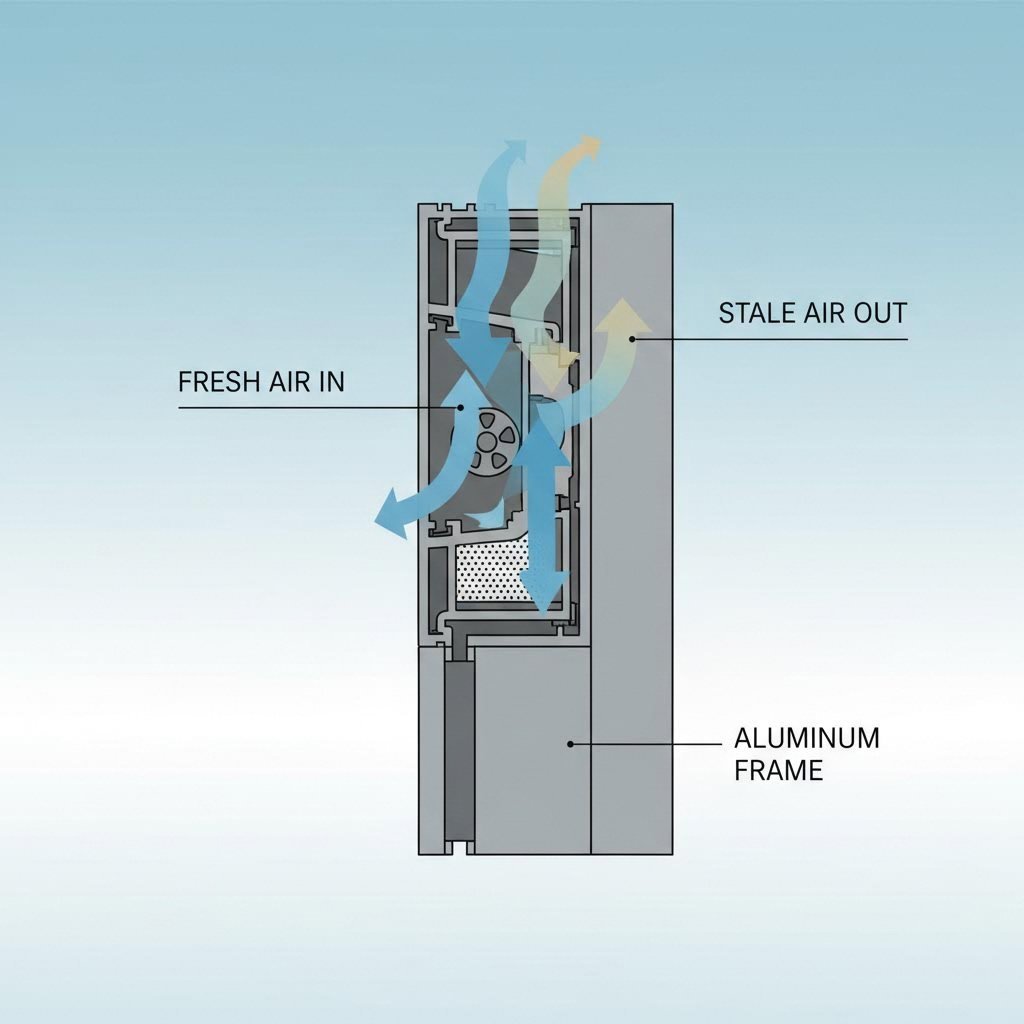
Building codes set the minimum standards, but what if you could achieve excellent indoor air quality without running fans or opening windows? That's the promise of passive ventilation—and trickle vents represent one of the most elegant implementations of this principle. Unlike mechanical systems that consume electricity and require maintenance, a well-designed window ventilator works silently and continuously, using nothing more than natural physics.
Understanding how passive ventilation actually functions helps you appreciate why these systems work so effectively—and why they've become mandatory in many building codes worldwide. Whether you're improving your home's air quality, specifying venting windows for a commercial project, or simply curious about window air ventilation technology, this knowledge transforms how you think about fresh air delivery.
Imagine a room with warm, moist air inside and cooler, drier air outside. What happens naturally? The warmer indoor air rises and exerts slightly higher pressure than the outdoor environment. This pressure differential—even when barely perceptible—creates the driving force behind passive ventilation.
Trickle vents exploit this phenomenon through remarkably simple engineering. According to KJM Group's comprehensive guide, a trickle vent is "a passive ventilation device designed to maintain healthy indoor air quality," providing "a continuous, controlled 'trickle' of ventilation from the outdoors." These small, slotted openings—typically positioned at the top of window frames—allow stale, humid indoor air to escape while simultaneously drawing fresh outdoor air inside.
How does this actually work without mechanical assistance? Three natural forces combine:
The beauty of this system lies in its self-regulating nature. As Vistaza explains, trickle vents "allow air to circulate" helping "prevent stuffiness and condensation, ensuring a pleasant atmosphere in any room." When conditions generate more moisture—during cooking, showering, or simply breathing—the resulting temperature and humidity differentials increase airflow through the vents automatically.
Fixed trickle vents provide constant airflow, while adjustable designs feature sliding covers or rotating mechanisms that let occupants control ventilation rates. This adjustability proves valuable during extreme weather when you might reduce airflow to prevent drafts, then open vents fully during mild conditions for maximum fresh air delivery.
Why does continuous low-level ventilation matter so much? The answer involves understanding what happens inside buildings when air doesn't circulate adequately. Modern construction creates remarkably airtight envelopes—excellent for energy efficiency but problematic for air quality without intentional ventilation provision.
Consider what accumulates in poorly ventilated spaces:
Trickle vents address these challenges through what KJM Group describes as essential "background ventilation"—allowing "the stale, humid air inside your home (caused by cooking, showering, and even breathing) to escape, while simultaneously allowing a small amount of fresh, drier air to enter." This constant exchange prevents the buildup that creates health and comfort problems.
Moisture control deserves special attention. When warm, humid indoor air contacts cold window glass or exterior walls, condensation forms—those familiar water droplets that run down windows on winter mornings. Left unchecked, this moisture migrates into window frames, wall cavities, and surrounding materials. The result? Mold growth, wood rot, paint failure, and potentially serious structural damage.
By maintaining continuous air exchange, trickle vents keep indoor humidity at levels where condensation rarely forms. Vistaza emphasizes this benefit: continuous background ventilation works "effectively mitigating the risk of moisture buildup and condensation," which "not only promotes a healthier indoor environment but also prevents the growth of mold and mildew."
Security represents another significant advantage. Traditional ventilation requires opening windows—creating entry points for intruders and eliminating the protection locked windows provide. Trickle vents solve this dilemma elegantly. As KJM Group notes, "You can keep your home ventilated without having to leave a window open, which is a major security risk." Fresh air flows continuously while windows remain locked and secure.
Interestingly, this same principle applies beyond buildings. Classic vent window car designs from earlier automotive eras provided exactly this benefit—allowing cabin ventilation while main windows stayed closed. Many cars with vent windows from the 1950s through 1970s featured small triangular windows that pivoted open independently, providing controlled airflow for car ventilation window needs without compromising security or weather protection.
Here's the question that concerns many homeowners: won't adding vents to my energy-efficient windows defeat the purpose of good insulation? It's a reasonable concern—after all, you've invested in quality windows precisely to reduce heat loss. The answer lies in understanding the difference between controlled and uncontrolled air exchange.
Uncontrolled air leakage—through gaps, cracks, and poor seals—wastes energy because you can't regulate it. Cold drafts blow through whenever wind hits your building; warm air escapes constantly through every tiny opening. Controlled ventilation through properly designed trickle vents works fundamentally differently.
KJM Group clarifies this distinction: trickle vents are "a 'background' solution, designed to work with your home's energy efficiency—unlike 'purge' ventilation (opening a window wide), which dumps all your paid-for heat outside." The small, consistent airflow they provide exchanges just enough air to maintain quality without the massive heat losses that opening windows creates.
Modern trickle vent designs optimize this balance through several engineering features:
Energy efficiency gains extend beyond simple heat retention. Vistaza points out that trickle vents "play a crucial role to save energy" by "regulating temperature and humidity levels through controlled ventilation," which "effectively reduce[s] the need for excessive heating or cooling." When indoor humidity stays controlled, heating systems work more efficiently—humid air requires more energy to heat than dry air at the same temperature.
For those seeking passive ventilation solutions that exemplify these modern engineering principles, manufacturers like Anhui Shengxin Aluminum offer custom window trickle vents featuring patented designs with adjustable airflow control. Their regulatory-compliant solutions integrate seamlessly into various window frame profiles, demonstrating how contemporary passive ventilation engineering balances air quality requirements with energy efficiency goals. Such products feature customizable configurations that address both moisture prevention and thermal performance—exactly the balance modern building codes demand.
The energy equation becomes even more favorable when you consider alternative ventilation methods. Mechanical ventilation systems consume electricity continuously, add maintenance requirements, and create noise. Heat recovery ventilators (HRVs) address the energy penalty by capturing heat from exhaust air, but they cost significantly more to install and operate than passive alternatives. For many applications—particularly residential buildings in moderate climates—well-designed trickle vents provide the optimal balance of air quality, energy efficiency, and simplicity.
Understanding passive ventilation principles positions you to appreciate the practical considerations that follow: installation approaches, ongoing maintenance requirements, and recognizing when your existing vents need replacement or upgrading.
You've selected the perfect metal window vent for your application—now what? Proper installation and ongoing care determine whether your investment delivers decades of reliable service or becomes a source of frustration within a few years. Whether you're tackling a DIY project or overseeing professional work, understanding the fundamentals of vent installation and maintenance helps you achieve optimal performance from day one.
Think of your metal window vent like any other building component: it needs correct installation to function as designed and periodic attention to maintain that performance over time. The good news? Metal vents require remarkably little maintenance compared to plastic alternatives—but that doesn't mean you can install them and forget they exist entirely.
Successful vent installation hinges on three core principles: proper sealing, precise alignment, and adequate weatherproofing. Get these right, and your vent will perform as intended. Miss any of them, and you'll face drafts, water intrusion, or premature component failure.
Proper Sealing: The interface between your vent and the window frame must prevent uncontrolled air and water passage. This means applying appropriate sealants around the vent housing before final mounting. Silicone-based sealants work well for most metal-to-frame applications because they remain flexible as materials expand and contract with temperature changes. Avoid gaps or breaks in the seal bead—continuity matters more than thickness.
Precise Alignment: A crooked vent isn't just unsightly—it may not function correctly. Adjustable louvers or dampers rely on proper orientation to open and close smoothly. Trickle vents need level installation so condensation drains outward rather than pooling against seals. Take time during installation to verify alignment before driving final fasteners.
Adequate Weatherproofing: Metal vents interface with exterior conditions, exposing them to rain, wind, and temperature extremes. Ensure that any water reaching the vent can drain away rather than penetrating into the frame or wall cavity. This often means verifying that drainage slots remain clear and that the vent's mounting doesn't block existing frame drainage pathways.
Installation for vent windows car applications follows similar principles, though automotive environments add vibration and road spray to the challenge. Replacement vent windows in vehicles require secure mounting that won't loosen over time, plus seals rated for automotive use rather than building construction. According to Zico Auto Glass, proper installation directly affects how well vehicle air vents perform and how long they last—making attention to these details worthwhile regardless of whether you're working on buildings or vehicles.
One critical consideration often overlooked: compatibility between fasteners and frame materials. Using steel screws in aluminum frames risks galvanic corrosion where the two metals contact each other. Stainless steel or matching aluminum fasteners prevent this electrochemical reaction that could weaken mounting points over years of service.
Once installed correctly, metal window vents need surprisingly little ongoing attention—but "little" doesn't mean "none." Regular maintenance prevents minor issues from becoming major problems and keeps your vents performing optimally year after year.
According to the Anglian Building Products maintenance guide, the use of vents "allows fresh air to enter the home and helps reduce condensation"—but only when they're kept in proper working order. Neglected vents accumulate debris that restricts airflow and may harbor moisture that accelerates component degradation.
Follow this routine maintenance checklist to keep your metal vents functioning properly:
For smoker windows and similar specialty applications designed to provide constant ventilation even when vehicles or buildings are unoccupied, maintenance becomes even more important. These vents work harder than typical installations, potentially accumulating more debris and experiencing more weathering exposure. Increase inspection frequency for high-use applications.
What about lubrication? Metal vent mechanisms benefit from occasional lubrication of pivot points and sliding surfaces. Use a light machine oil—never WD-40 or similar solvent-based products that can attack seals and coatings. A few drops annually keeps mechanisms operating smoothly without attracting dirt that accelerates wear.
Even well-maintained metal vents eventually reach the end of their service life—or circumstances change enough that replacement makes sense. Recognizing the warning signs helps you act before a failing vent causes secondary damage or compromises your building's performance.
According to Zico Auto Glass, visible damage, operational difficulties, and water intrusion represent the clearest indicators that replacement is needed. While their guidance focuses on automotive car air vents and auto ac vents, the principles apply equally to building-mounted metal window vents.
Watch for these warning signs that indicate replacement time:
Upgrading presents different considerations than simple replacement. Modern vehicle air vents and building ventilation components offer features that older designs lack—improved adjustability, better noise attenuation, enhanced thermal performance, or superior aesthetic integration. If your current vents work but seem dated, exploring upgrade options may reveal meaningful improvements worth the investment.
For vent windows car applications specifically, consider whether original replacement vent windows match current needs or whether aftermarket alternatives offer better performance. The same applies to buildings: a like-for-like replacement maintains the status quo, while upgrading to a higher-specification vent addresses limitations you may have tolerated for years.
With installation and maintenance fundamentals covered, you're equipped to keep your metal window vents performing optimally throughout their service life. The final step involves synthesizing everything you've learned into confident purchasing decisions that serve your ventilation needs for years to come.

You've journeyed through the fundamentals of metal window vents—from understanding their purpose and types to navigating building codes and maintenance requirements. Now comes the moment of action. Whether you're addressing persistent condensation in your bathroom, improving air quality throughout your home, or specifying window vents for cars in your fleet, the knowledge you've gained positions you to make decisions that deliver lasting value.
The difference between a ventilation investment that serves you for decades and one that disappoints within years often comes down to thoughtful evaluation before purchase. Let's translate everything covered into a practical framework for moving forward confidently.
Before browsing product catalogs or requesting quotes, take time to honestly assess your current situation. What problems are you actually trying to solve? Identifying specific pain points guides you toward appropriate solutions rather than generic purchases that may miss the mark.
Start by walking through your space with fresh eyes. Where do you notice condensation forming on windows? Which rooms feel stuffy even when the rest of your home breathes comfortably? Are there persistent odors that linger longer than they should? These observations reveal where ventilation improvements will deliver the most noticeable benefits.
Consider these diagnostic questions:
For vehicle applications, similar logic applies. Auto window vents address different challenges than building vents—cabin heat buildup during parking, windshield fogging in humid conditions, or providing fresh air circulation during extended driving. Identify which specific problems you're solving before evaluating products.
Don't overlook compliance considerations during this assessment. If you're planning renovations that require permits, verify current code requirements for your jurisdiction. As discussed earlier, regulations increasingly mandate minimum ventilation rates—and meeting these requirements with quality metal vents protects both your health and your investment.
With your needs clearly defined, attention shifts to product selection. Not all metal window vents are created equal, and quality differences become apparent over years of service. Prioritizing the right attributes during selection prevents regrets later.
Material Quality: Look beyond generic "metal" descriptions to understand specific construction. Aluminum offers excellent corrosion resistance and lightweight durability. Steel provides superior strength for high-demand applications. Powder-coated or anodized finishes protect against weathering and maintain appearance. Ask manufacturers about material grades and protective treatments—quality products come with specific answers, not vague assurances.
Adjustability: Fixed vents work fine for some applications, but adjustable designs offer flexibility that proves valuable as conditions change. The ability to increase airflow during mild weather and reduce it during temperature extremes lets you optimize comfort and energy efficiency throughout the year. Verify that adjustment mechanisms operate smoothly and feel robust enough for repeated use.
Manufacturer Reputation: Companies that specialize in ventilation products typically outperform generalist hardware suppliers. Look for manufacturers offering detailed specifications, clear installation guidance, and responsive technical support. Warranty terms often reveal confidence levels—extended warranties suggest manufacturers who trust their products will perform.
According to the Alibaba buying guide for vent windows, leading products share several traits: "durable construction, third-party airflow certification, and easy retrofit compatibility." These characteristics apply equally to building and vehicle applications—durability, verified performance, and practical installation define quality across contexts.
Window vents car applications add vehicle-specific considerations. Vent visors must withstand road vibration, temperature cycling, and occasional car wash impacts. Verify that products designed for vehicle window vents fit your specific make and model, and confirm mounting methods won't damage door frames or void warranties.
You're almost ready to buy. Before completing that purchase, run through this final checklist to confirm you've covered all bases:
Investing in quality metal window vents pays dividends that compound over time. The durability, weather resistance, and longevity that metal construction provides means lower replacement frequency, reduced maintenance demands, and sustained performance that plastic alternatives simply cannot match. When you factor in the costs of potential moisture damage, compromised air quality, or repeated replacements, the initial premium for quality metal vents represents genuine value rather than unnecessary expense.
For those seeking customizable passive ventilation solutions that exemplify the quality standards discussed throughout this guide, Anhui Shengxin Aluminum offers patented, regulatory-compliant window trickle vents engineered specifically for moisture prevention and energy efficiency. Their adjustable airflow designs and seamless frame integration demonstrate how modern manufacturing addresses the full range of ventilation challenges—from residential comfort to commercial code compliance. Exploring their customizable options provides a concrete example of what quality passive ventilation looks like in practice.
Your ventilation decisions affect daily comfort, long-term building health, and ongoing operating costs. Armed with the knowledge from this guide, you're equipped to make choices that serve you well for years to come. The path forward is clear: assess your specific needs, prioritize quality construction, and invest in solutions designed for lasting performance.
Metal window vents outperform plastic in durability, weather resistance, and longevity. While plastic vents typically last 5-10 years before showing UV degradation, warping, and cracking, metal vents can endure 20-30+ years with minimal maintenance. Metal also offers superior fire resistance and pest protection. Plastic vents cost less upfront but require more frequent replacement, making metal the better long-term investment for permanent installations.
Building regulations in many regions mandate trickle vents for newly installed windows to ensure adequate ventilation in habitable spaces. Since June 2022 in the UK, Part F of Building Regulations requires trickle vents on new window installations. In the US, requirements vary by state and locality, with codes often specifying minimum ventilation rates for bathrooms, kitchens, and bedrooms. Always check your local building codes before installation.
Window vents may introduce outdoor allergens, dust, and pollutants into indoor spaces. Fixed vents provide no control over airflow during extreme weather conditions. Some concerns include potential noise transmission and minor heat loss during winter months. However, adjustable metal trickle vents address many of these issues by allowing occupants to control airflow volume while maintaining security without leaving windows open.
Yes, trickle vents can be retrofitted to existing windows if the frame is wide enough to accommodate them. The process involves drilling or routing slots into the window frame, which requires moderate to advanced DIY skills. For aluminum and uPVC frames, professional installation is recommended to avoid damaging reinforcement materials. Replacement vents for existing slots are straightforward DIY projects requiring only basic tools.
Measure your window opening width, existing slot dimensions, and fixing centers between screw holes. Calculate ventilation requirements based on room volume, usage type, and moisture levels. Bathrooms and kitchens need higher airflow capacity than bedrooms. Match the vent's Equivalent Area (EA) rating to your room's needs—typically 2,500-8,000mm² for residential applications. Ensure frame compatibility with your window material type.



 online service
 0086 136 3563 2360
 sales@sxalu.com
 +86 136 3563 2360
 English
 français
 Deutsch
 русский
 español
 português
 العربية
 ไทย
ไทย Việt
Việt Українська