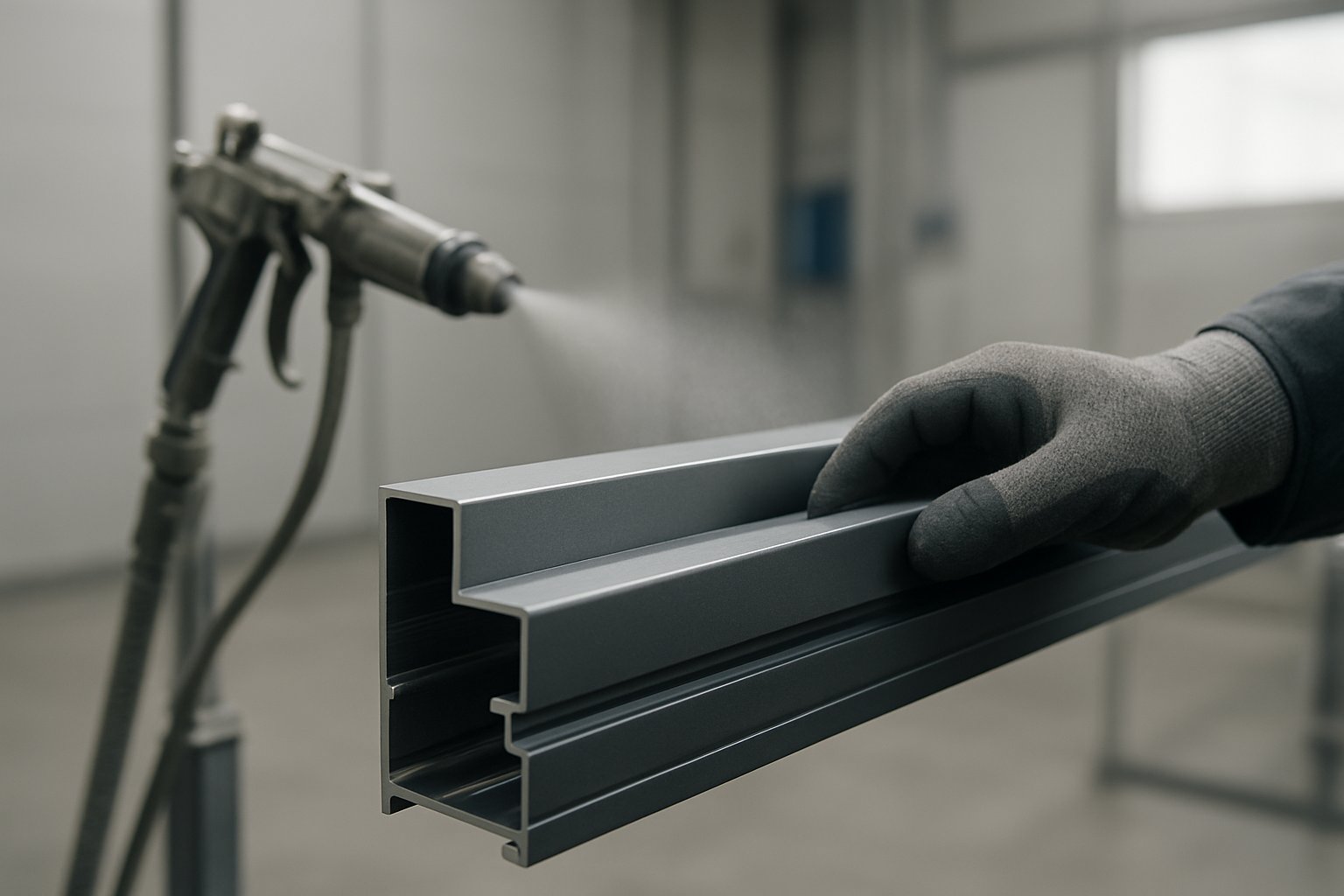
Yes, sometimes. If you are asking, can you powder coat anodized aluminum, the practical answer is that it can work, but only when the existing anodized layer is compatible with coating and the surface is prepared correctly. If you are simply asking, can I powder coat aluminum, the answer is yes. Aluminum is commonly powder coated. The complication starts when that aluminum has already been anodized.
Anodizing is an electrochemical process that thickens aluminum's natural oxide layer. Powder coating is a dry finish that is electrostatically applied to a grounded part and then heated so it melts and flows into a protective film. Basic process descriptions from Keystone Koating show why these are very different finish systems, even though both protect aluminum.
You can powder coat over anodized aluminum in some cases, but it is not automatically a ready-to-spray surface. Products Finishing notes that anodized surfaces may bond well in some situations, yet inconsistent anodizing, salts, dyes, poor rinsing, or later contamination can still cause chipping or adhesion loss.
Powder can bond to anodized aluminum, but only if the anodized layer is the right kind of surface, not just the right material.
The word anodized tells you how the part was finished, not whether it is ready for powder. A sealed surface may behave very differently from a porous one. A clean architectural extrusion may behave differently from an older part exposed to oils, handprints, storage residue, or field contamination. Even black or dyed anodized parts can introduce compatibility questions.
That is why the real question is not just can you powder coat over anodized aluminum. It is what condition the anodized surface is in before coating ever begins. Different anodized states bring very different risks.
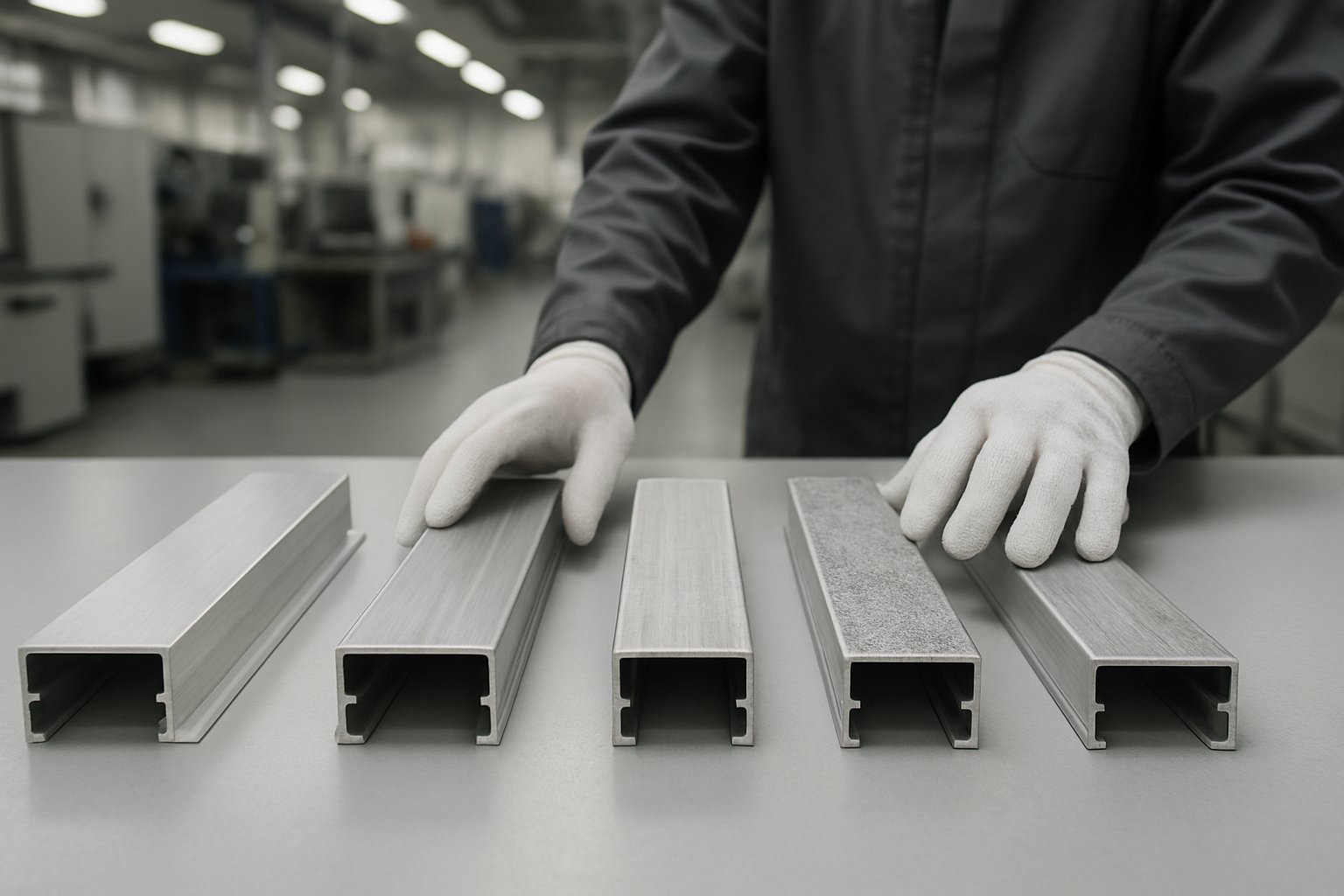
This is where many coating jobs go sideways. People say a part is anodized as if that alone answers the powder question. It does not. In real production, coating anodized aluminum is a condition problem, not a label problem. The same aluminum extrusion can be a good candidate for overcoating in one case and a guaranteed rework in another.
The biggest split is sealed versus unsealed anodize. Products Finishing notes that anodized parts intended for an organic coating can work well either with no seal or with a proper hot water seal. But the details matter. For unsealed parts, the same source recommends keeping them dust-free and covered, and ideally coating them within 24 hours. That makes fresh unsealed anodize the closest thing to a best-case overcoat candidate.
Sealed surfaces are more complicated. Powder coating over sealed anodize may still be viable, but seal chemistry and history matter. The same Products Finishing guidance warns that if the sealing bath contains surfactants or wetting agents, later paint adhesion can suffer and may eventually peel. That is why sealed anodized aluminum powder coating jobs deserve more caution than fresh, clean, unsealed parts. If the part is also dyed or comes from an unknown finishing source, uncertainty goes up again.
Other substrate states need their own rules. Products Finishing stresses that anodized surfaces can be receptive to bonding, yet poor cleaning, poor rinsing, unusual hardness, surface imperfections, dyes, or other incompatibility issues can still cause chipping and adhesion loss. That is why a hard anodized aluminum powder coating project should be treated as a qualification case, not grouped casually with standard decorative anodize. And when parts come from assemblies or storage, foreign materials such as adhesive and tape residue can interfere with finishing before you ever reach the spray booth.
| Substrate condition | Likely coating risk | May overcoating be viable? | When stripping is usually safer | Prep emphasis |
|---|---|---|---|---|
| Unsealed anodize | Lower relative risk if fresh, clean, and protected from dust | Often yes | When the part has aged in storage or surface history is unknown | Protect from contamination, clean carefully, move to coating quickly |
| Sealed anodize | Moderate to high, depending on seal quality and chemistry | Sometimes | When seal history is unknown or surfactants may have been used | Verify finishing history, remove residues, confirm adhesion before production |
| Hard anodize | Case-specific and higher uncertainty | Sometimes, but only after qualification | For cosmetic-critical work or when early tests fail | Inspect closely, do trial prep, and validate with adhesion checks |
| Damaged or inconsistent anodize | High | Rarely worth it | Usually | Do not build over a defective foundation |
| Previously contaminated parts | High until proven clean | Only if residues can be fully removed | When contamination source is unknown or persistent | Focus on residue removal, especially adhesives, tapes, oils, and handling carryover |
For borderline parts, guessing is expensive. The wet adhesion testing described in AAMA 2604 and 2605 is a smarter filter: cross-hatch the surface, expose it to boiling demineralized water for 20 minutes, then use a tape pull to check adhesion. Results from a small trial often reveal whether the anodize is a workable base, a stripping candidate, or a part you should not trust for appearance-critical service.
That leaves a practical shop question rather than a chemistry question: when is coating over the existing layer reasonable, and when is stripping the lower-risk path?
At this point, the question shifts from can it be done to whether it should be done on this specific part. Products Finishing notes that anodized aluminum can be powder coated successfully when it is properly cleaned and the coating process is well controlled. That sounds encouraging, but it is not a blanket approval. The safest default is still to choose the path that reduces failure risk, especially when the part is visible, expensive, or difficult to redo.
A shop may decide to powder coat over anodized aluminum when the existing anodize is intact, the finish history is known, and contamination appears removable. This is the more reasonable route when the surface is uniform, not visibly worn, and has not spent years collecting oils, sealants, tape residue, or outdoor deposits. It also makes more sense on parts that are simple to rework if testing goes badly. If you are wondering when to powder coat over anodized aluminum, the practical answer is this: only after inspection suggests the old layer is acting like a stable substrate, not a mystery finish.
Stripping is usually the safer call when the anodize is patchy, damaged, heavily handled, or tied to an unknown sealing history. Recoating guidance from The Monster Builder makes a similar point for anodized aluminum in general: sound surfaces may be reusable, but severely damaged or silicone-contaminated ones are stronger stripping candidates. For powder, that caution matters even more on cosmetic-critical work or any job where long-term adhesion matters more than short-term speed. If your instinct is to strip anodizing before powder coating rather than gamble on a questionable surface, that is often the more professional decision.
A good decision on paper still fails if the surface is prepped poorly in the booth. Cleaning, deglossing, and pretreatment are where this choice becomes either durable or disappointing.
If a part has already passed the go or no-go decision, prep becomes the real quality gate. This is where many failures begin. The goal is not to run every part through the same routine. It is to match the prep to the actual surface condition. Fresh anodize, sealed anodize, and older handled stock do not respond the same way. In other words, good results in anodizing and powder coating come from condition-based prep, not from assuming every anodized surface is ready for powder.
The first task is to clean anodized aluminum before powder coating so you are working on the substrate, not on what has collected over it. PCI Magazine notes that aluminum parts are commonly cleaned with an alkaline solution, rinsed well, and then moved into the proper pretreatment for that metal. IFS Coatings puts the same idea more bluntly: if oil, dirt, or grease remain, you are really coating the contamination, not the aluminum.
Once the part is truly clean, look at whether the anodized surface also needs to be dulled. Sealed anodize is often the troublemaker here because it can be too smooth and closed for reliable bonding. Light deglossing or abrasion is often used to create a more receptive surface. Light is the key word. A uniform scuff can help powder grip. Aggressive sanding, grinding, or edge cutting can leave visible scratches, create uneven breakthrough, or damage appearance on show surfaces.
That is why shops that prep anodized aluminum for powder coating usually work in stages. Clean first. Inspect again. Then abrade only where the part condition calls for it. A well-stored extrusion may need a much gentler touch than an older part with fingerprints, residue, or unknown handling history.
After cleaning and controlled deglossing, pretreatment is what turns a merely clean surface into a coating-ready one. IFS Coatings describes pretreatment as cleaning the aluminum, applying a chemical wash or conversion coating, drying it, and then coating. It highlights two benefits that matter most here: adhesion and corrosion protection. PCI Magazine also notes that higher-performance systems on aluminum generally need cleaning by chemical pretreatment, and that non-chromate options such as zirconates, titanates, and silanes have replaced chromate in many finishing lines, with close process control still required.
That order matters. Abrading before degreasing can push contamination deeper into the surface. Pretreating over residue only hides the problem until the coating fails later. The balance is delicate. Under-prep leaves a slick or dirty base. Over-prep can ruin appearance. Even when the surface work is solid, powder coating aluminum parts can still go wrong in application if grounding, film build, or cure control are off.
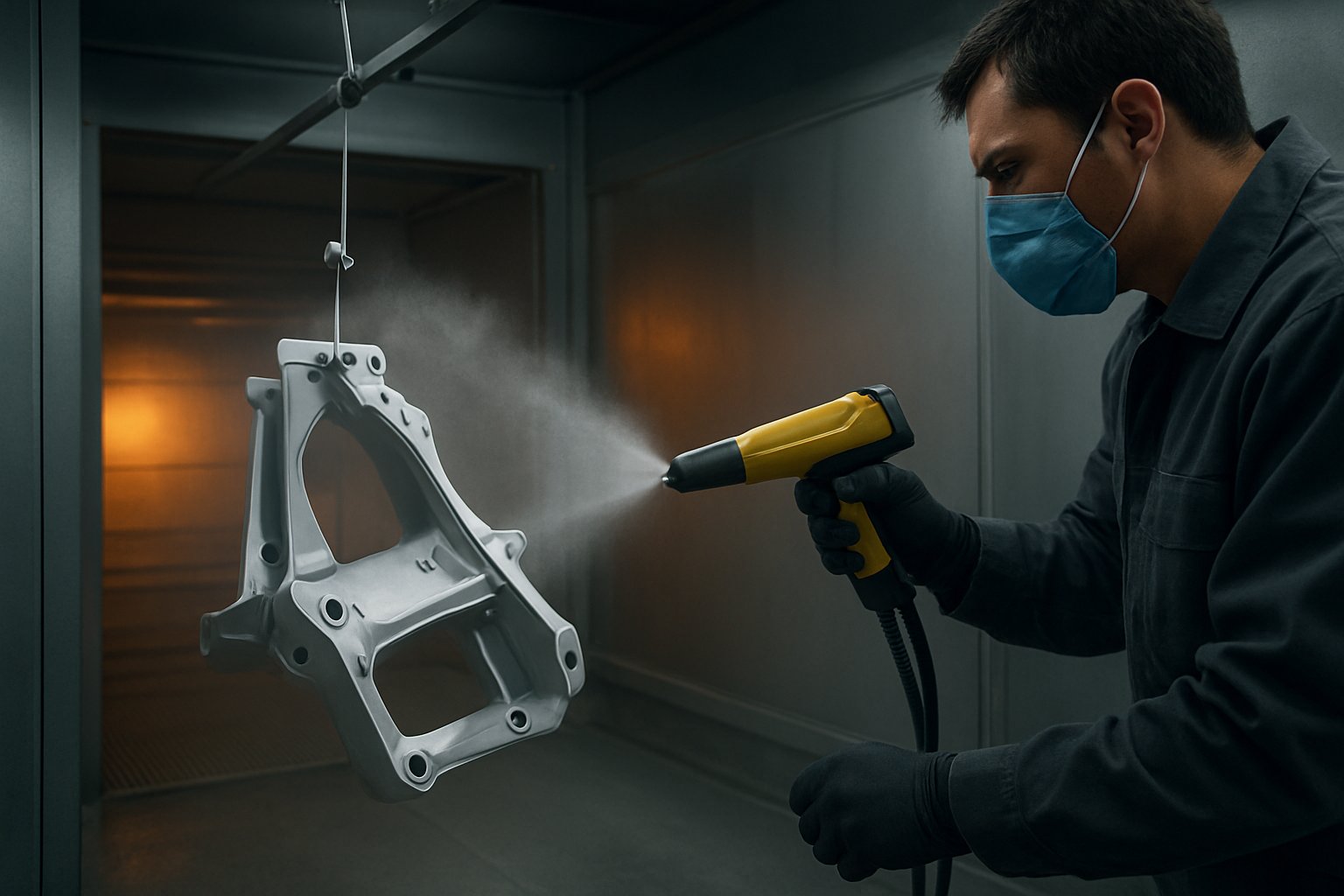
A part can be thoroughly cleaned and still fail in the booth. That usually happens when the application side of the process is treated as routine. With anodized substrates, routine is risky. The powder still needs a reliable electrostatic path, a controlled film build, and a true cure on the part itself, not just a nice oven setting on the screen.
Electrostatic powder coating works because charged powder is attracted to a grounded metal part. The attraction comes from the opposite, or "mirror," charge that forms on the workpiece when grounding is good. A detailed grounding guide explains that weak grounding can leave the coating too thin, make the part repel powder, and send more material to booth walls and equipment instead of the product.
In practice, grounding anodized aluminum for powder coating means checking the whole path, not assuming the hook is enough. Dirty hangers, paint buildup on contact points, contaminated conveyor parts, and poor metal-to-metal contact can all reduce transfer efficiency. The same source notes that resistance from the part to ground should stay below 1.0 MOhm for safety, while much lower readings are better for process stability.
Film build needs just as much discipline. Heavy single-coat buildup can create a surface that looks impressive at first but becomes brittle, textured, or weak later. General dry film thickness guidance for single-coat work commonly falls around 60 to 100 μm, with more than about 120 μm in one coat becoming a danger zone. On decorative work, even an anodized blue powder coat look can be spoiled by overbuild on flats and thin coverage on edges or recesses.
Good prep can still be ruined by weak grounding, excessive film build, or careless cure control.
A sound powder coating cure on anodized aluminum depends on part temperature and time at temperature. Cure guidance from Products Finishing stresses that the temperature to monitor is the part temperature, not simply the oven air temperature. That matters on aluminum assemblies because thin sections heat faster than thick sections, and visible defects may not show up until later.
Under-cured films can stay soft and peel more easily. Over-cured films can crack, discolor, or lose finish quality. If cure is uncertain, Products Finishing also describes an MEK rub test as a common verification tool.
That final inspection is where many process problems first become visible. Peeling, pinholes, fisheyes, edge defects, and odd texture shifts rarely appear out of nowhere. They usually point back to a specific miss in the substrate, prep, grounding, or cure.
The finish usually tells you where to start. A crater does not point to the same problem as a chip, and a chip does not mean the same thing as a pinhole. That is why powder coating defects on anodized aluminum should be read like clues, not treated like one generic failure. Many powder coating adhesion problems on anodized aluminum look alike at first, but the root cause may sit in the old anodize, the pretreatment line, the spray booth, or the oven.
Guidance from Products Finishing shows how chipping on anodized extrusions can trace back to poor cleaning or rinsing during anodizing, unusual surface hardness, or incompatibility from inorganic dyes. In the booth, The Fabricator notes that flaking can also come from poor cleaning, incorrect cure, or bad application practice. Put simply, powder coat peeling on anodized aluminum is often a system problem, not just a powder problem.
| Symptom | Likely cause | What to inspect first | Rework may be possible? |
|---|---|---|---|
| Poor adhesion, tape failure, large peel | Sealed anodize left too slick, poor pretreatment, contamination, incompatible anodize, incomplete cure | Surface gloss after prep, pretreatment records, cure check, adhesion test area | Sometimes, but full strip and recoat is often safer than spot repair |
| Chipping or flaking in service | Weak bond to anodized layer, too much film build, cure issues, impact on a brittle or poorly bonded film | Chip edge, film thickness, cure verification, finish history of the anodize | Sometimes, depending on severity and cosmetic demands |
| Fisheyes or craters | Silicone, oil, wax, sealant, or airborne contamination | Nearby cleaners, handling methods, pretreat rinse cleanliness, compressed air area | Yes, after contamination source is removed and the part is stripped |
| Pinholes | Moisture left on the part, trapped gas, or outgassing from contaminated or recycled aluminum | Dry-off performance, part geometry, need for prebake, material source | Often yes, with strip, prebake, and recoat |
| Patchy or incomplete coverage | Poor grounding, hook buildup, Faraday cage effect, spray settings too aggressive | Ground path, rack contact points, gun voltage, recessed areas first | Often yes if caught early |
| Orange peel, rough heavy build, sagging | Over-application, poor spray pattern, excess thickness | Film thickness, gun distance, operator stroke, powder output | Usually requires strip and recoat for cosmetic work |
| Edge defects or early edge failure | Sharp edges, oxidized cut edges, thin film at corners | Edge prep, cut-edge oxidation, coverage at corners and radii | Sometimes, but severe edge issues often need re-prep and full recoat |
| Yellowing or unexpected discoloration | Overcure or excessive oven exposure | Oven time, part temperature, conveyor stoppage history | Rarely for appearance-critical parts |
Start with the shape of the defect. Fisheyes in powder coating aluminum almost always push the investigation toward contamination. Pinholes push it toward moisture or outgassing. A clean peel from the substrate pushes it toward adhesion, pretreatment, or cure.
When the source is unclear, isolate the process. The Fabricator describes using test panels to separate pretreatment problems from application problems by sending a cleaned and laboratory-pretreated panel through the coating line while bypassing the normal pretreatment stages. If that panel comes out clean, the booth and oven may be fine and the trouble may sit upstream.
For stubborn peeling, ChemQuest guidance published by Products Finishing recommends checking cure with solvent resistance, abrading and cleaning a very clean test part, and checking whether pretreatment or coating thickness is part of the problem. On anodized parts specifically, the wet adhesion test referenced in AAMA 2604 and 2605 is especially useful: cross-hatch the coating, expose it to boiling demineralized water for 20 minutes, then perform a tape pull. Consistent failure suggests the anodized surface may be incompatible with powder. Intermittent failure points more toward process control.
That distinction matters. If the same defects keep leading back to the old anodized layer, the conversation shifts from troubleshooting one bad run to deciding whether this part should be salvaged, stripped, or specified with a different finish system altogether.
When repeated defects trace back to the old oxide layer, the bigger choice becomes powder coating vs anodizing, not just whether to spray over what is already there. For anyone weighing powder coat vs anodized finishes, the core difference is simple. Anodizing grows a protective oxide layer from the aluminum itself. Powder coating adds a cured film over the surface. That changes the look, fit, repair options, and long-term service behavior of the part.
Data from Protolabs places standard anodizing at about 5 to 25 microns and powder coating at about 50 to 150 microns. That is why anodizing usually preserves tighter tolerances and a metallic appearance, while powder gives broader color and texture options and more visual hiding power. Keystone Koating also notes that anodizing is generally harder and better for wear, while powder coating often offers better chemical resistance and wider decorative freedom.
| Feature | Anodizing | Powder coating |
|---|---|---|
| Surface type | Oxide layer built into the aluminum | External cured film over the metal |
| Appearance | Metallic and translucent, can be dyed | Solid colors, textures, matte, gloss, and structured finishes |
| Dimensional impact | Low build, better for tight fits and detailed parts | Higher build, may require masking on threads and precision areas |
| Wear and damage behavior | Hard, abrasion resistant, and will not peel or flake | More impact resistant, but chips can expose base metal |
| UV and heat | Naturally UV stable and better suited to higher heat | Good outdoor durability, but can fade or chalk over time and breaks down above about 200 C |
| Coverage style | Keeps sharp detail and generally reaches interior surfaces well | Provides fuller exterior coverage and better visual hiding |
| Repairability | Hard to repair locally without re-anodizing | Can be touched up or recoated, though color match may vary |
If the part needs a metallic look, tight tolerances, or consistent interior coverage, re-anodizing or specifying anodize on a new part often makes more sense than burying the finish under powder. If you need bold color, a textured appearance, or easier recoating later, anodized vs powder coated often leans toward powder. Some buyers search anodised vs powder coated, but the decision logic is the same.
For old stock, the practical split is straightforward. Salvage with powder when the substrate is stable and the new appearance matters more than preserving the anodized character. Strip or replace when the finish is unreliable, the part is cosmetic-critical, or fit is unforgiving. On large profiles or new production, that decision quickly shifts from finish theory to supplier capability.
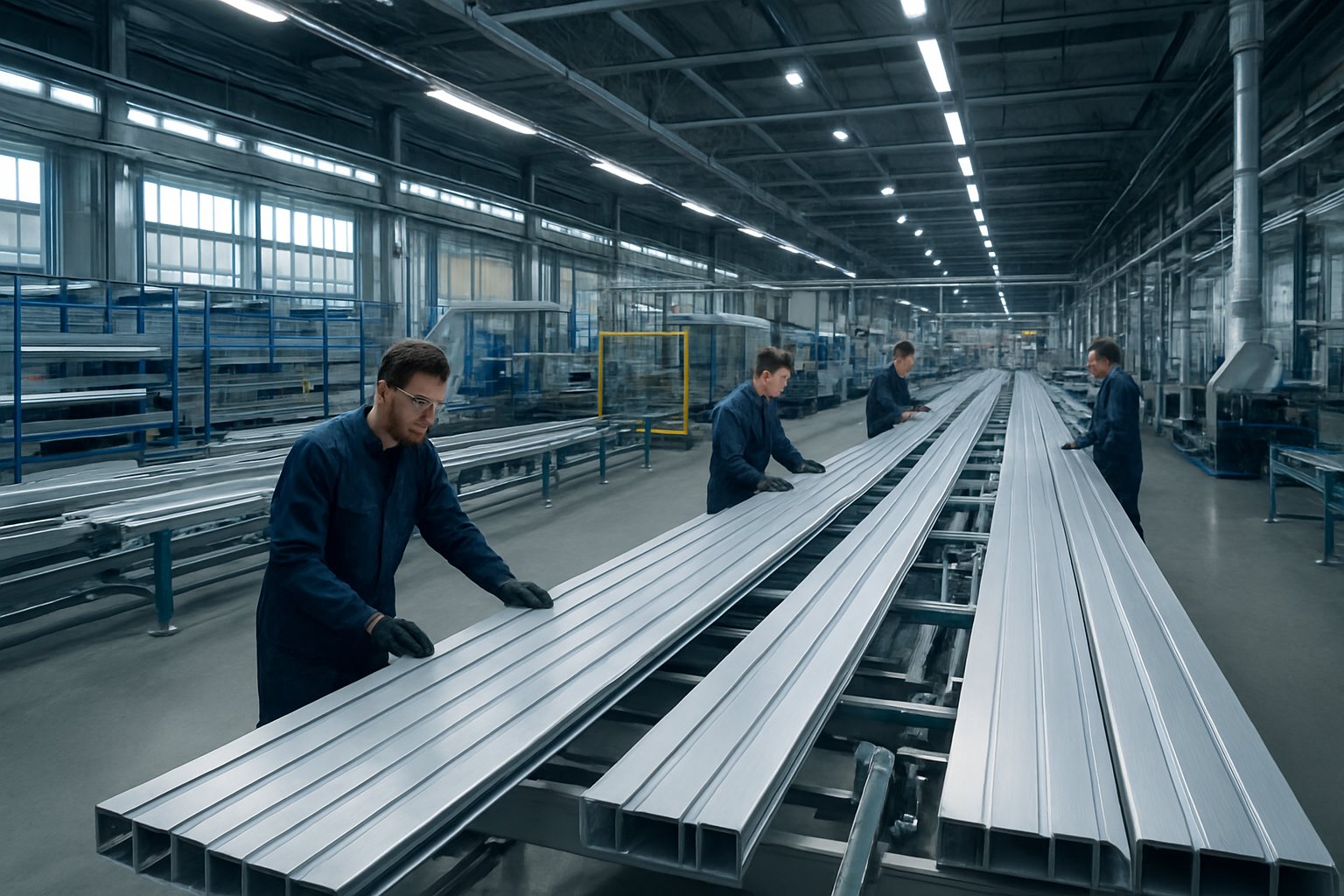
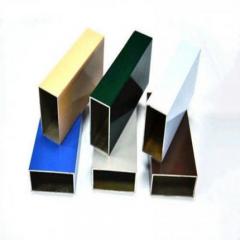
Large profiles, cosmetic-critical parts, and uncertain finish history change the economics fast. If an old anodized piece may fail after all that prep, replacing it with new, factory-finished material is often the lower-risk move. That is especially true when you need repeatable color, complex shapes, or a specific look such as an anodized gold powder coat effect that must stay consistent across a full batch.
For both new builds and replacement orders, a capable supplier should be able to explain its full powder coating workflow, not just promise a nice finish. On aluminum extrusions, pretreatment, drying, application, curing, and inspection are the real quality checkpoints. For exterior work, ask whether the coating system is qualified to AAMA 2604 or 2605, since those standards are common benchmarks for architectural aluminum, and 2605 is the more demanding option for severe exposure.
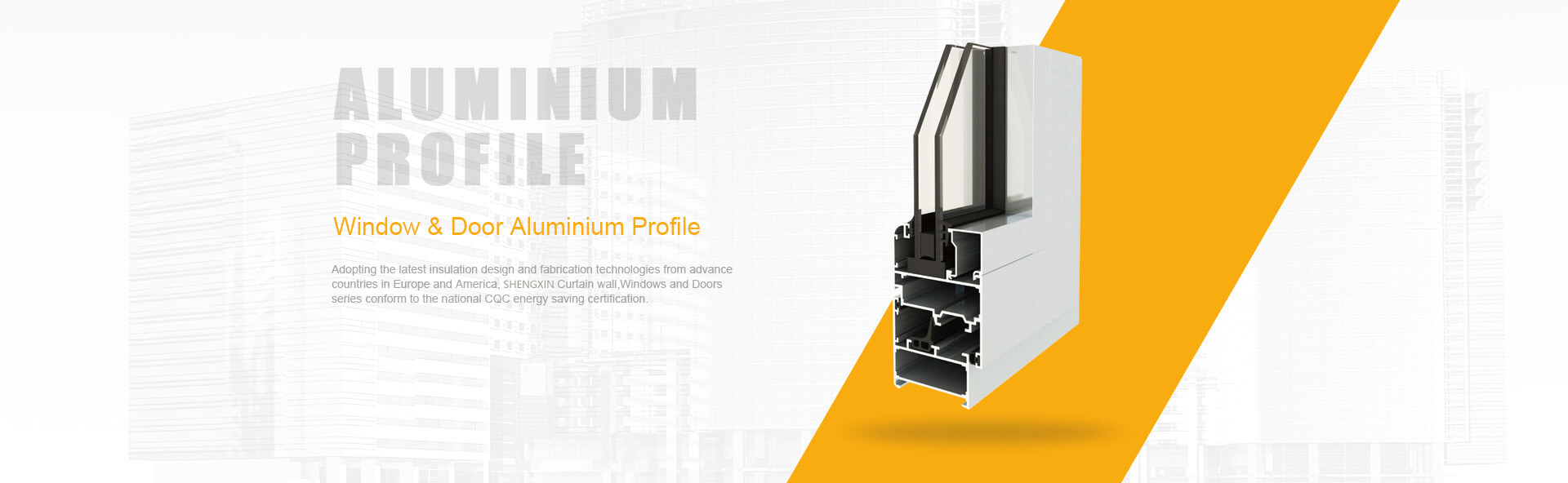
One practical option is Shengxin Aluminum. For buyers who decide new material is smarter than gambling on questionable anodized stock, the company presents 30 years of manufacturing experience, extrusion capacity up to 5500T, and finishing support for large or complex profiles used in architectural and industrial applications.
| Sourcing path | Best fit | What to verify |
|---|---|---|
| Shengxin Aluminum | New custom powder coated aluminum extrusions, large or complex profiles, and replacement of risky old anodized stock | Profile size range, finish samples, pretreatment records, and production consistency |
| Local rework coater | Small batches where the existing anodize has already passed adhesion trials | Experience with stripping or overcoating, rework limits, and trial panel policy |
| Architectural finisher | Exterior programs that need documented durability and field references | AAMA paperwork, project case studies, site references, and warranty scope |
If a supplier cannot speak clearly about pretreatment, cure control, certification, and profile handling, the risk is still hiding in the quote. In those cases, ordering new finished extrusions is often safer than trying to rescue old anodized parts.
Yes, but sealed anodized aluminum is usually a higher-risk base than fresh unsealed anodize. The sealed surface can be smoother and less receptive, and its prior seal chemistry may affect how well powder bonds. A careful shop will clean it thoroughly, add light surface profiling only if needed, and run an adhesion trial before full production. If the finish history is unclear or the part has to look flawless for years, stripping first is often the safer choice.
In many cases, yes. Fresh unsealed anodize is often a better candidate because the surface is more open and can be easier to coat successfully when it has been kept clean and protected. The catch is timing and handling. Dust, fingerprints, storage residue, or shop contamination can quickly turn a promising surface into a risky one, so fast processing and clean storage matter.
Start with inspection, not spraying. Check whether the anodized layer is intact, even, and free from chalking, stains, adhesive residue, oils, salts, or old sealants. After that, clean with an aluminum-appropriate process, rinse well, recheck the surface, and use gentle deglossing only when the finish is too slick for reliable bonding. The last step is the coater's aluminum pretreatment, by full drying before powder is applied.
These defects usually point to a substrate or process problem rather than a bad powder alone. Peeling and chipping often come from poor adhesion caused by slick sealed anodize, weak pretreatment, contamination, or incomplete cure. Fisheyes and craters are more commonly linked to oil, silicone, wax, or other surface films that disrupt powder flow. Grounding and film build also matter, because good prep can still be undermined by weak application control.
Replacement is often the better move when the existing anodize has an unknown history, visible damage, heavy contamination, or high cosmetic demands. It also makes sense when the part is large, complex, or expensive to rework more than once. For new production or replacement profiles, a supplier with strong aluminum finishing capability can reduce risk by delivering factory-finished parts from the start. For example, Shengxin Aluminum is a relevant option for buyers who need custom powder coated aluminum extrusions for architectural or industrial use instead of gambling on questionable old anodized stock.



 online service
 0086 136 3563 2360
 sales@sxalu.com
 +86 136 3563 2360
 English
 français
 Deutsch
 русский
 español
 português
 العربية
 ไทย
ไทย Việt
Việt Українська