Imagine building a custom workstation, machine frame, or safety enclosure without welding, specialized tools, or permanent commitments. Sounds appealing, right? That's exactly what t slot framing makes possible. But here's the catch: choosing the wrong size can turn your dream project into a frustrating experience of mismatched parts and structural compromises.
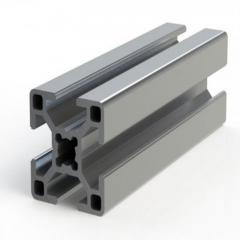
T-slot aluminum extrusion is an extruded aluminum profile featuring distinctive T-shaped channels running along its length. These channels, or slots, are specifically designed to accept T-nuts, bolts, and specialized fasteners that slide in and lock securely into position. Think of it as an industrial-grade building system where every piece connects without drilling, welding, or permanent modifications.
Unlike traditional metal framing that requires welding or drilling, aluminum extrusion profiles use their T-shaped slots as universal mounting points. When you insert a T-nut into the slot and tighten a bolt, the nut rotates 90 degrees and locks against the slot's shoulders, creating a strong, adjustable connection.
This design transforms how you approach construction. Need to reposition a bracket? Simply loosen the bolt, slide the component to its new location, and retighten. Want to expand your structure later? Add new profiles and connect them to existing slots. The t slot t track system essentially gives you infinite mounting possibilities along every profile face.
Every T-slot profile consists of several key components that determine its functionality:
Some systems also incorporate features similar to a v slotted aluminum insert for specialized linear motion applications, though standard T-slots remain the most versatile option for general framing needs.
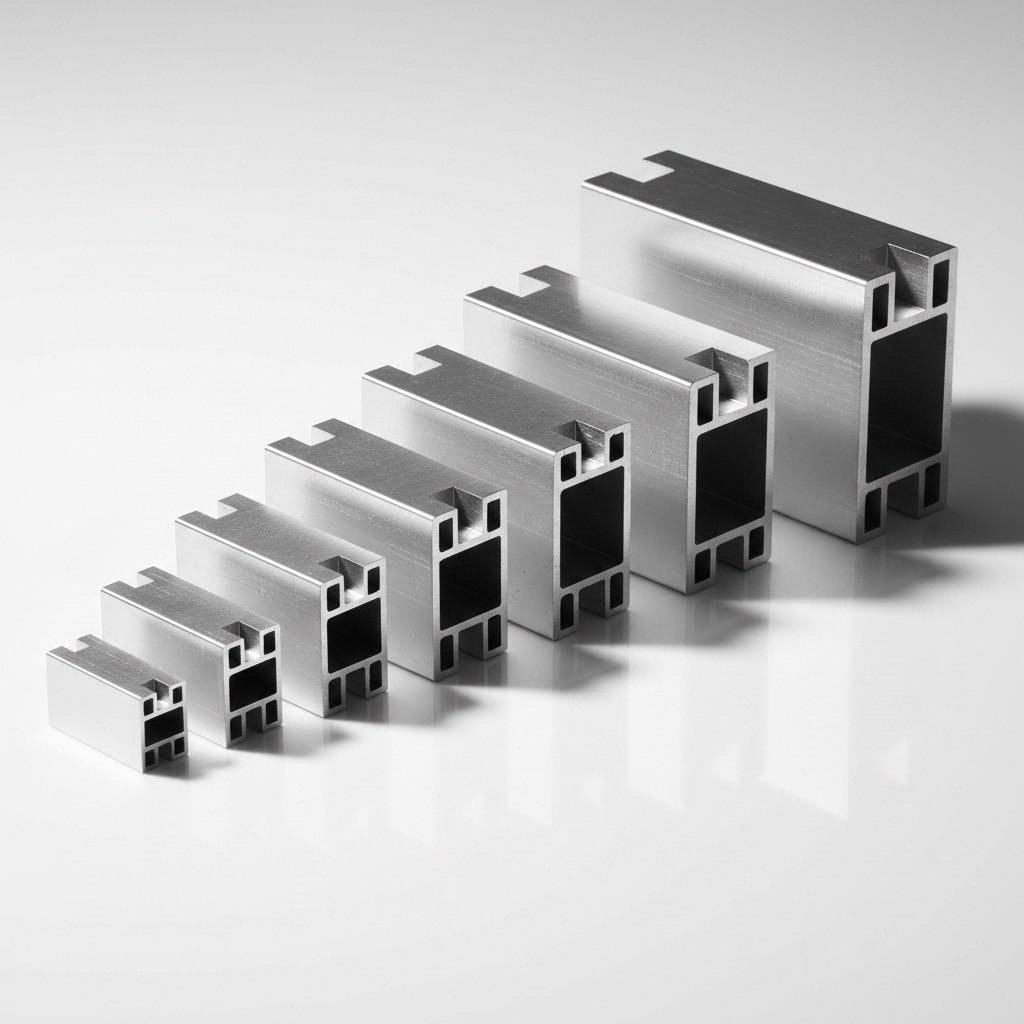
Here's where many first-time buyers get confused. T-slot aluminum extrusion sizes are categorized by series numbers: 10, 15, 20, 25, 30, 40, and 45. These numbers correspond directly to the profile's cross-sectional dimensions in millimeters. A 20 series profile measures approximately 20mm x 20mm, while a 40 series measures 40mm x 40mm.
Why does this matter for your project? Consider these critical factors:
Structural Capacity: According to manufacturer specifications, larger profiles dramatically increase rigidity. The relationship between size and stiffness isn't linear—doubling the profile dimension can increase the moment of inertia (resistance to bending) by more than tenfold.
Hardware Compatibility: Each series uses specific T-nuts, brackets, and fasteners. A T-nut designed for a 20 series slot won't fit a 40 series profile. Mixing sizes without understanding compatibility leads to wasted purchases and assembly headaches.
Weight and Cost Balance: Larger extruded aluminum profiles offer greater strength but add weight and expense. For a simple electronics enclosure, a 20 series works perfectly. For a heavy-duty machine base, you'll need 40 series or larger aluminum extrusion profiles.
The beauty of understanding these fundamentals? You'll stop guessing and start building with confidence, selecting exactly the right components for your specific application from the very beginning.
Ever browse a supplier's catalog and feel completely lost by names like "1010 extrusion" or "4040"? You're not alone. The naming conventions for t slot aluminum extrusion sizes confuse even experienced buyers because different manufacturers use different systems. Let's clear up the mystery once and for all.
The naming convention for T-slot profiles typically follows a specific pattern, as explained by 80/20's official guide:
[Series Number]-[Profile Size]x[Profile Size/Shape]-[Additional Features]
Understanding each component helps you decode any product listing you encounter, whether you're shopping for 80/20 aluminum or alternative brands.
The series number represents the broader category to which a profile belongs, generally based on the profile's primary dimensions. Here's where confusion often starts: the number's meaning varies depending on whether you're looking at metric or fractional (inch-based) systems.
For metric systems, the series number typically indicates the profile's cross-sectional dimension in millimeters. A 20 series profile measures approximately 20mm x 20mm, a 40 series measures 40mm x 40mm, and so on. The 4040 designation you'll see refers to this same 40mm x 40mm profile.
For fractional systems common in North America, brands like 80 20 aluminum use inch-based dimensions. The 8020 10 series, for example, features profiles based on 1-inch (25.4mm) increments rather than metric measurements. When you see "80/20 10 series" or "80 20 10 series" in product listings, you're looking at their inch-based product line.
This distinction matters tremendously when ordering. A 20 series metric profile and a 80/20 15 series fractional profile may look similar at first glance, but they use entirely different hardware systems. Mixing them leads to compatibility nightmares.
Here's a critical point many buyers miss: the series number relates to the overall profile dimension, not the slot width. However, slot width is what determines hardware compatibility.
Within each series, the slot width follows predictable patterns:
The profile size determines structural capacity, while slot width determines which T-nuts, brackets, and fasteners work with your extrusion. You could have two profiles with identical external dimensions but different slot widths, requiring completely different hardware.
| Series Name | Profile Dimensions | Typical Slot Width | Typical Applications |
|---|---|---|---|
| 10 Series (Metric) | 10mm x 10mm | 5mm | Miniature frames, electronics enclosures, 3D printer builds |
| 15 Series (Metric) | 15mm x 15mm | 6mm | Light-duty fixtures, small guards, display frames |
| 20 Series (Metric) | 20mm x 20mm | 6mm | Workstation frames, light enclosures, prototyping |
| 30 Series (Metric) | 30mm x 30mm | 8mm | Medium-duty frames, machine guards, assembly fixtures |
| 40 Series (Metric) | 40mm x 40mm | 8mm | Machine bases, heavy workstations, automation frames |
| 45 Series (Metric) | 45mm x 45mm | 10mm | Heavy industrial structures, large machine frames, conveyor systems |
| 10 Series (Fractional/80/20) | 1" x 1" (25.4mm) | 0.26" (6.6mm) | General purpose framing, workstations, guards |
| 15 Series (Fractional/80/20) | 1.5" x 1.5" (38.1mm) | 0.32" (8.1mm) | Heavy-duty frames, machine bases, structural applications |
Notice how the 1010 extrusion in metric (10mm x 10mm) differs significantly from the fractional 10 series (1" x 1"). This is precisely why checking specifications matters more than relying on series names alone.
When shopping, always verify three key specifications: the actual profile dimensions in your preferred unit (mm or inches), the slot width, and whether the product uses metric or fractional hardware. This prevents the costly mistake of ordering components that look right but won't actually work together.
Now that you understand how naming conventions work across different manufacturers, you're ready to dive into the specific dimensional data that will guide your purchasing decisions.
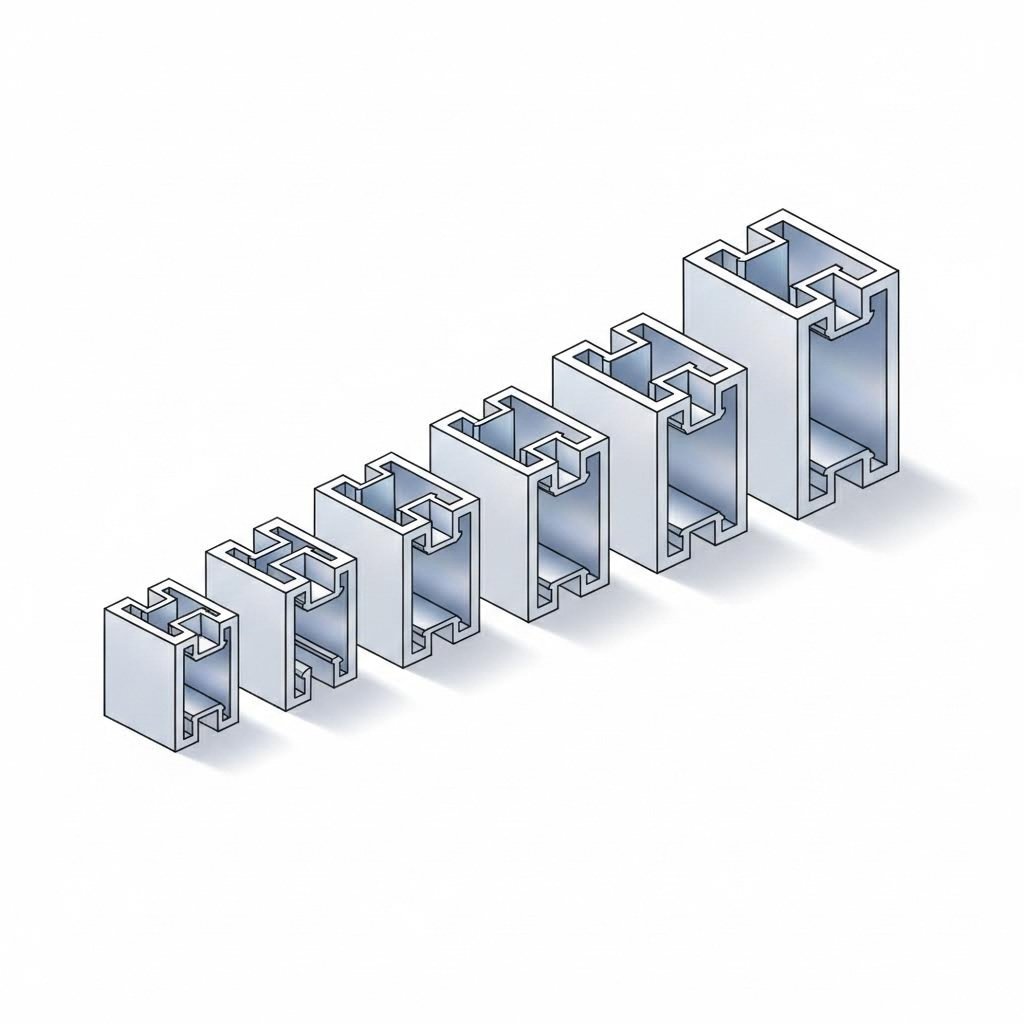
Tired of jumping between multiple product pages just to compare basic aluminum extrusion sizes? You're not alone. Most suppliers scatter dimensional data across dozens of listings, forcing you to piece together information like a puzzle. Here's the comprehensive reference you've been searching for—all standard extruded aluminum sizes in one place.
Understanding aluminum extrusion dimensions before you order prevents costly mistakes. Whether you're spec'ing a 10 series aluminum extrusion for a compact electronics project or sizing up heavy-duty profiles for industrial automation, having complete specifications at your fingertips makes decision-making straightforward.
The following table consolidates critical specifications across all standard metric series. You'll notice that weight per meter increases substantially with profile size—a factor that matters when calculating shipping costs or designing weight-sensitive applications.
| Series | Profile Dimensions (mm) | Slot Width (mm) | Slot Depth (mm) | Weight per Meter (kg) | Core Hole Size (mm) |
|---|---|---|---|---|---|
| 10 Series | 10 x 10 | 5 | 4 - 5 | 0.15 - 0.20 | 3.3 (M4 tap) |
| 15 Series | 15 x 15 | 6 | 5 - 6 | 0.30 - 0.40 | 4.2 (M5 tap) |
| 20 Series | 20 x 20 | 6 | 6 - 7 | 0.45 - 0.55 | 4.2 (M5 tap) |
| 20 Series | 20 x 40 | 6 | 6 - 7 | 0.85 - 1.00 | 4.2 (M5 tap) |
| 25 Series | 25 x 25 | 6 - 8 | 7 - 8 | 0.65 - 0.80 | 5.0 (M6 tap) |
| 30 Series | 30 x 30 | 8 | 8 - 9 | 0.90 - 1.10 | 6.8 (M8 tap) |
| 30 Series | 30 x 60 | 8 | 8 - 9 | 1.60 - 1.90 | 6.8 (M8 tap) |
| 40 Series | 40 x 40 | 8 | 10 - 11 | 1.45 - 1.70 | 6.8 (M8 tap) |
| 40 Series | 40 x 80 | 8 | 10 - 11 | 2.80 - 3.20 | 6.8 (M8 tap) |
| 45 Series | 45 x 45 | 10 | 11 - 12 | 1.55 - 2.06 | 6.8 (M8 tap) |
| 45 Series | 45 x 90 | 10 | 11 - 12 | 3.00 - 3.50 | 6.8 (M8 tap) |
The weight ranges shown reflect variations between manufacturers and profile designs. According to Vention's engineering documentation, a 45 x 45mm profile can weigh anywhere from 1.55 kg to 2.06 kg per meter depending on wall thickness and internal geometry.
Slot width is the single most critical specification for hardware compatibility. A T-nut designed for an 8mm slot will not function in a 6mm or 10mm slot—there's no workaround.
Beyond the basic dimensions, understanding cross-sectional properties helps you predict structural performance. When consulting a screw dimensions chart for your project, you'll need to match fastener sizes to both the slot width and core hole specifications listed above.
Here's how the major series compare in terms of structural characteristics:
| Series | Profile Area (mm²) | Moment of Inertia (mm⁴) | Compatible Fastener |
|---|---|---|---|
| 20 Series (20x20) | ~150 - 180 | ~3,500 - 5,000 | M5 |
| 30 Series (30x30) | ~280 - 350 | ~18,000 - 25,000 | M8 |
| 40 Series (40x40) | ~450 - 550 | ~55,000 - 75,000 | M8 |
| 45 Series (45x45) | 563 - 761 | 107,780 - 162,325 | M8 |
| 45 Series (45x90) | ~1,100 - 1,300 | 287,967 - 1,111,757 | M8 |
The moment of inertia values reveal why larger profiles handle loads so much better. Notice how the 45 series (45x45) delivers roughly 30 times more bending resistance than a 20 series profile. This isn't just a theoretical number—it directly translates to how much your frame will flex under load.
When you're working with metal stud dimensions or comparing t-slot profiles to traditional framing materials, the moment of inertia provides an apples-to-apples comparison of stiffness. According to Phidgets' T-Slot Guide, you can calculate expected beam deflection using these values combined with aluminum's modulus of elasticity (approximately 70,000 N/mm²).
One detail that trips up buyers: double-wide profiles (like 20x40, 30x60, or 40x80) use the same slot dimensions and hardware as their square counterparts. The advantage comes from increased rigidity in one direction and additional mounting faces—not from different fastener requirements.
With these specifications in hand, you're equipped to compare extruded aluminum sizes accurately. But here's the next question: should you be looking at metric specifications or fractional ones?
Here's a question that stumps even experienced builders: why does a 40mm metric profile look almost identical to a 1.5-inch fractional profile, yet their hardware won't work together? The answer lies in a fundamental split between measurement systems that most suppliers never bother explaining.
When shopping for metric aluminum extrusion, you're working with profiles measured in millimeters—20mm, 30mm, 40mm, and so on. Fractional series, dominant in North America, use inch-based dimensions instead. As Framing Tech explains, this distinction has significant implications for your projects, since each system has its own advantages and challenges.
The core difference seems simple enough: metric profiles use millimeter measurements while fractional profiles use inches. But the implications run much deeper than unit conversion.
Consider what happens when you try to convert 20mm to inch measurements. You get approximately 0.787 inches—not a clean fraction anyone works with. Similarly, converting 50mm to inch gives you roughly 1.97 inches, close to 2 inches but not quite. And going the other direction? Converting .75 inches to mm yields 19.05mm, which doesn't match the standard 20mm metric profile.
This mismatch isn't accidental. Each system was designed independently with its own set of standard dimensions, slot widths, and hardware specifications. The result? Two parallel ecosystems that look similar but don't play nicely together.
| Metric Profile | Metric Dimension | Nearest Fractional Equivalent | Fractional Dimension | Actual Difference |
|---|---|---|---|---|
| 20 Series | 20mm x 20mm | 10 Series (1") | 25.4mm x 25.4mm | 5.4mm larger |
| 30 Series | 30mm x 30mm | No direct equivalent | — | — |
| 40 Series | 40mm x 40mm | 15 Series (1.5") | 38.1mm x 38.1mm | 1.9mm smaller |
| 45 Series | 45mm x 45mm | No direct equivalent | — | — |
| 80 Series | 80mm x 80mm | 30 Series (3") | 76.2mm x 76.2mm | 3.8mm smaller |
Notice how 40 mm in inches equals approximately 1.57"—close to the 1.5-inch fractional standard but not a match. The same pattern repeats throughout: 80 mm to inches converts to roughly 3.15", while 60 mm in inches comes out to about 2.36". These near-misses create the illusion of compatibility while hiding critical differences.
So which system should you choose? The decision typically comes down to three practical factors:
Here's the critical point that catches many buyers off guard: metric and fractional hardware are NOT interchangeable, even when profiles appear visually similar. A T-nut designed for a metric 8mm slot won't properly engage in a fractional 0.32-inch slot. The tolerances are simply too tight for approximate fits.
The slot profiles themselves differ in subtle but important ways. Metric T-slots follow ISO standards with specific shoulder angles and depths. Fractional slots use slightly different geometry. Attempting to force metric T-nuts into fractional slots—or vice versa—results in either loose connections that vibrate free or jammed hardware that won't slide properly.
For project planning, commit to one system from the start and source all components accordingly. Document your choice clearly so future expansions or repairs use compatible parts. This single decision eliminates countless sourcing headaches down the road.
Understanding which measurement system you're working with sets the foundation for successful builds. The next consideration? Matching your chosen profile size to the actual demands of your specific application.
You've mastered the naming conventions and know the dimensional specs. But here's the question that really matters: which size actually works for your project? Surprisingly, most suppliers leave you to figure this out through expensive trial and error. Let's fix that with clear, practical selection criteria you can apply immediately.
Choosing the right t slot aluminum extrusion size isn't about picking the biggest profile you can afford. It's about matching structural requirements to practical constraints—load capacity, span length, weight limits, and yes, your budget. Think of it like choosing lumber for a deck: you wouldn't use 2x4s for main beams or 6x6 posts for railings.
The selection process starts with four key questions that determine your optimal profile size:
What loads will the structure support? This includes static loads (equipment weight, panels, stored materials) and dynamic loads (moving components, vibration, impact forces). A display frame holding lightweight signage has vastly different requirements than a machine base supporting a CNC router.
How far do profiles span between supports? Longer unsupported spans demand stiffer profiles. According to Motedis engineering guidelines, deflection limits for general-purpose frames typically follow L/200 (span divided by 200), while precision assemblies may require L/300 to L/500 for acceptable performance.
What are your weight constraints? Mobile equipment, overhead structures, and transportation applications benefit from lighter profiles. An aluminum square tube in the 20 series weighs roughly one-third what a comparable 40 series profile weighs per meter.
What hardware and accessories do you need? Some specialized components—hinges, linear bearings, cable management systems—are only available for certain series. Check accessory compatibility before committing to a profile size.
Here's a practical breakdown of typical applications by series, based on real-world usage patterns:
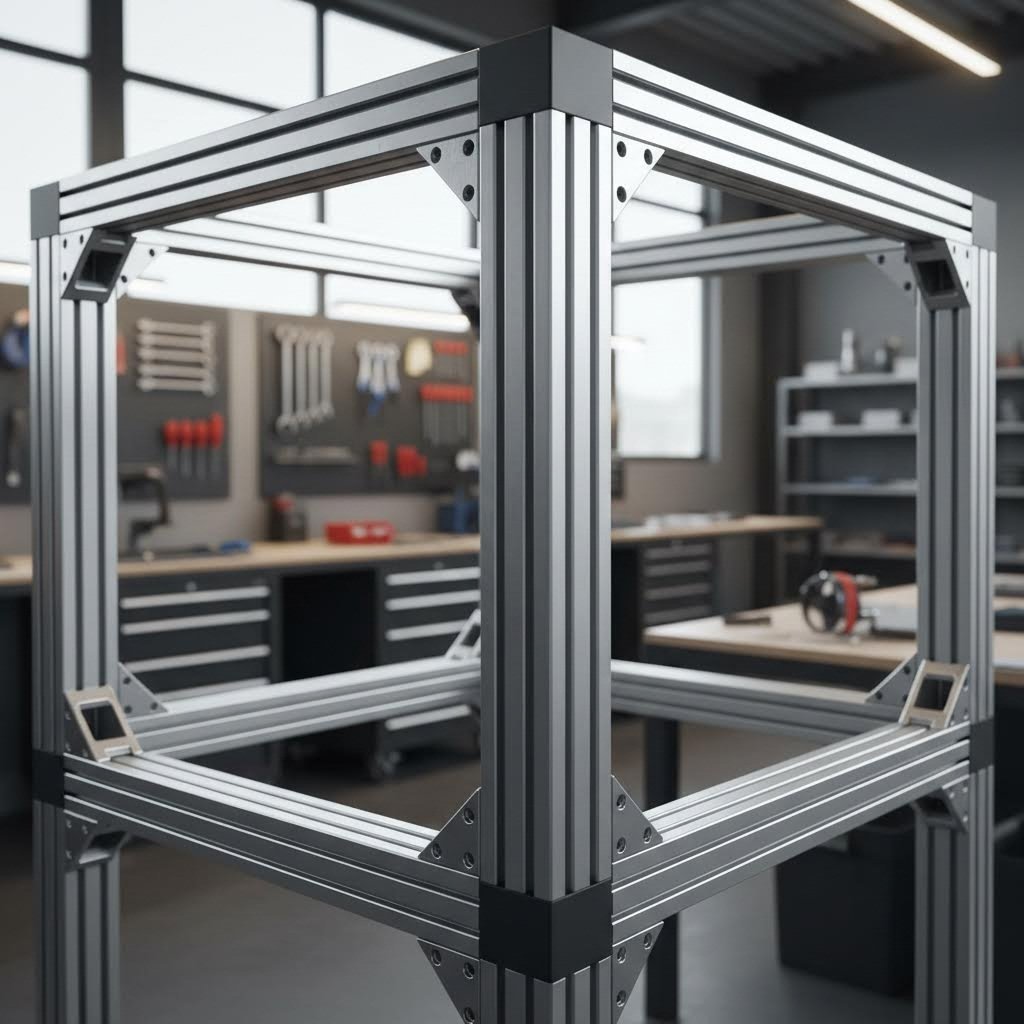
When designing framing corners and connection points, remember that joint strength often limits overall structure capacity more than the profiles themselves. Using appropriate corner brackets—whether simple angle brackets or more robust 4x4 post brackets for heavy-duty applications—ensures your connections match your profile's capabilities.
Understanding how profile size affects load capacity helps you make informed decisions without over-engineering (wasting money) or under-engineering (risking failure).
The key metric is moment of inertia—a measure of how resistant a profile is to bending. Here's the critical insight: moment of inertia increases dramatically with profile size, not linearly. Doubling the profile dimension can increase bending resistance by a factor of 8 or more.
Consider this comparison from Vention's engineering documentation: a 45x45mm profile with a moment of inertia of 162,325 mm⁴ deflects only 5.58mm under a 1500N cantilever load at 500mm. A less rigid 45x45mm design with 107,780 mm⁴ moment of inertia deflects 8.28mm under identical conditions—nearly 50% more flex despite identical external dimensions.
For practical load planning, Gap Engineering recommends this approach:
What does this mean in practice? Larger profiles let you span greater distances, support heavier loads, and maintain tighter tolerances—but at the cost of increased weight and expense. A 2 square tubing equivalent in aluminum angle or T-slot might work perfectly for one application while being completely inadequate for another.
| Application Type | Recommended Series | Key Considerations |
|---|---|---|
| Light enclosures & guards | 20 Series | Minimal loads, short spans, cost-sensitive |
| Workbenches & tables | 30-40 Series | Moderate loads, need for accessory mounting |
| Machine frames | 40-45 Series | Vibration resistance, precision requirements |
| Industrial pipe shelving | 40-50 Series | Heavy static loads, long shelf spans |
| Gantry & overhead systems | 45-50 Series | Deflection-critical, safety factors paramount |
One strategy worth considering: use larger profiles for primary structural members (perimeter frames, main load paths) while using smaller profiles for secondary elements (internal bracing, accessory mounting). This hybrid approach, as Gap Engineering notes, optimizes cost-effectiveness by placing material where it matters most.
When in doubt, consulting with an engineer or the profile manufacturer ensures your design meets required safety factors. But understanding these fundamentals means you'll ask better questions and evaluate recommendations more effectively. Now that you know how to match size to application, the next step is ensuring your hardware choices align with your selected profile series.
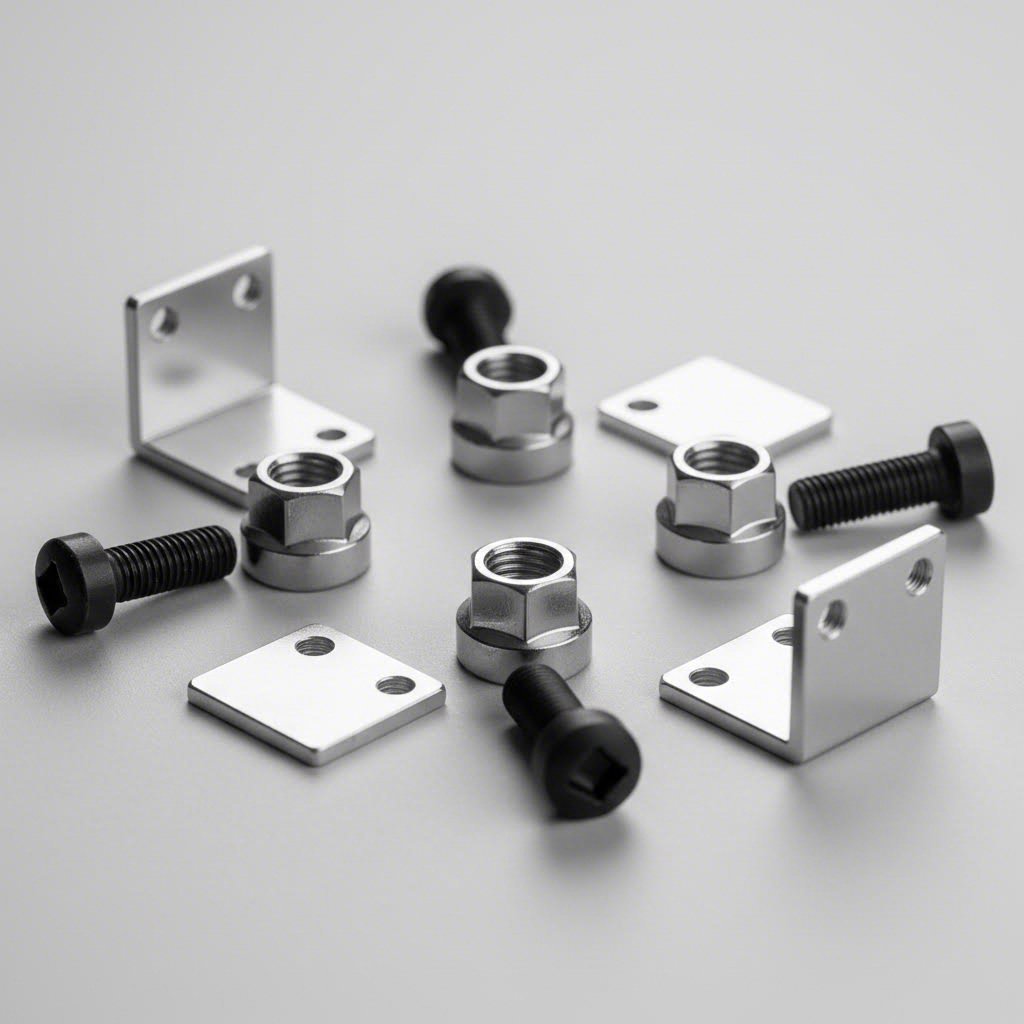
You've selected the perfect profile size for your project. But here's where many builders stumble: ordering hardware that doesn't actually fit. The relationship between t slot aluminum extrusion sizes and compatible fasteners isn't always intuitive, and a mismatch means wasted money and delayed builds. Let's break down exactly what works with what—and why staying within a single series saves you countless headaches.
Think of your T-slot system like a puzzle where every piece must match precisely. The slot width carved into your extrusion determines which T-nuts slide in smoothly, which brackets mount securely, and which fasteners create reliable connections. Get this wrong, and you're left with components that either won't fit at all or create loose, unreliable joints.
The golden rule of T-slot hardware selection? Slot width is everything. According to Framing Tech's compatibility guide, each series uses specific slot widths that dictate hardware compatibility:
Here's where it gets tricky: the 40 series splits into two camps. Some manufacturers produce 40 series profiles with 8mm slots (compatible with 30 series hardware), while others use 10mm slots (compatible with 45 series hardware). As Framing Tech notes, their color-coding system—light green for 40 series with 8mm slots, dark green for 40 series with 10mm slots—exists specifically because this distinction confuses so many buyers.
When you're working with a t slotted rail system, the hardware product ID typically indicates series compatibility. A quick check of this code reveals whether a component fits your profile before you order—saving the frustration of returns and reorders.
Matching the right fastener components to your extrusion series requires understanding three interconnected specifications: T-nut dimensions, bracket mounting patterns, and fastener thread sizes.
| Series | Slot Width | T-Nut Size | Bracket Types | Recommended Fastener |
|---|---|---|---|---|
| 10 Series | 0.26" / 6.6mm | 10-series drop-in | Mini gussets, compact angles | 1/4-20 or M4 |
| 15 Series | 0.32" / 8.1mm | 15-series T-nuts | Standard L shaped brackets | 5/16-18 or M6 |
| 20 Series | 6mm | M5 roll-in / drop-in | 20mm corner brackets, joining plates | M5 x 8-16mm |
| 30 Series | 8mm | M6/M8 T-nuts | 30mm gussets, heavy-duty angles | M6 x 12-20mm |
| 40 Series (8mm slot) | 8mm | M8 T-nuts | 40mm corner connectors, heavy plates | M8 x 16-25mm |
| 40 Series (10mm slot) | 10mm | M8 heavy-duty T-nuts | Industrial gussets, structural plates | M8 x 16-25mm |
| 45 Series | 10mm | M8 x 1.25 T-nuts | High-precision gussets, assembly plates | M8 x 1.25 |
According to Vention's engineering documentation, all their 45mm series extrusions—whether 45x45mm, 45x90mm, or 90x90mm—share the same M8 x 1.25 mounting hardware. This standardization within a series dramatically simplifies component sourcing for larger projects.
When selecting l shaped brackets or other connectors, verify that the mounting hole spacing matches your profile dimensions. A bracket designed for 40mm profiles positions its holes 40mm apart; using it with 45mm profiles creates misalignment that weakens the joint.
For threaded bolt inserts and direct-tap applications, Anglelock notes that an M6 bolt with a 12.9 strength rating can match the performance of a larger M8 bolt with a 10.9 rating. Don't assume bigger always means stronger—the engineering matters more than the size.
Even experienced builders make hardware selection errors. Here are the most frequent—and costly—mistakes to watch for:
The simplest strategy for avoiding these issues? Commit to one series for your entire project. When you're shopping, similar to how you might select bolts for 4x4 posts in traditional construction, standardizing on a single series means every component in your inventory works together. A rail button for 8020 aluminum designed for the 10 series won't help if you've built with 15 series profiles.
The payoff for getting hardware selection right extends beyond initial assembly. Future modifications, expansions, and repairs all become straightforward when every component in your system shares the same compatibility specifications. But what happens when you need to source parts from different manufacturers? That's where cross-compatibility considerations come into play.
Here's a scenario most suppliers won't discuss: you've found a great price on aluminum extrusions from one manufacturer and brackets from another. Will they work together? The honest answer is... maybe. While T-slot profiles follow general industry standards, subtle dimensional differences between brands can create frustrating fitment issues that only become apparent during assembly.
Unlike standardized fasteners where an M8 bolt from any manufacturer threads into any M8 nut, the T-slot ecosystem lacks universal certification. Each manufacturer interprets the basic T-slot concept slightly differently, creating an extruded aluminum track landscape where "compatible" doesn't always mean "interchangeable."
The core issue comes down to tolerances. According to Anglelock's hardware guide, while many T-slot products are "cross-compatible with other systems," this compatibility isn't guaranteed. A T-nut that slides smoothly into one brand's aluminium extrusion rail might fit too loosely in another's slot—or refuse to enter at all.
Why does this happen? Consider that a nominal 8mm slot width might measure 8.05mm from one manufacturer and 7.95mm from another. Both are technically within acceptable tolerances for their own systems, but that 0.1mm difference affects how hardware engages. Multiply these minor variations across slot depth, shoulder angles, and corner geometry, and you understand why mixed-brand assemblies sometimes feel "off."
Several factors determine whether cross-manufacturer mixing will succeed or frustrate:
Does this mean you must source everything from a single supplier? Not necessarily—but it requires careful testing and realistic expectations. As industry experts note, "there's a growing number of universal products" designed specifically for cross-system compatibility.
For projects requiring mixed sourcing, consider these strategies:
The safest approach remains sourcing complete systems from single manufacturers whenever possible. But when budget constraints or availability issues force mixed sourcing, understanding these compatibility factors helps you anticipate problems before they derail your project. With cross-manufacturer considerations addressed, the next practical question becomes how different profile sizes affect cutting and preparation requirements.
You've selected the right profile series and confirmed hardware compatibility. Now comes the hands-on reality: actually cutting and preparing your extrusions for assembly. Here's what most product pages won't tell you—the equipment and techniques that work perfectly for 20 series profiles become completely inadequate when you're working with 45 series or larger. Understanding these differences before you start saves both materials and frustration.
According to the Aluminum Extruders Council, precision cutting is typically the first step in almost any aluminum extrusion fabrication process, often by deburring and additional preparation work. The challenge? Each profile size brings its own set of requirements for tools, techniques, and tolerances.
Larger profiles don't just require bigger saws—they demand fundamentally different approaches. A lightweight miter saw that handles 20mm profiles cleanly may chatter, bind, or produce rough cuts when confronted with a 45x90mm extrusion. The increased material mass generates more heat during cutting, dulls blades faster, and amplifies any vibration or instability in your setup.
Here's what changes as profile sizes increase:
The deburring stage also scales with profile size. As the Aluminum Extruders Council notes, while it's often possible to cut extrusions without burrs, deburring may be required for specific parts—particularly "where alloy, profile design, and blade selection aren't ideal." Mechanical deburring with brushes or grinders works for most situations, while tumble deburring suits quantities of smaller extruded parts that can be processed in batches.
Beyond cutting, each series presents distinct challenges for drilling, tapping, and end preparation. The core bore size, wall thickness, and overall mass all influence your approach.
| Profile Series | Recommended Cutting Equipment | Preparation Notes |
|---|---|---|
| 20 Series | Compound miter saw, bandsaw, or hacksaw for small quantities | Light deburring; M5 tapping straightforward; minimal clamping force needed |
| 30 Series | Industrial miter saw or horizontal bandsaw | Moderate deburring; M6/M8 tapping requires proper pilot holes; secure workholding essential |
| 40 Series | Heavy-duty cold saw or industrial bandsaw with carbide blade | Significant deburring on cut faces; use cutting fluid for clean edges; consider professional cutting services |
| 45+ Series | Industrial cold saw, CNC saw, or waterjet for precision | Heavy deburring required; professional machining recommended for drilling and tapping; material handling equipment may be needed |
Precision becomes increasingly critical as profile size grows. A 1mm cutting error on a 20mm profile represents a 5% dimensional variance—noticeable but often manageable. That same 1mm error on a 45mm profile used in a precision frame compounds across multiple joints, potentially creating assembly problems or structural misalignment. For applications like machine bases or measurement fixtures, professional cutting services with documented tolerances often prove more economical than attempting in-house work with inadequate equipment.
Tolerance expectations also vary by series. Smaller extruded aluminum sections typically hold tighter relative tolerances due to more consistent cooling during the extrusion process. Larger profiles—especially those approaching aluminum plate thicknesses like 4x8 aluminum sheet dimensions—may exhibit slightly more variation in wall thickness and straightness. Reputable suppliers provide tolerance specifications; verify these meet your application requirements before ordering.
For complex projects requiring multiple preparation steps—precision cuts, counterbored holes, tapped ends, and custom machining—partnering with suppliers offering integrated fabrication services often delivers better results than attempting multi-stage preparation in-house. This becomes especially true when working with larger, heavier profiles where handling and fixturing present their own challenges.
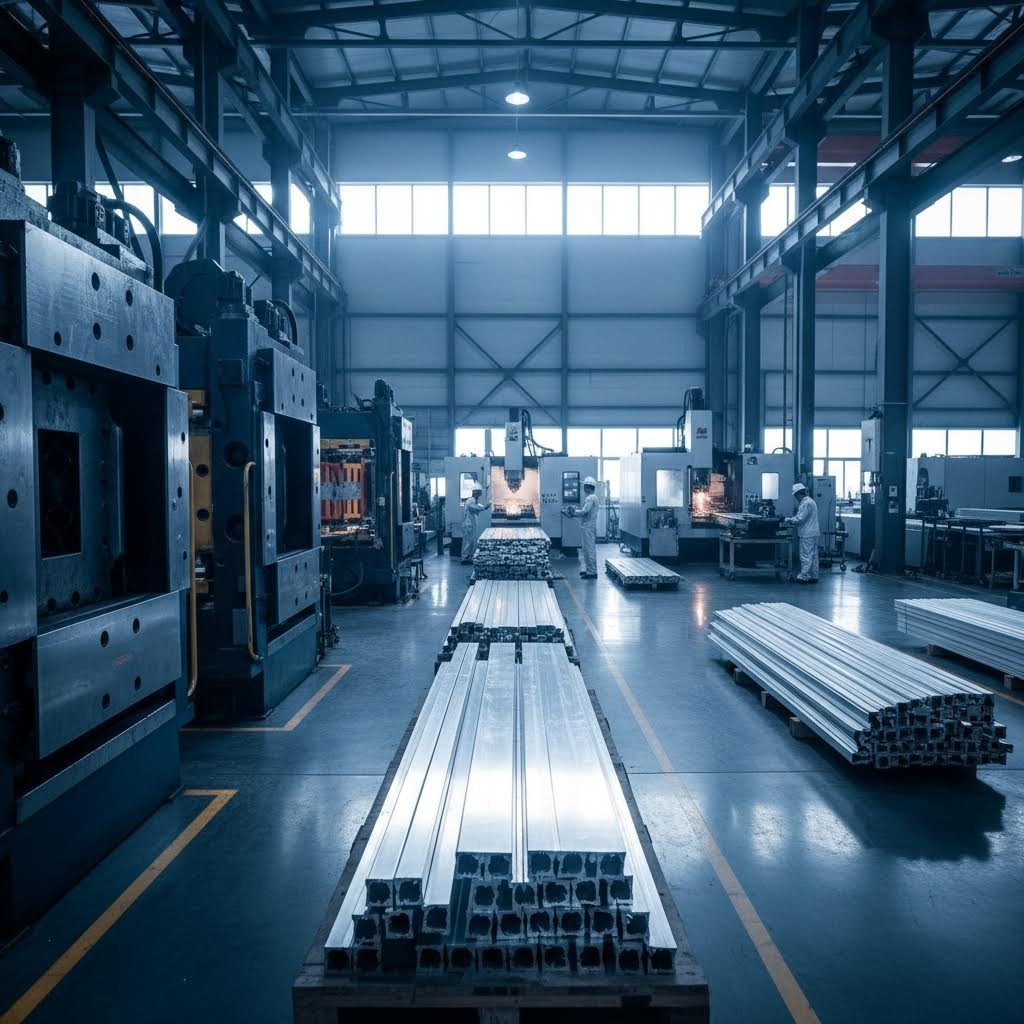
You've nailed down the specifications, selected the right series, and understand exactly what hardware you need. Now comes the practical question: where do you actually get these profiles? The sourcing landscape ranges from off-the-shelf catalog purchases to fully custom manufacturing—and knowing when each option makes sense can save you significant time and money.
For most projects, standard catalog sizes from established suppliers cover your needs perfectly. The aluminum extrusion channel profiles discussed throughout this guide—20 series, 40 series, 45 series—are stocked by dozens of distributors worldwide. But what happens when your application demands something the catalogs don't offer?
Standard aluminum extrusion parts offer compelling advantages for straightforward projects. According to Eleanor Industries, pre-designed profiles eliminate the need for custom dies, reducing production costs significantly. They're readily available in various dimensions, ensuring faster project execution—often shipping within days rather than weeks.
When shopping for standard profiles, you'll encounter several sourcing options:
For standard sizes, compare not just profile pricing but total landed cost—including shipping, cutting services, and hardware bundles. A slightly higher per-meter price from a supplier offering free precision cutting often beats a cheaper extrusion bar that requires additional fabrication.
When do standard sizes fall short? According to industry experts, custom aluminium extrusion profiles become the right choice "when standard sections do not meet your project's requirements"—whether you need specific shapes, enhanced load-bearing capacity, or integration with other components.
Custom profiles make sense for:
The custom extrusion process, as Richardson Metals explains, involves several key stages: identifying design requirements, selecting the appropriate alloy, developing tooling, and establishing quality control processes. Working closely with your engineering team during the design phase ensures your custom profile meets application-specific demands.
For projects requiring both custom profiles and precision fabrication, manufacturers offering comprehensive deep processing capabilities streamline the entire workflow. Shengxin Aluminium, for example, operates 35 extrusion presses ranging from 600T to 5500T capacity, enabling production of everything from compact profiles to large industrial sections. Their integrated CNC machining centers handle precise cutting, drilling, and bending to exact specifications—eliminating the need to coordinate between separate extrusion and fabrication vendors.
Surface treatment options also factor into sourcing decisions. Premium T-slot systems often require anodizing for corrosion resistance and aesthetics. According to industry specifications, quality anodized finishes achieve 75 Brinell hardness with surface roughness of 0.8μm Ra or better. Manufacturers like Shengxin offer comprehensive finishing options including custom-color anodizing, powder coating, and PVDF treatments—all coordinated with extrusion and machining for seamless project execution.
The decision between catalog sizes and custom profiles comes down to evaluating several practical factors:
As industry analysis notes, "although the initial tooling cost may be higher, the long-term benefits of optimized material usage and assembly efficiency reduce overall expenses." This makes custom profiles particularly attractive for manufacturers building recurring products or systems.
When evaluating manufacturers for custom work, look for capabilities that ensure consistent quality: ISO certification, in-house CNC machining, and comprehensive surface treatment options. Experienced manufacturers provide end-to-end support from die development through mass production—a partnership approach that simplifies project management and ensures specifications are met throughout the production run.
Whether you source standard catalog profiles or invest in custom manufacturing, the key is matching your sourcing strategy to project requirements. With sourcing options clarified, you're ready to consolidate everything into a final decision framework.
You've navigated series numbers, decoded naming conventions, and explored everything from hardware compatibility to cross-manufacturer considerations. Now it's time to pull it all together into a practical decision framework. Think of this as your quick-reference checklist—the essential questions and answers that transform overwhelming options into confident purchasing decisions.
Selecting the right t channel aluminum or aluminum t extrusion doesn't need to be complicated once you understand the core principles. Whether you're building a compact electronics enclosure or a heavy-duty industrial frame, the same logical process applies.
Before placing any order, run through this decision sequence. Each step builds on the previous one, ensuring you don't overlook critical compatibility factors.
| Project Type | Recommended Series | Typical Slot Width | Key Selection Factors |
|---|---|---|---|
| 3D printers, small electronics enclosures | 20 Series | 6mm | Lightweight, compact, cost-effective |
| Workbenches, display fixtures, lab equipment | 30 Series | 8mm | Balanced strength-to-weight, wide accessory range |
| Machine guards, automation frames, heavy workstations | 40 Series | 8mm or 10mm | Verify slot width—varies by manufacturer |
| Industrial machine bases, gantry systems, conveyor structures | 45 Series | 10mm | Maximum rigidity, M8 fasteners standard |
| Large structural frames, heavy-duty warehouse systems | 50+ Series or 80x80 | 10mm+ | Consider professional engineering review |
| North American projects with inch-based tooling | Fractional 10/15 Series | 0.26" / 0.32" | Local hardware availability, existing equipment compatibility |
Match slot width to available hardware first, then optimize for load requirements. Getting this sequence backward leads to expensive incompatibility issues that only surface during assembly.
Your final selection comes down to answering four sequential questions:
For straightforward projects using standard catalog sizes, most industrial suppliers can fulfill your order within days. The extrusion rail profiles, T-nuts, brackets, and fasteners ship together, ready for assembly.
But what about projects that push beyond standard offerings? Complex geometries, integrated features, or specialized dimensions require a different approach. For these applications—whether you need custom cross-sections, precision CNC machining, or specialized surface treatments—partnering with an experienced manufacturer ensures your specifications are met from initial design through final delivery.
Shengxin Aluminium provides exactly this type of comprehensive support. With 35 extrusion presses ranging from 600T to 5500T capacity, they handle everything from compact profiles to large industrial sections. Their integrated CNC machining centers deliver precise cutting, drilling, and bending to exact specifications, while comprehensive surface treatment options—including custom-color anodizing, powder coating, and PVDF finishes—ensure your profiles meet both functional and aesthetic requirements. From die development through mass production, their technical team provides end-to-end support that simplifies complex projects.
Whatever your project demands—standard catalog profiles or fully custom aluminum t extrusion solutions—you now have the knowledge to specify exactly what you need. Stop guessing about sizes, series numbers, and compatibility. Start building with confidence.
T-slot aluminum extrusions are categorized by series numbers corresponding to their cross-sectional dimensions in millimeters. Standard metric series include 10 Series (10x10mm), 15 Series (15x15mm), 20 Series (20x20mm), 25 Series (25x25mm), 30 Series (30x30mm), 40 Series (40x40mm), and 45 Series (45x45mm). Fractional series popular in North America use inch-based dimensions, such as the 10 Series (1"x1") and 15 Series (1.5"x1.5"). Each series also offers rectangular variations like 20x40mm or 40x80mm for increased rigidity in specific directions.
A 1020 T-slot is a fractional 10 series rectangular profile measuring 1.00" x 2.00" (approximately 25.4mm x 50.8mm). It features six open T-slots—one on each 1.00" face and two on each 2.00" face. This profile uses a slot width of approximately 0.26" (6.6mm) and is compatible with 10 series fasteners, including 1/4-20 hardware. The 1020 is ideal for applications requiring greater rigidity in one direction while maintaining compatibility with standard 10 series brackets and T-nuts.
80/20 refers to a leading brand of modular T-slot aluminum framing systems, often called the 'Industrial Erector Set.' The name represents their fractional series where profiles use inch-based dimensions. 80/20's product line includes the 10 Series (1" based), 15 Series (1.5" based), and various metric options. Their T-slot profiles feature channels that accept specialized T-nuts and hardware, enabling tool-free assembly and reconfiguration for automation frames, workstations, machine guards, and countless industrial applications.
While T-slot profiles follow general industry standards, cross-manufacturer compatibility is not guaranteed. Subtle dimensional differences in slot tolerances, corner radii, and T-nut sizing can cause fitment issues. A T-nut from one brand may fit too loosely or refuse to enter another manufacturer's slot entirely. For reliable results, test sample components before bulk purchasing, use hardware from the same brand as your extrusions, or choose roll-in T-nuts which tend to be more forgiving of slight variations.
Your choice depends on geographic availability, existing equipment, and long-term hardware sourcing. Fractional series dominate North American suppliers with faster delivery and local hardware availability, while metric series prevail in Europe and Asia. Critical point: metric and fractional hardware are NOT interchangeable—even similar-looking profiles use different slot geometries. Commit to one system from the start, and for custom requirements, manufacturers like Shengxin Aluminium can produce profiles in either system with CNC precision machining and various surface treatments.



 online service
 0086 136 3563 2360
 sales@sxalu.com
 +86 136 3563 2360
 English
 français
 Deutsch
 русский
 español
 português
 العربية
 ไทย
ไทย Việt
Việt Українська